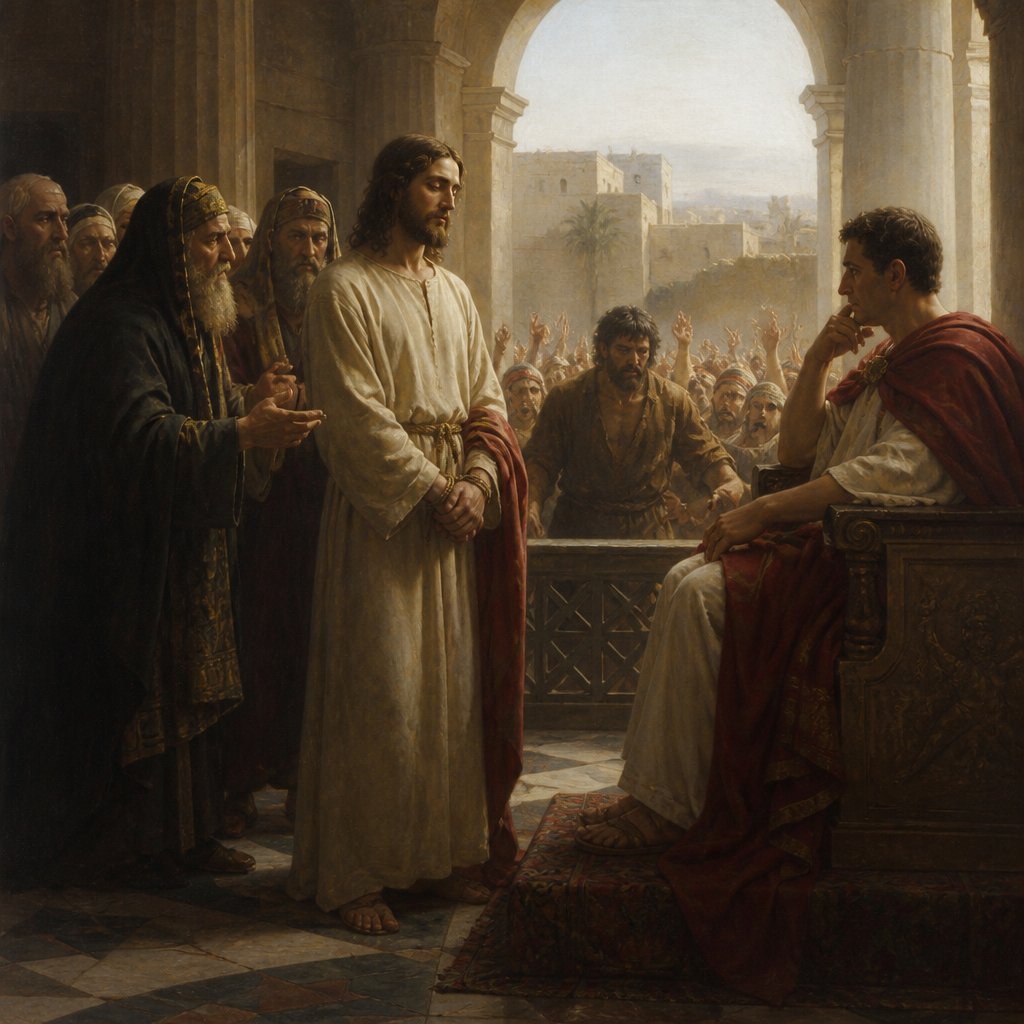
The Bible verse Mark 15:2-15 from the King James Version (KJV) reads:
"And Pilate asked him, Art thou the King of the Jews? And he answering said unto him, Thou sayest it. And the chief priests accused him of many things: but he answered nothing. And Pilate asked him again, saying, Answerest thou nothing? behold how many things they witness against thee. But Jesus yet answered nothing; so that Pilate marvelled. Now at that feast he released unto them one prisoner, whomsoever they desired. And there was one named Barabbas, which lay bound with them that had made insurrection with him, who had committed murder in the insurrection. And the multitude crying aloud began to desire him to do as he had ever done unto them. But Pilate answered them, saying, Will ye that I release unto you the King of the Jews? For he knew that the chief priests had delivered him for envy. But the chief priests moved the people, that he should rather release Barabbas unto them. And Pilate answered and said again unto them, What will ye then that I shall do unto him whom ye call the King of the Jews? And they cried out again, Crucify him. Then Pilate said unto them, Why, what evil hath he done? And they cried out the more exceedingly, Crucify him. And so Pilate, willing to content the people, released Barabbas unto them, and delivered Jesus, when he had scourged him, to be crucified."
This passage from the Gospel of Mark depicts the trial of Jesus before Pontius Pilate and the subsequent release of Barabbas instead of Jesus. It is a pivotal moment in the story of Jesus' crucifixion as it highlights the political and religious dynamics at play during this significant event.
The theme of power and authority is prevalent throughout this passage. Pilate, as the Roman governor, holds the authority to make decisions regarding Jesus' fate. He questions Jesus about his claim to be the King of the Jews, a title that would threaten the Roman rule in Jerusalem. Jesus' response, "Thou sayest it," is a confirmation of his kingship, but without the tone of defiance or rebellion. This portrayal of Jesus as a peaceful and humble king contrasts with the Roman understanding of power and royalty.
The conflict between religious leaders and the Roman authorities is also evident in this passage. The chief priests, motivated by envy and fear of Jesus' popularity and influence, accuse him of many things, yet Jesus remains silent. This silence not only fulfills Old Testament prophecies but also reflects Jesus' submission to God's will and his refusal to engage in futile arguments with his accusers.
The decision to release Barabbas, a notorious criminal, instead of Jesus further emphasizes the theme of injustice. Pilate, motivated by a desire to please the crowd and maintain peace, succumbs to the pressure and orders Jesus' crucifixion. This act highlights the corrupt nature of human authority and the tendency to prioritize political expediency over justice and righteousness.
Symbolically, Barabbas represents humanity's sinfulness and rebellion against God. His release reflects the substitutionary atonement, where Jesus takes the place of sinners, bearing the punishment and consequences of their wrongdoing. This substitutionary act is central to Christian theology and is exemplified in Jesus' sacrificial death on the cross.
The context of this passage is set during the Jewish festival of Passover, a time of remembrance of God's deliverance of the Israelites from slavery in Egypt. The release of a prisoner during this festival was a customary act of clemency, intended to emphasize mercy and forgiveness. However, the irony of releasing Barabbas, a criminal, instead of Jesus, the sinless Son of God, underscores the perversion of justice and the rejection of the true source of salvation.
In conclusion, the Bible verse Mark 15:2-15 is a poignant and profound account of Jesus' trial before Pilate and the unjust decision to crucify him. It highlights themes of power, authority, injustice, and substitutionary atonement while providing a sobering reflection on the flawed nature of human governance and the redemptive work of Christ. This passage serves as a reminder of the depth of God's love and the magnitude of Christ's sacrifice for the salvation of humanity.
Get our apps


Artwork for Mark 15:2-15
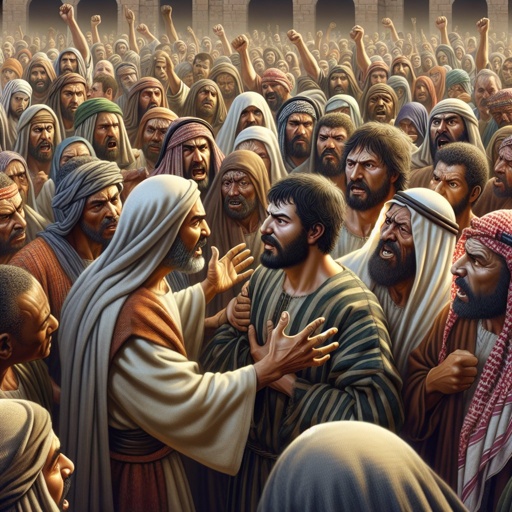
Mark 15:2-15 - "And Pilate asked him, “Are you the King of the Jews?” And he answered him, “You have said so.” And the chief priests accused him of many things. And Pilate again asked him, “Have you no answer to make? See how many charges they bring against you.” But Jesus made no further answer, so that Pilate was amazed. Now at the feast he used to release for them one prisoner for whom they asked. And among the rebels in prison, who had committed murder in the insurrection, there was a man called Barabbas. And the crowd came up and began to ask Pilate to do as he usually did for them. And he answered them, saying, “Do you want me to release for you the King of the Jews?” For he perceived that it was out of envy that the chief priests had delivered him up. But the chief priests stirred up the crowd to have him release for them Barabbas instead. And Pilate again said to them, “Then what shall I do with the man you call the King of the Jews?” And they cried out again, “Crucify him.” And Pilate said to them, “Why, what evil has he done?” But they shouted all the more, “Crucify him.” So Pilate, wishing to satisfy the crowd, released for them Barabbas, and having scourged Jesus, he delivered him to be crucified."
"And Pilate asked him, “Are you the King of the Jews?” And he answered him, “You have said so.” And the chief priests accused him of many things. And Pilate again asked him, “Have you no answer to make? See how many charges they bring against you.” But Jesus made no further answer, so that Pilate was amazed. Now at the feast he used to release for them one prisoner for whom they asked. And among the rebels in prison, who had committed murder in the insurrection, there was a man called Barabbas. And the crowd came up and began to ask Pilate to do as he usually did for them. And he answered them, saying, “Do you want me to release for you the King of the Jews?” For he perceived that it was out of envy that the chief priests had delivered him up. But the chief priests stirred up the crowd to have him release for them Barabbas instead. And Pilate again said to them, “Then what shall I do with the man you call the King of the Jews?” And they cried out again, “Crucify him.” And Pilate said to them, “Why, what evil has he done?” But they shouted all the more, “Crucify him.” So Pilate, wishing to satisfy the crowd, released for them Barabbas, and having scourged Jesus, he delivered him to be crucified." - Mark 15:2-15

Mark 15:2 - "And Pilate asked him, Art thou the King of the Jews? And he answering said unto him, Thou sayest it."

Mark 15:12

Mark 15:25 - "And it was the third hour, and they crucified him."

Mark 15:13 - "And they cried out again, Crucify him."

Mark 15:15 - "¶ And so Pilate, willing to content the people, released Barabbas unto them, and delivered Jesus, when he had scourged him, to be crucified."
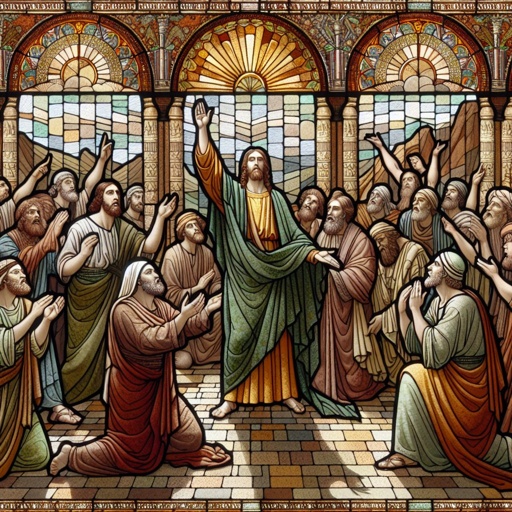
Mark 15:18 - "And began to salute him, Hail, King of the Jews!"

Mark 2:15 - "And it came to pass, that, as Jesus sat at meat in his house, many publicans and sinners sat also together with Jesus and his disciples: for there were many, and they followed him."

Mark 15:30 - "Save thyself, and come down from the cross."

Mark 15:28 - "And the scripture was fulfilled, which saith, And he was numbered with the transgressors."

Mark 3:15 - "And to have power to heal sicknesses, and to cast out devils:"

Mark 15:5 - "But Jesus yet answered nothing; so that Pilate marvelled."

Mark 15:47 - "And Mary Magdalene and Mary the mother of Joses beheld where he was laid."

Mark 15:26 - "And the superscription of his accusation was written over, THE KING OF THE JEWS."

Mark 15:37 - "And Jesus cried with a loud voice, and gave up the ghost."

Mark 15:38 - "And the veil of the temple was rent in twain from the top to the bottom."

Mark 6:15 - "Others said, That it is Elias. And others said, That it is a prophet, or as one of the prophets."

Mark 15:45 - "And when he knew it of the centurion, he gave the body to Joseph."

Mark 15:23 - "And they gave him to drink wine mingled with myrrh: but he received it not."

Acts 15:37 - "And Barnabas determined to take with them John, whose surname was Mark."

Mark 15:10 - "For he knew that the chief priests had delivered him for envy."

Mark 15:3 - "And the chief priests accused him of many things: but he answered nothing."

Mark 15:42 - "¶ And now when the even was come, because it was the preparation, that is, the day before the sabbath,"

"And it was the third hour, and they crucified him." - Mark 15:25

Mark 15:22 - "And they bring him unto the place Golgotha, which is, being interpreted, The place of a skull."

Mark 15:35 - "And some of them that stood by, when they heard it, said, Behold, he calleth Elias."

Mark 1:15 - "And saying, The time is fulfilled, and the kingdom of God is at hand: repent ye, and believe the gospel."

Mark 15:6 - "Now at that feast he released unto them one prisoner, whomsoever they desired."

Mark 15:17 - "And they clothed him with purple, and platted a crown of thorns, and put it about his head,"