What does Mark 16:3 mean?
“And they said among themselves, Who shall roll us away the stone from the door of the sepulchre?” — Mark 16:3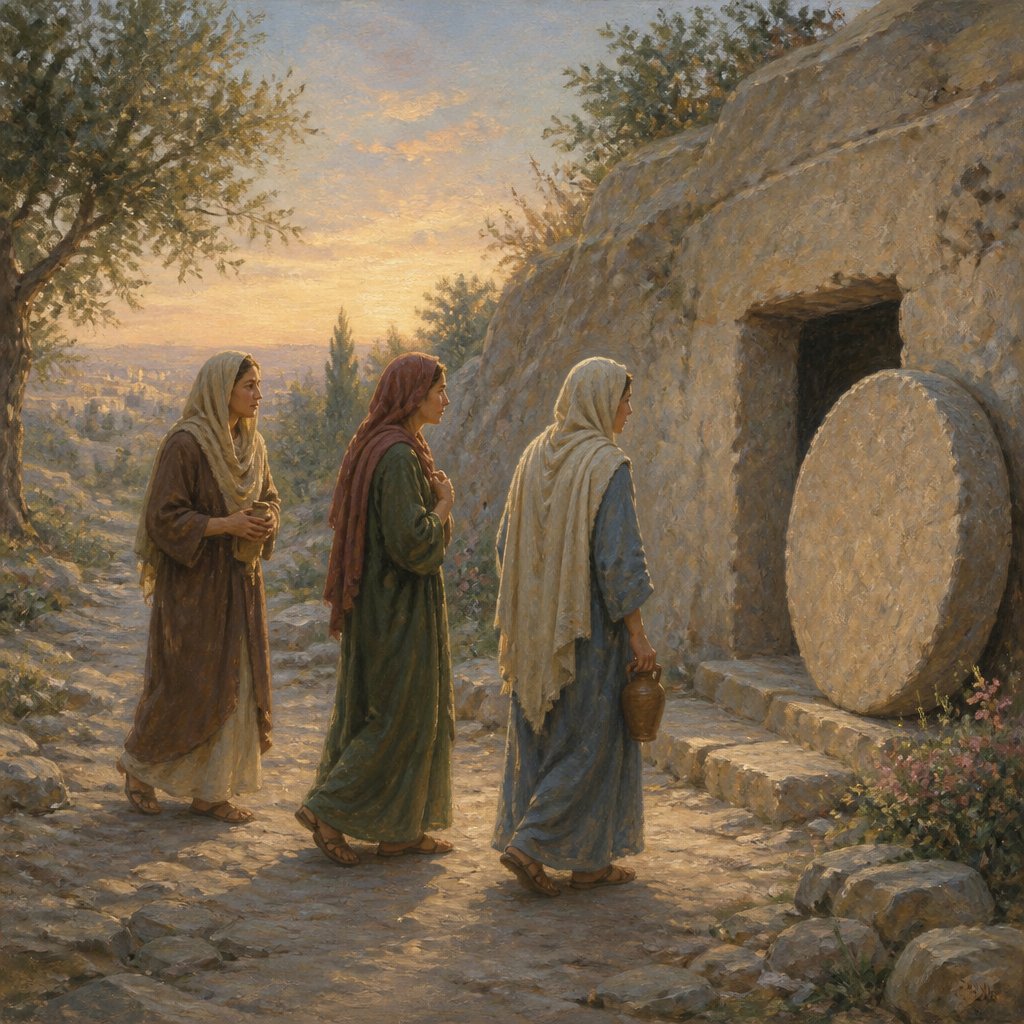
Mark 16:3 in the King James Version (KJV) states: "And they said among themselves, Who shall roll us away the stone from the door of the sepulchre?"
This verse is part of the narrative of the resurrection of Jesus Christ. It occurs in the context of the Easter story, which is one of the most important events in the Christian faith. The verse takes place just after three women, Mary Magdalene, Mary the mother of James, and Salome, have come to the tomb of Jesus to anoint his body with spices. However, when they arrive at the tomb, they see that the stone that had sealed the entrance to the tomb has been rolled away.
The women, in their shock and confusion, wonder among themselves who will roll away the stone from the door of the sepulchre. This question reflects their concern about how they will gain access to the tomb in order to anoint the body of Jesus. The large stone would have required several strong men to move, and the women likely did not know how they would be able to accomplish this task on their own.
The theme of this verse is one of human concern and uncertainty. The women are faced with a seemingly insurmountable obstacle—the stone blocking the entrance to the tomb—and they are unsure of how they will be able to overcome it. This theme of facing obstacles and uncertainty is relatable to many people in their own lives. The verse reminds us that there are moments when we may feel overwhelmed and uncertain about how to move forward, but it also serves as a reminder that solutions to our problems can sometimes come from unexpected sources.
The context of this verse is crucial to understanding its significance within the larger narrative of the resurrection. The women's concern about the stone reflects their love and devotion to Jesus. They had come to the tomb to honor his body with the spices, and the presence of the stone initially presents a barrier to this act of love and devotion. The fact that the stone has been rolled away by the time they arrive at the tomb serves as a clear sign that something miraculous has occurred.
The symbolism of the stone and its removal is highly significant within the Christian faith. In the Bible, stones often represent obstacles or barriers that stand in the way of God's purposes. The rolling away of the stone at the entrance of Jesus' tomb symbolizes the removal of these barriers through the power of God. It signifies the triumph of life over death, and the fulfillment of God's promise to bring about redemption and salvation for humanity.
In addition, the physical act of rolling away the stone serves as a powerful symbol of the spiritual reality of the resurrection. The removal of the stone from the tomb creates an opening that allows the women—and later, the disciples—to witness the reality of Jesus' resurrection. It shows that the power of God is far greater than any earthly obstacles and reaffirms the central message of the Christian faith: that through Christ, all things are possible.
Overall, Mark 16:3 is a verse that captures a pivotal moment in the Easter story. It reflects the human concern and uncertainty of the women as they encounter the unexpected obstacle of the sealed tomb. Yet, it also points to the larger themes of the resurrection, the triumph of life over death, and the power of God to overcome all barriers. The verse serves as a reminder that even in the face of seemingly insurmountable obstacles, God's power is at work, bringing about new life and hope.
Get our apps


Artwork for Mark 16:3

Mark 16:3 - "And they said among themselves, Who shall roll us away the stone from the door of the sepulchre?"

"And they said among themselves, Who shall roll us away the stone from the door of the sepulchre?" - Mark 16:3

Mark 3:16 - "And Simon he surnamed Peter;"

"And Simon he surnamed Peter;" - Mark 3:16

2 Timothy 3:16

Mark 16:20
Mark 16:20
Mark 16:20

Mark 16:20

Mark 16:20

Mark 16:1-2

Mark 16:6-8

Mark 16:4-5

Mark 16:6-8

Mark 16:4-5

Mark 10:13–16

Mark 16:4-5

Mark 16:6-8

african american mark 16:11

african american mary magdalene, mark 16: 9

Mark 9:16 - "And he asked the scribes, What question ye with them?"

Mark 16:13 - "And they went and told it unto the residue: neither believed they them."

Mark 3:3 - "And he saith unto the man which had the withered hand, Stand forth."

Mark 16:4 - "And when they looked, they saw that the stone was rolled away: for it was very great."

Mark 7:16 - "If any man have ears to hear, let him hear."

Mark 8:16 - "And they reasoned among themselves, saying, It is because we have no bread."

Mark 3:31-34

Mark 16:10 - "And she went and told them that had been with him, as they mourned and wept."

Mark 16 african american jesus rebukes disciples

Mark 16 african american angry jesus and disciples