What does Mark 5:3 mean?
“Who had his dwelling among the tombs; and no man could bind him, no, not with chains:” — Mark 5:3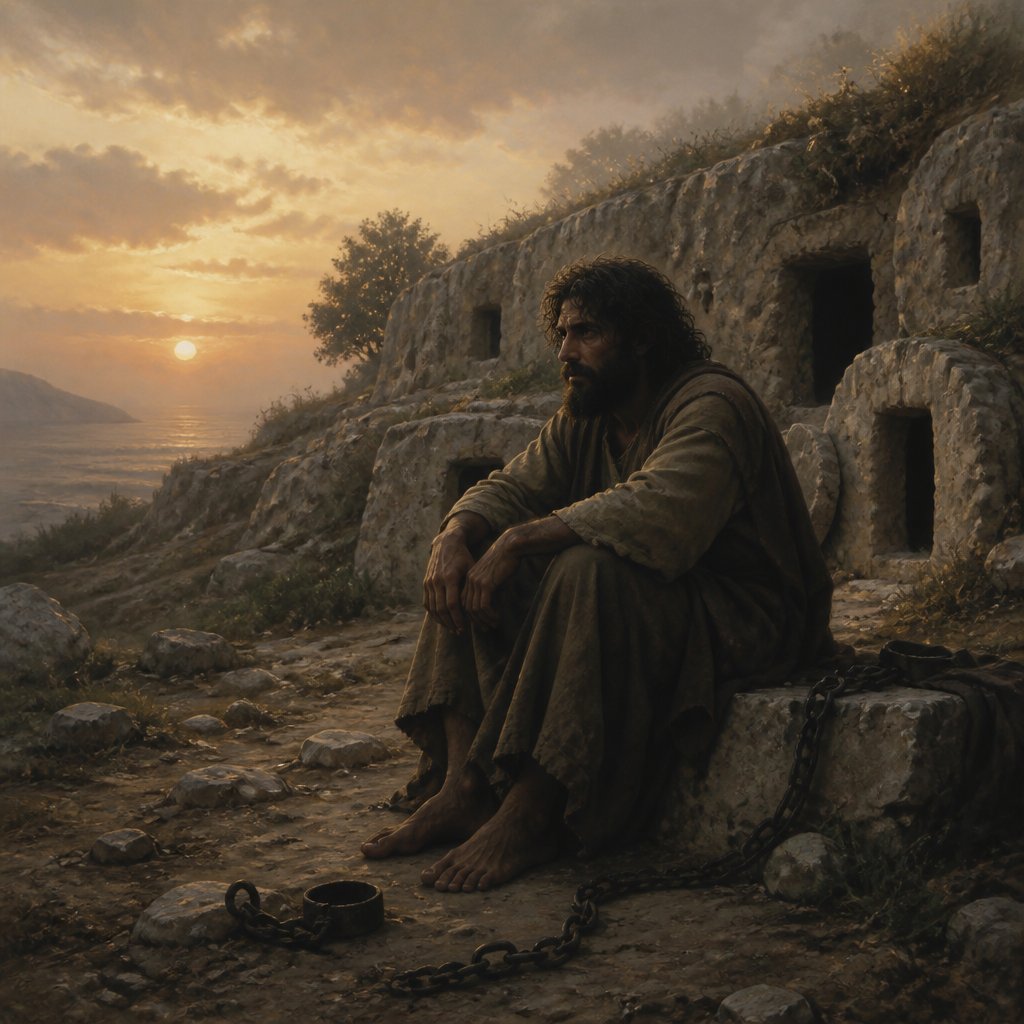
Mark 5:3 (KJV) reads, "Who had his dwelling among the tombs; and no man could bind him, no, not with chains."
This verse is taken from the Gospel of Mark, which is the second book of the New Testament in the Bible. It is part of a larger passage that tells the story of Jesus' encounter with a man possessed by demons in the region of the Gerasenes. This man had been living among the tombs, and no one could restrain him, not even with chains.
The context of this verse is important for understanding its full meaning. The passage begins with Jesus and his disciples crossing the Sea of Galilee and arriving in the region of the Gerasenes. As soon as they land, they encounter this possessed man. The man was possessed by a legion of demons, who were causing him to live among the tombs, cutting himself with stones, and exhibiting violent and uncontrollable behavior.
This verse sets the stage for the dramatic encounter that follows, where Jesus miraculously heals the man by casting out the demons and restoring him to his right mind. The man's transformation is so profound that the people of the region are amazed, and they witness him sitting at Jesus' feet, clothed and in his right mind.
One of the key themes in this passage is the power of Jesus over the forces of darkness. The man possessed by demons represents the extreme of human brokenness and torment. His inability to be restrained even by chains symbolizes the futility of human efforts to overcome spiritual forces of evil. Yet, Jesus' authority and power are greater than that of the demons, as he is able to free the man from their grip and restore him to wholeness.
Another important theme in this passage is the compassion of Jesus for those who are suffering. Despite the man's frightening and violent behavior, Jesus approaches him with love and compassion. This demonstrates Jesus' willingness to confront and heal even the most extreme forms of brokenness and bondage.
The symbolism in this verse is also rich and significant. The man's dwelling among the tombs represents the depths of his spiritual and emotional despair. In the ancient Jewish culture, tombs were associated with uncleanness and death, and living among the tombs would have been seen as a sign of extreme spiritual and social alienation. The presence of the demons further reinforces this image of spiritual bondage and death.
The inability of anyone to bind the man with chains symbolizes the powerlessness of human efforts to overcome spiritual forces of evil. This highlights the need for a power greater than human strength to deliver and heal those who are in the grip of such forces. Jesus' ability to free the man from the demons and restore him to health and wholeness represents the triumph of divine power over the forces of darkness and death.
In conclusion, Mark 5:3 is a powerful and evocative verse that captures the dramatic encounter between Jesus and the man possessed by demons. It speaks to the themes of Jesus' power over the forces of darkness, his compassion for those who are suffering, and the need for a divine power to overcome spiritual bondage and brokenness. The symbolism of the man's dwelling among the tombs and the inability to bind him with chains adds depth and richness to the passage, depicting the depths of spiritual despair and the hope of divine deliverance.
Get our apps


Artwork for Mark 5:3

Mark 5:3 - "Who had his dwelling among the tombs; and no man could bind him, no, not with chains:"
"Who had his dwelling among the tombs; and no man could bind him, no, not with chains:" - Mark 5:3

Mark 2:5

Mark 3:5 - "And when he had looked round about on them with anger, being grieved for the hardness of their hearts, he saith unto the man, Stretch forth thine hand. And he stretched it out: and his hand was restored whole as the other."

Mark 16:4-5

Mark 16:4-5

Mark 16:4-5

Mark 3:3 - "And he saith unto the man which had the withered hand, Stand forth."

Mark 3:31-34

Mark 5:17 - "And they began to pray him to depart out of their coasts."

Mark 3:16 - "And Simon he surnamed Peter;"

Mark 15:5 - "But Jesus yet answered nothing; so that Pilate marvelled."

Mark 4:3 - "Hearken; Behold, there went out a sower to sow:"

Mark 5:1 - "And they came over unto the other side of the sea, into the country of the Gadarenes."

Mark 5:11 - "Now there was there nigh unto the mountains a great herd of swine feeding."

Mark 5:25 - "And a certain woman, which had an issue of blood twelve years,"

Mark 3:30 - "Because they said, He hath an unclean spirit."

Mark 3:15 - "And to have power to heal sicknesses, and to cast out devils:"

Mark 5:32 - "And he looked round about to see her that had done this thing."

Mark 5:24 - "And Jesus went with him; and much people followed him, and thronged him."

Job 21:5 - "Mark me, and be astonished, and lay your hand upon your mouth."

Mark 3:24 - "And if a kingdom be divided against itself, that kingdom cannot stand."

Mark 3:25 - "And if a house be divided against itself, that house cannot stand."

Mark 3:19 - "And Judas Iscariot, which also betrayed him: and they went into an house."

Mark 3:12 - "And he straitly charged them that they should not make him known."

Mark 12:3 - "And they caught him, and beat him, and sent him away empty."

Mark 5:8 - "For he said unto him, Come out of the man, thou unclean spirit."

Mark 5:6 - "But when he saw Jesus afar off, he ran and worshipped him,"
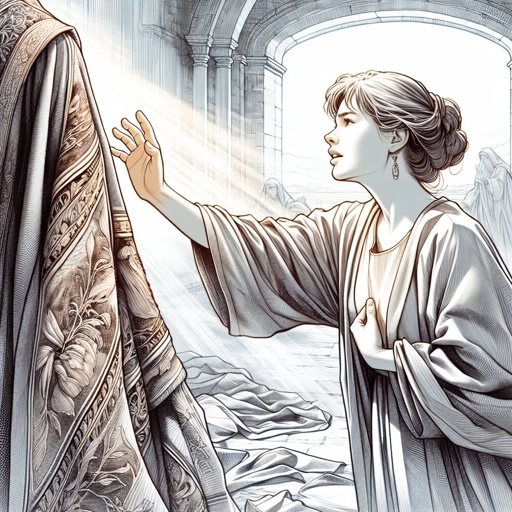
Mark 5:28 - "For she said, If I may touch but his clothes, I shall be whole."

Mark 8:5 - "And he asked them, How many loaves have ye? And they said, Seven."