What does Mark 9:17 mean?
“And one of the multitude answered and said, Master, I have brought unto thee my son, which hath a dumb spirit;” — Mark 9:17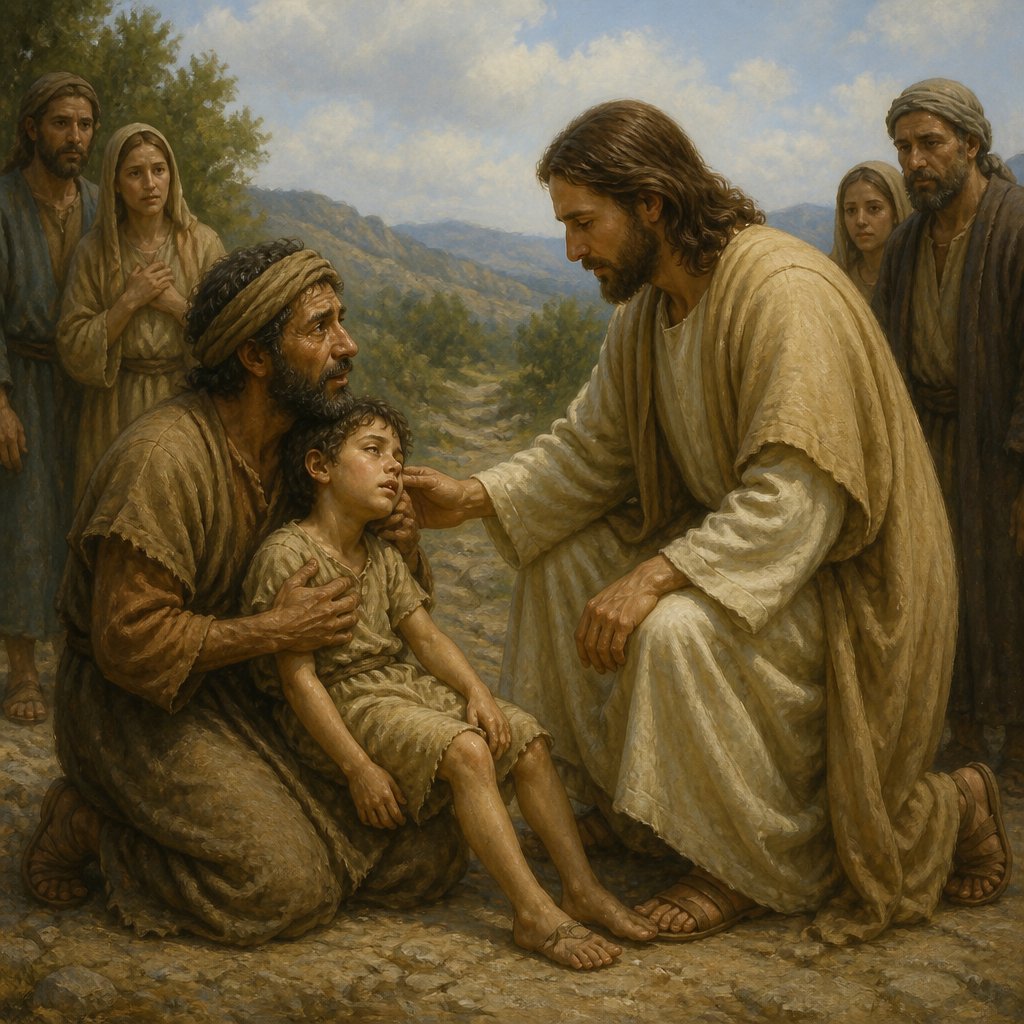
The Bible verse Mark 9:17 in the King James Version reads: "And one of the multitude answered and said, Master, I have brought unto thee my son, which hath a dumb spirit." This verse is part of a larger narrative in the Gospel of Mark, which focuses on the ministry of Jesus Christ and the various miracles he performs. In this particular passage, a man brings his son to Jesus, seeking healing for the boy who is possessed by a "dumb spirit" or a spirit that causes muteness.
In this verse, we see the desperation of the father as he brings his son to Jesus, referred to as "Master" in the passage. The man's plea for help conveys a sense of urgency and a deep desire for his son to be healed. This sets the stage for the miraculous healing that is about to take place.
The context of this verse is significant in understanding its meaning. In the larger narrative of Mark 9, we see Jesus and three of his disciples coming down from the mountain where the Transfiguration had taken place. As they encounter a crowd, the boy's father approaches Jesus and pleads for him to have compassion and help his son. The disciples had tried to cast out the demon, but they were not successful. This sets the stage for Jesus to demonstrate his power over the spiritual realm and perform a miraculous healing.
One of the key themes in this passage is the faith of the father. Despite the inability of the disciples to heal his son, the man still believes that Jesus has the power to bring about the healing his son needs. This demonstrates the unwavering faith and trust that the man has in Jesus, despite the perceived failure of the disciples. It also emphasizes the idea that true faith in Jesus is essential for experiencing his miraculous works.
Furthermore, the passage symbolizes the power and authority of Jesus over demonic forces. The presence of the "dumb spirit" in the boy represents the oppressive and damaging influence of evil in the world. By healing the boy, Jesus demonstrates his power to overcome these forces and bring about restoration and wholeness. This serves as a powerful symbol of the victory of good over evil and the ability of Jesus to bring about spiritual liberation.
In a broader context, this verse also speaks to the compassion and mercy of Jesus. The desperate plea of the father and the suffering of the boy move Jesus to act with love and understanding. This emphasizes Jesus' role as a healer and a source of comfort for those who are in need. His willingness to heal the boy despite the shortcomings of his disciples reflects his unconditional love and willingness to intervene in the lives of those who seek him.
In conclusion, the Bible verse Mark 9:17 in the King James Version carries layers of meaning and significance. It portrays the unwavering faith of a desperate father, the power and authority of Jesus over evil forces, and the compassion and mercy of Jesus towards those in need. This passage serves as a powerful reminder of the transformative and miraculous works of Jesus, and the importance of having unwavering faith in him.
Get our apps


Artwork for Mark 9:17

Mark 9:17 - "And one of the multitude answered and said, Master, I have brought unto thee my son, which hath a dumb spirit;"
"And one of the multitude answered and said, Master, I have brought unto thee my son, which hath a dumb spirit;" - Mark 9:17

Mark 10:17-30

Mark 14:17 - "And in the evening he cometh with the twelve."

Mark 9:2 Show only 4 people Show a mountain area According to Mark 9:2

Mark 10:17-30

Mark 2:9

Mark 9:2 Show only 4 people and one of them is Jesus Show a mountain area According to Mark 9:2

Mark 9:38

Mark 2:9

Mark 9:36-37

Mark 5:17 - "And they began to pray him to depart out of their coasts."

Mark 13:17 - "But woe to them that are with child, and to them that give suck in those days!"

Mark 9:48 - "Where their worm dieth not, and the fire is not quenched."

Mark 6:9 - "But be shod with sandals; and not put on two coats."

Mark 9:40 - "For he that is not against us is on our part."

Mark 9:46 - "Where their worm dieth not, and the fire is not quenched."

Mark 9:44 - "Where their worm dieth not, and the fire is not quenched."

"And in the evening he cometh with the twelve." - Mark 14:17

Mark 9:32 - "But they understood not that saying, and were afraid to ask him."

Mark 15:17 - "And they clothed him with purple, and platted a crown of thorns, and put it about his head,"

african american mary magdalene, mark 16: 9

Mark 9:16 - "And he asked the scribes, What question ye with them?"

Mark 9:6 - "For he wist not what to say; for they were sore afraid."

Mark 7:17 - "And when he was entered into the house from the people, his disciples asked him concerning the parable."

Mark 9:4 - "And there appeared unto them Elias with Moses: and they were talking with Jesus."

Mark 9:2 Do not show Jesus' face Show only 4 people including Jesus Show a mountain area therefore, show only 4 people in a mountain area and for one of them don't show the face. Mark 9:2

Mark 9:27 - "But Jesus took him by the hand, and lifted him up; and he arose."

Philippians 3:17 - "Brethren, be followers together of me, and mark them which walk so as ye have us for an ensample."

Mark 3:17 - "And James the son of Zebedee, and John the brother of James; and he surnamed them Boanerges, which is, The sons of thunder:"