What does Mark 9:19 mean?
“He answereth him, and saith, O faithless generation, how long shall I be with you? how long shall I suffer you? bring him unto me.” — Mark 9:19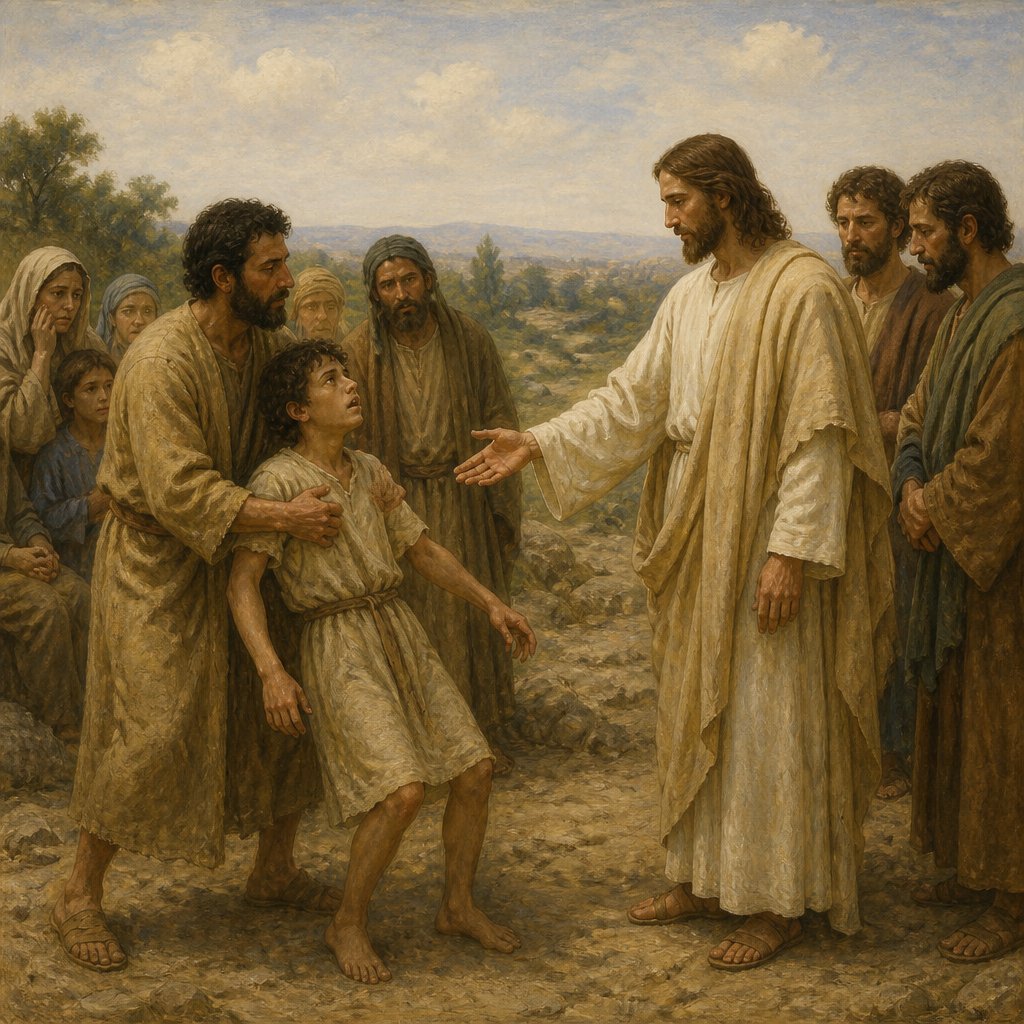
Mark 9:19 KJV: "He answereth him, and saith, O faithless generation, how long shall I be with you? how long shall I suffer you? bring him unto me."
In this verse from the Gospel of Mark, Jesus is speaking to a crowd after being approached by a man whose son is possessed by a mute spirit. The man had brought his son to Jesus' disciples, but they were unable to cast out the spirit. Jesus responds to the man's plea for help by expressing frustration with the lack of faith he perceives in the people around him.
This verse is a powerful and poignant reminder of the importance of faith in the Christian life. It serves as a reminder that without faith, it is impossible to please God, as Hebrews 11:6 states. It's also a reminder that faith is a necessary component of healing and deliverance, as seen in the context of the passage with the possessed boy.
The theme of faith is central to this verse, but there are other themes at play as well. One of these is the concept of spiritual warfare. The possessed boy in this passage represents the ongoing struggle between good and evil, and it serves as a metaphor for the spiritual battles that Christians face in their daily lives. Jesus' ability to cast out the demon from the boy demonstrates his authority over the forces of darkness and serves as a powerful reminder that, through faith in him, believers can overcome the spiritual battles they face.
Another theme in this passage is the humanity of Jesus. His frustration and impatience with the lack of faith in those around him demonstrate his human emotions and struggles. This verse serves as a reminder that Jesus faced the same challenges and frustrations that we do and understands our weaknesses and struggles.
In the broader context of the Gospel of Mark, this verse plays a significant role in demonstrating Jesus' authority over demons and his compassion for those who are suffering. Throughout the Gospel, Jesus performs numerous miracles, including healing the sick, casting out demons, and raising the dead. These miracles are evidence of his divine power and authority as the Son of God.
Symbolically, the possessed boy in this passage represents the brokenness and bondage that all people experience as a result of sin. The inability of the disciples to cast out the demon on their own emphasizes the need for a savior who can deliver humanity from the power of sin and death. Jesus' command to bring the boy to him serves as a symbolic invitation for all who are burdened and oppressed to come to him for healing and deliverance.
Overall, Mark 9:19 is a powerful and multi-layered verse that addresses themes of faith, spiritual warfare, the humanity of Jesus, and the need for healing and deliverance. It serves as a reminder of the importance of faith in the Christian life and points to Jesus as the source of healing and freedom for all who come to him in faith.
Get our apps


Artwork for Mark 9:19

Mark 9:19 - "He answereth him, and saith, O faithless generation, how long shall I be with you? how long shall I suffer you? bring him unto me."
"He answereth him, and saith, O faithless generation, how long shall I be with you? how long shall I suffer you? bring him unto me." - Mark 9:19

Mark 9:2 Show only 4 people Show a mountain area According to Mark 9:2

Mark 2:9

Mark 9:2 Show only 4 people and one of them is Jesus Show a mountain area According to Mark 9:2

Mark 9:38

Mark 2:9

Mark 9:36-37

Mark 11:19 - "And when even was come, he went out of the city."

Mark.19:52 Jeesus parantaa sokean

Mark 3:19 - "And Judas Iscariot, which also betrayed him: and they went into an house."

Mark 9:48 - "Where their worm dieth not, and the fire is not quenched."

Mark 6:9 - "But be shod with sandals; and not put on two coats."

Mark 9:40 - "For he that is not against us is on our part."

Mark 9:46 - "Where their worm dieth not, and the fire is not quenched."

Mark 9:44 - "Where their worm dieth not, and the fire is not quenched."

Mark 9:32 - "But they understood not that saying, and were afraid to ask him."

Mark 14:19 - "And they began to be sorrowful, and to say unto him one by one, Is it I? and another said, Is it I?"

african american mary magdalene, mark 16: 9

Mark 9:16 - "And he asked the scribes, What question ye with them?"

Mark 9:6 - "For he wist not what to say; for they were sore afraid."

Mark 4:19 - "And the cares of this world, and the deceitfulness of riches, and the lusts of other things entering in, choke the word, and it becometh unfruitful."

Mark 15:19 - "And they smote him on the head with a reed, and did spit upon him, and bowing their knees worshipped him."

Mark 6:19 - "Therefore Herodias had a quarrel against him, and would have killed him; but she could not:"

Mark 9:4 - "And there appeared unto them Elias with Moses: and they were talking with Jesus."

Mark 9:2 Do not show Jesus' face Show only 4 people including Jesus Show a mountain area therefore, show only 4 people in a mountain area and for one of them don't show the face. Mark 9:2

Mark 9:27 - "But Jesus took him by the hand, and lifted him up; and he arose."

Genesis 19-9

Mark 9:49 - "For every one shall be salted with fire, and every sacrifice shall be salted with salt."

Mark 9:34 - "But they held their peace: for by the way they had disputed among themselves, who should be the greatest."