What does Matthew 15:25 mean?
“Then came she and worshipped him, saying, Lord, help me.” — Matthew 15:25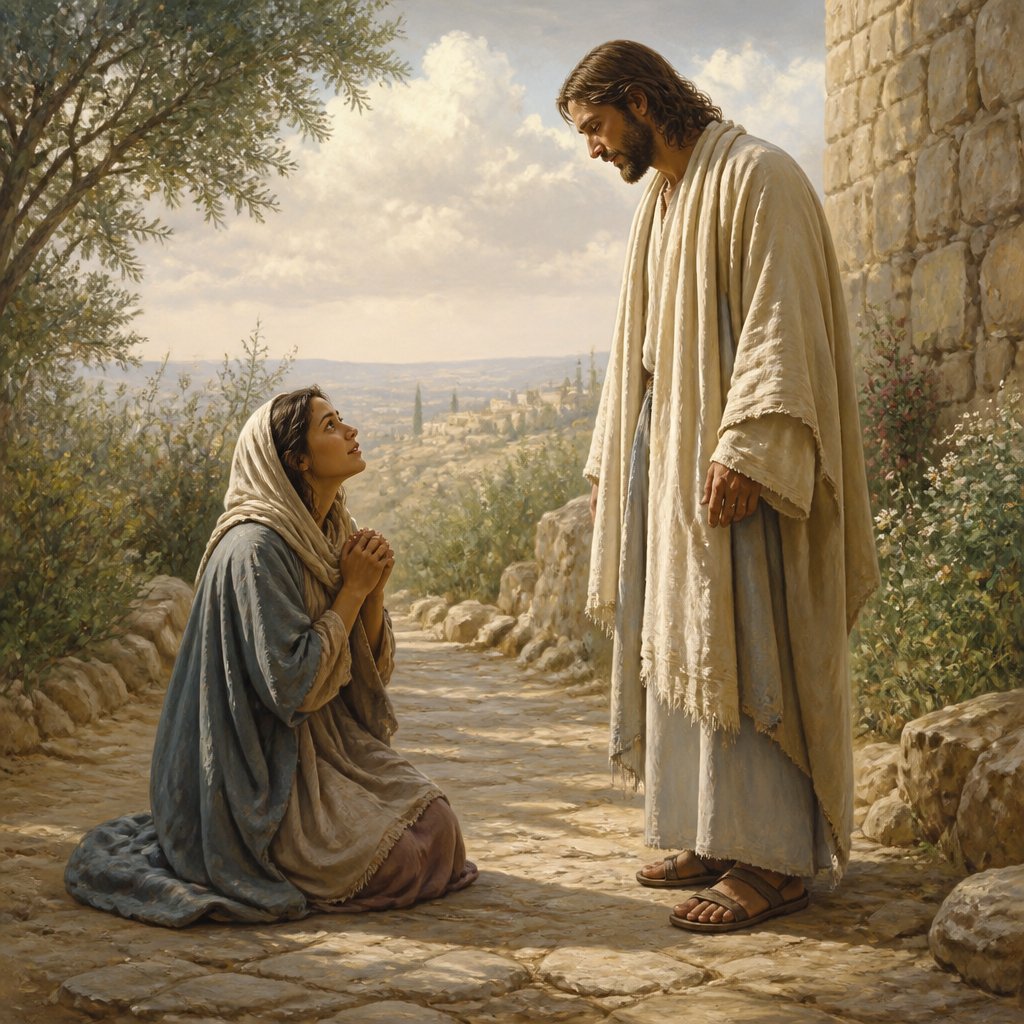
Matthew 15:25 in the King James Version (KJV) states, "Then came she and worshipped him, saying, Lord, help me." This verse is part of a larger narrative in the Bible where a Canaanite woman approaches Jesus with a desperate plea for her daughter who is demon-possessed. This encounter serves as a powerful example of faith and persistence, as well as a demonstration of Jesus' compassion and power.
The context of this passage is important to fully understand its meaning. At the beginning of Matthew 15, Jesus is approached by the Pharisees and scribes, who question him about why his disciples do not observe the tradition of washing hands before eating. Jesus confronts these religious leaders, pointing out their hypocrisy in upholding human traditions over God's commandments. This interaction sets the stage for the encounter with the Canaanite woman.
When the woman approaches Jesus, she addresses him as "Lord," acknowledging his authority and power. This demonstrates her faith in Jesus as a divine healer and her hope that he can help her daughter. Her act of worship shows her reverence and submission to Jesus, recognizing him as the source of her help.
The woman's plea, "Lord, help me," is a simple but profound expression of her desperation and trust in Jesus. This statement reflects her understanding of Jesus' ability to deliver her daughter from the demonic oppression. She recognizes that only Jesus has the power to help her in her time of need.
In response to the woman's plea, Jesus initially appears to dismiss her, saying, "It is not meet to take the children's bread, and to cast it to dogs" (Matthew 15:26, KJV). This statement seems harsh and degrading, as Jesus refers to the woman and her daughter as "dogs," a derogatory term commonly used by Jews to describe Gentiles. However, the woman persists, demonstrating remarkable faith and humility. She replies, "Truth, Lord: yet the dogs eat of the crumbs which fall from their masters' table" (Matthew 15:27, KJV). This bold response reveals the woman's unwavering faith in Jesus' ability to help her, even in the face of apparent rejection.
Jesus commends the woman for her great faith, and instantly her daughter is healed. This interaction between Jesus and the Canaanite woman challenges the prejudices and exclusivity of the Jewish culture at the time, as well as emphasizes the universality of Jesus' ministry. It serves as a powerful reminder that God's mercy and grace are available to all who come to him in faith, regardless of their ethnicity or background.
The themes present in Matthew 15:25 include faith, persistence, humility, and the inclusivity of God's kingdom. The Canaanite woman's unwavering faith and persistence in seeking Jesus' help exemplify the importance of approaching God with humility and trust, even in the face of apparent rejection or silence. Her example challenges readers to remain steadfast in their faith and to approach God with boldness and persistence.
The encounter also highlights the inclusivity of Jesus' ministry. Despite the cultural and religious divisions of the time, Jesus does not discriminate based on ethnicity or social status. Instead, he demonstrates compassion and power in response to the woman's faith, ultimately extending God's grace to her and her daughter.
Symbolically, the crumbs that the woman mentions in her response can be seen as a representation of the abundance of God's mercy and grace, which extends even to those who may be considered unworthy or outside the fold. The image of crumbs falling from the master's table portrays the idea that even the smallest measure of God's grace is more than sufficient to bring about healing and restoration.
In conclusion, Matthew 15:25 captures a significant moment in the ministry of Jesus, illustrating the power of faith, persistence, and humility in approaching God. The Canaanite woman's unwavering faith and boldness serve as a powerful example for believers, highlighting the inclusivity of God's kingdom and the abundance of his grace. This passage encourages readers to approach God with boldness and trust, knowing that he is able to meet their deepest needs and bring about healing and restoration.
Get our apps


Artwork for Matthew 15:25

Matthew 15:25 - "Then came she and worshipped him, saying, Lord, help me."
"Then came she and worshipped him, saying, Lord, help me." - Matthew 15:25

Matthew 25:15 - "And unto one he gave five talents, to another two, and to another one; to every man according to his several ability; and straightway took his journey."

Matthew 25:25

Matthew 25: 14-25

matthew 15 matthew 15:10

Matthew 26:25

Matthew 25:23

Matthew 25:21

Matthew 16:25

matthew 25:31

Matthew 25:21

Matthew 25:23

Matthew 21:25

Matthew 25:25 - "And I was afraid, and went and hid thy talent in the earth: lo, there thou hast that is thine."

Matthew 25:11-13

Matthew 6:25 – 34

Genesis 25-15

Matthew 25:4 - "But the wise took oil in their vessels with their lamps."

Matthew 25:5 - "While the bridegroom tarried, they all slumbered and slept."

Matthew 24:25 - "Behold, I have told you before."

Matthew 25:7 - "Then all those virgins arose, and trimmed their lamps."

Matthew 25:3 - "They that were foolish took their lamps, and took no oil with them:"

Matthew 26:15

Matthew 26:15

Matthew 15:23

Matthew 24:15

Matthew 15:15 - "Then answered Peter and said unto him, Declare unto us this parable."

Matthew 5:15

Matthew 15:23