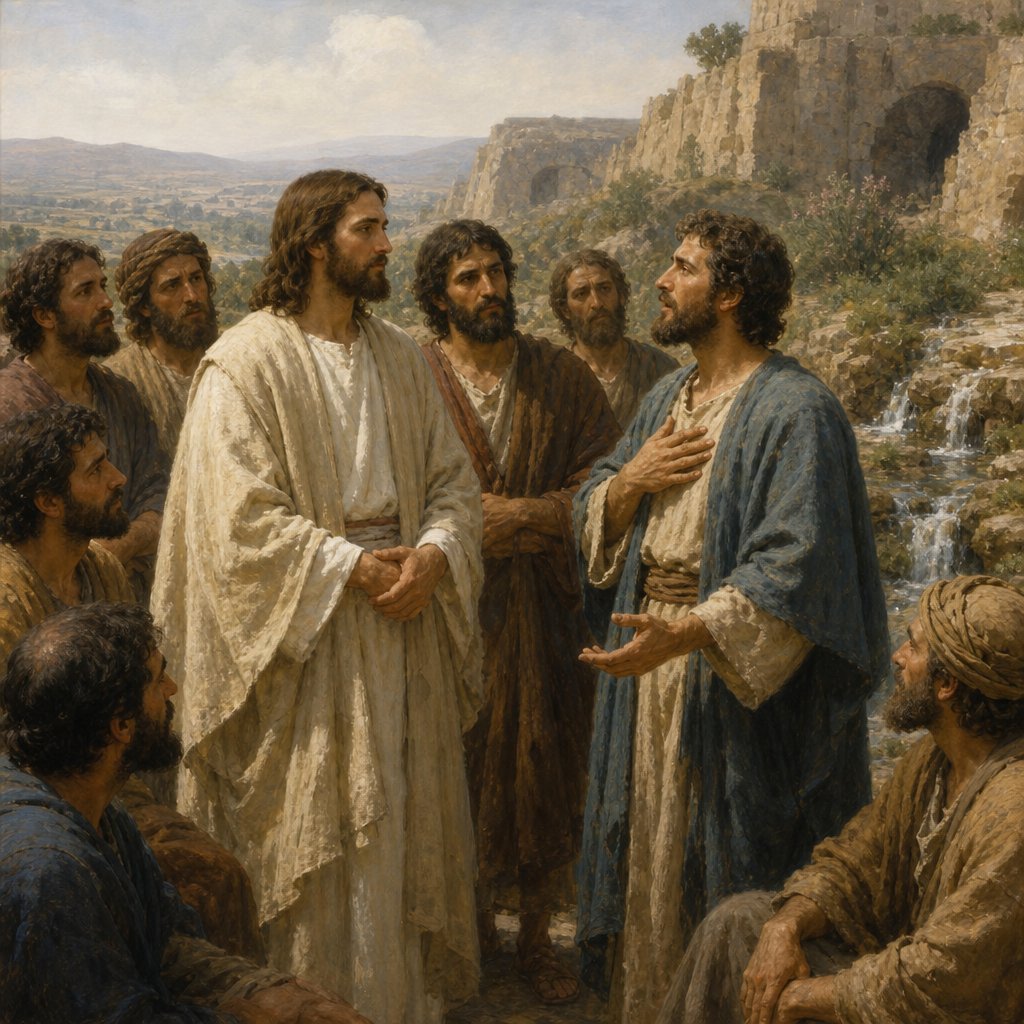
In Matthew 16:13-16, the King James Version brings the reader to a decisive moment in the Lord’s ministry, where the question of his identity becomes unavoidable and personal. The passage reads, “When Jesus came into the coasts of Caesarea Philippi, he asked his disciples, saying, Whom do men say that I the Son of man am? And they said, Some say that thou art John the Baptist: some, Elias; and others, Jeremias, or one of the prophets. He saith unto them, But whom say ye that I am? And Simon Peter answered and said, Thou art the Christ, the Son of the living God.”
The setting itself carries weight. Jesus comes “into the coasts of Caesarea Philippi,” a region at the outer edge of the land where his people lived, associated with Gentile presence and various competing allegiances. The movement to the borderlands underscores that his question is not merely for a local synagogue discussion; it is a question with universal implications, asked in a place suggestive of political power and religious plurality. In such a setting, the world has many answers ready-made, and Jesus draws those answers out first. He asks, “Whom do men say that I the Son of man am?” The title “Son of man” is both humble and deeply charged. On the surface it sounds like an ordinary way of speaking of human life, yet it also echoes the language of divine authority and promised rule found in Scripture. By using it, Jesus simultaneously veils and reveals himself, inviting faith to recognize what mere opinion cannot.
The first exchange exposes the difference between public speculation and revealed truth. The disciples report what “men” say: “Some say that thou art John the Baptist: some, Elias; and others, Jeremias, or one of the prophets.” Each guess confesses something true and yet falls short. To call him John the Baptist is to see moral seriousness and prophetic urgency, but it reduces Jesus to a revived reformer. To call him Elias is to connect him with the expectation that Elijah would appear in connection with the great day of the Lord, suggesting that Jesus stands at the hinge of history, yet it still makes him only a forerunner rather than the fulfillment. To call him Jeremias or another prophet is to grant him the weight of a speaking God-sent messenger, but it keeps him within the familiar category of those who point beyond themselves. Symbolically, these answers represent humanity’s tendency to honor Jesus while still keeping him manageable: he is admired, compared, placed into a known line, yet not submitted to as Lord.
Then Jesus narrows the question with force and intimacy: “But whom say ye that I am?” The shift from “men” to “ye” is the heart of the passage. It insists that discipleship cannot be lived on borrowed perceptions. It is not enough to know the religious conversation of the crowd; the followers of Jesus must answer for themselves. The verse becomes a kind of dividing line, because everything that follows in the Gospel flows from whether Jesus is received merely as a prophet among many or as the one whom God has uniquely sent.
Peter answers as spokesman for the group, and his confession gathers the meaning of the entire scene: “Thou art the Christ, the Son of the living God.” “The Christ” is not simply a surname; it is a title of fulfillment. It names Jesus as the promised Anointed One, the expected King and Deliverer, the One in whom the hopes of Scripture converge. This confession places Jesus at the center of God’s plan rather than at the edge of human speculation. At the same time, Peter adds, “the Son of the living God,” which elevates the confession beyond messianic politics or national expectation. The phrase “living God” contrasts the God of Israel with all lifeless idols and empty religious forms; it proclaims a God who speaks, acts, saves, and reigns. To confess Jesus as the Son of the living God is to recognize in him a unique relationship to God that no prophet shares. A prophet can say, “Thus saith the LORD,” but Peter’s confession recognizes that Jesus is more than a mouthpiece; he belongs to God in a singular way, bearing divine authority and identity.
Several themes converge here. There is the theme of revelation versus opinion: the crowd can guess in impressive ways, but the disciple is called to a confession that goes deeper than rumor and comparison. There is the theme of identity: Jesus does not allow himself to be defined by popular categories, even reverent ones. There is also the theme of confession as the foundation of faith: the Gospel does not present salvation as mere admiration of Jesus, but as recognizing who he truly is. In symbolism, the movement from the “coasts” to the question, from “men” to “ye,” from “Son of man” to “Son of the living God,” traces a path from outward appearances to inward truth, from human uncertainty to divine certainty, from the shifting voices of the many to the settled confession that becomes the bedrock of Christian belief.
The significance of Matthew 16:13-16, then, is that it is a turning point where Jesus draws out the essential confession that defines his church and his followers: not simply that he teaches like a prophet, but that he is “the Christ,” and not only that he is God’s chosen, but that he is “the Son of the living God.” It confronts every reader with the same question Jesus asked his disciples, pressing beyond what others say and demanding a personal answer that is not merely respectful but true.
Get our apps


Artwork for Matthew 16:13-16

Matthew 16:13-16 - "When Jesus came into the coasts of Caesarea Philippi, he asked his disciples, saying, Whom do men say that I the Son of man am? And they said, Some say that thou art John the Baptist: some, Elias; and others, Jeremias, or one of the prophets. He saith unto them, But whom say ye that I am? And Simon Peter answered and said, Thou art the Christ, the Son of the living God."
"When Jesus came into the coasts of Caesarea Philippi, he asked his disciples, saying, Whom do men say that I the Son of man am? And they said, Some say that thou art John the Baptist: some, Elias; and others, Jeremias, or one of the prophets. He saith unto them, But whom say ye that I am? And Simon Peter answered and said, Thou art the Christ, the Son of the living God." - Matthew 16:13-16

Matthew 13:16 - "But blessed are your eyes, for they see: and your ears, for they hear."

"But blessed are your eyes, for they see: and your ears, for they hear." - Matthew 13:16

Matthew 3:16

Matthew 16:16 - "And Simon Peter answered and said, Thou art the Christ, the Son of the living God."

Matthew 16:13 - "¶ When Jesus came into the coasts of Caesarea Philippi, he asked his disciples, saying, Whom do men say that I the Son of man am?"

Matthew 3:16

Matthew 3:16

Matthew 16:25

Matthew 19:16-17

Matthew 27:16 - "And they had then a notable prisoner, called Barabbas."

Genesis 16:13

Matthew 12:16 - "And charged them that they should not make him known:"

Matthew 24:16 - "Then let them which be in Judaea flee into the mountains:"

Psalm 1:6

Psalm 1:6
Titus 1:6

Proverbs 1:6

Titus 1:6

Proverbs 1:6

Proverbs 1:6

Luke 16:1-13

Revelation 13:16-17

Revelations 1:13-16

Ezekiel 1:6-13

Titus 1:6

Proverbs 1:6

Proverbs 1:6

Esther 1:6