What does Matthew 8:10 mean?
“When Jesus heard it, he marvelled, and said to them that followed, Verily I say unto you, I have not found so great faith, no, not in Israel.” — Matthew 8:10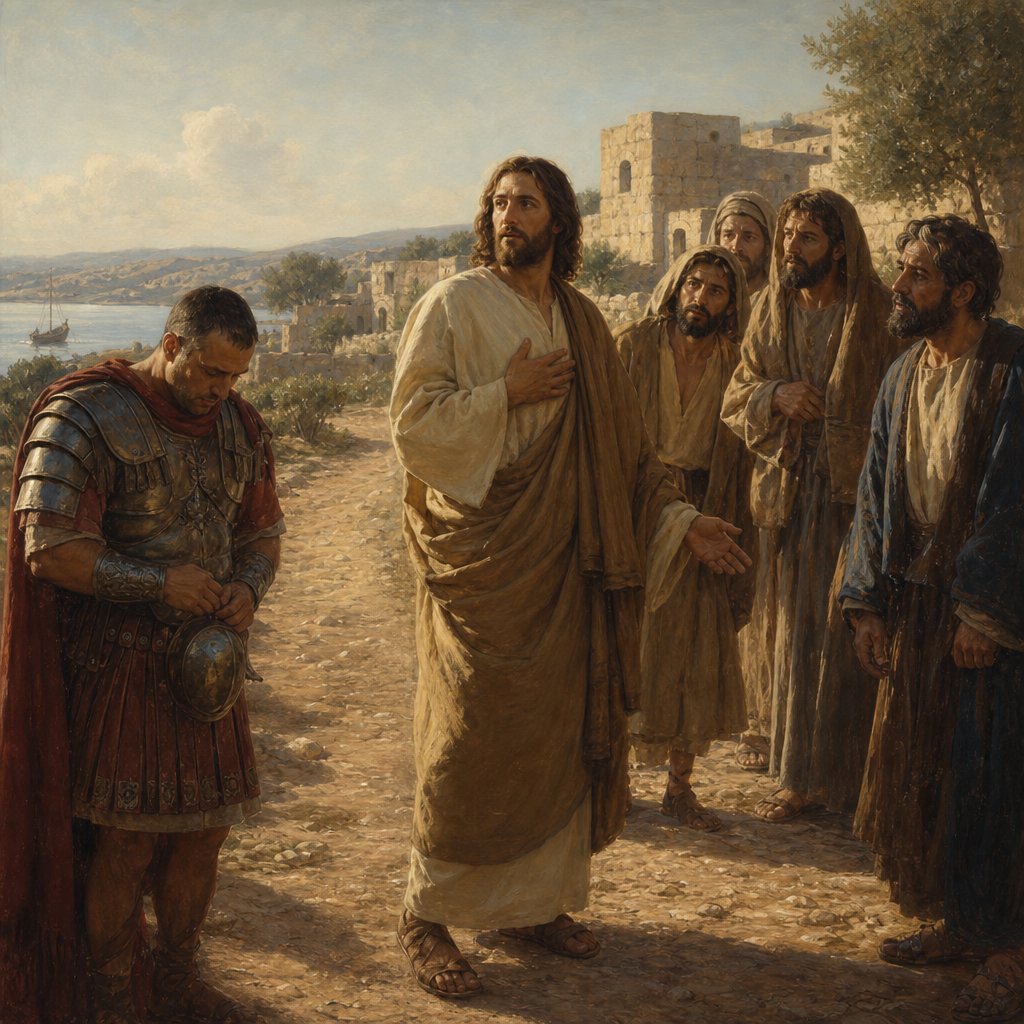
Matthew 8:10 in the King James Version reads, “When Jesus heard it, he marvelled, and said to them that followed, Verily I say unto you, I have not found so great faith, no, not in Israel.”
In its immediate context this sentence stands at the heart of the encounter between Jesus and the centurion at Capernaum. The centurion is a Roman officer, a Gentile, and therefore someone outside the covenant nation of Israel in the ordinary religious and social sense. He comes to Jesus on behalf of his servant that is “sick of the palsy, grievously tormented” (Matthew 8:6). When Jesus offers to come and heal him, the centurion answers with a humility and spiritual insight that becomes the occasion for Matthew 8:10: “Lord, I am not worthy that thou shouldest come under my roof: but speak the word only, and my servant shall be healed” (Matthew 8:8). He explains his reasoning by drawing on the authority structure he knows: as a man under authority, he both obeys and commands, and his word is carried out (Matthew 8:9). Jesus’ marvel is not simply at the man’s politeness; it is at the spiritual accuracy of what the centurion has perceived about Christ’s authority.
The central theme of Matthew 8:10 is faith, and not faith in the abstract, but faith that rests on Christ’s sovereign word. The centurion believes Jesus can heal at a distance, without touch, ritual, or visible process: “speak the word only.” In the KJV, Jesus calls this “so great faith.” Greatness here is not volume of emotion but clarity of trust—confidence that Christ’s authority is real and effective even when unseen. The centurion treats Jesus’ speech as decisive action. This anticipates a major pattern in the Gospel: the power of Christ’s word to create, command, rebuke, and restore. In this moment, the centurion’s reasoning becomes a kind of parable: just as soldiers move at the word of a superior, sickness must yield at the word of the true Lord.
Another theme is the surprising location of faith. Jesus says, “I have not found so great faith, no, not in Israel.” This is a striking comparison because Israel is the nation that possesses the Scriptures, the promises, the temple worship, and the expectation of Messiah. Yet the one who most clearly recognizes the nature of Jesus’ authority in this scene is a Gentile outsider. The verse therefore confronts complacency based on religious privilege. It suggests that proximity to covenant signs does not automatically produce living trust, and that God may find faith where the religious world does not expect it. In Matthew’s narrative, this also prepares for the broader turning of blessing outward to the nations, without denying Israel’s place in God’s plan but exposing the danger of unbelief within Israel.
Jesus “marvelled” is itself significant. The KJV’s wording presents a real moment of astonishment in Jesus’ human experience. The Gospels rarely say Jesus marvels, and when they do, it highlights something of exceptional spiritual weight. Here, what causes wonder is not a miracle of nature but a human response—faith. That emphasis teaches that the Lord takes notice of faith, commends it, and holds it forth publicly as an example. Jesus does not keep this assessment private; he “said to them that followed.” The saying functions as instruction to disciples and crowds alike: watch what true faith looks like, and do not assume it belongs only to the familiar religious circle.
Symbolically, the centurion’s stance outside his house—unworthy for Jesus to enter—reflects a deeper humility. He does not attempt to leverage rank, merit, or nationality. Though he has earthly authority, he places himself beneath Christ. The house becomes a symbol of boundaries: social boundaries between Jew and Gentile, and spiritual boundaries between the holy and the unclean. Yet the centurion does not demand that Jesus cross those boundaries in the way he imagines healing must happen. Instead, he appeals to a higher reality: Christ’s word can cross any boundary. This becomes a picture of how grace reaches across distance and division. The centurion’s faith is “great” precisely because it does not require visible reassurance; it honors Christ as Lord whose command is enough.
Matthew 8:10 also carries forward a larger Matthean theme about the kingdom of heaven and who truly belongs to it. The verse is immediately followed by Jesus’ sober expansion: “And I say unto you, That many shall come from the east and west, and shall sit down with Abraham, and Isaac, and Jacob, in the kingdom of heaven: But the children of the kingdom shall be cast out into outer darkness: there shall be weeping and gnashing of teeth” (Matthew 8:11–12). That continuation shows that Matthew 8:10 is not merely a compliment; it is a turning point that opens up the meaning of the miracle. The centurion becomes a sign of “many” from afar who will share in the promised fellowship, while warning that mere descent from Abraham without faith does not secure participation in the kingdom. Thus, Matthew 8:10 is both invitation and warning: invitation that faith brings Gentiles near, warning that unbelief can leave Israelites far.
In the flow of Matthew 8, this verse also sits among a series of demonstrations of Jesus’ authority. Just before this, Jesus cleanses a leper (Matthew 8:2–3), showing power over defilement and exclusion. Here, he heals with a word at a distance, showing authority not limited by space. Soon after, he stills the tempest (Matthew 8:26–27) and casts out devils (Matthew 8:32), displaying authority over nature and the spiritual realm. Matthew 8:10, then, is more than a narrative remark; it interprets the miracles by revealing the proper response to Jesus’ authority. The greatest wonder is not only that Jesus can command sickness, but that someone can rightly recognize him and trust him.
The significance of Matthew 8:10, using the KJV alone, is that Jesus publicly identifies true faith as confident reliance upon his word and authority, and he deliberately highlights that such faith may be found outside expected religious boundaries. It magnifies Christ as the Lord whose spoken command is sufficient, humbles those who presume upon privilege, and foreshadows the gathering of the nations into the kingdom while warning that nearness to Israel’s heritage without faith is not enough.
Get our apps


Artwork for Matthew 8:10

Matthew 8:10 - "When Jesus heard it, he marvelled, and said to them that followed, Verily I say unto you, I have not found so great faith, no, not in Israel."
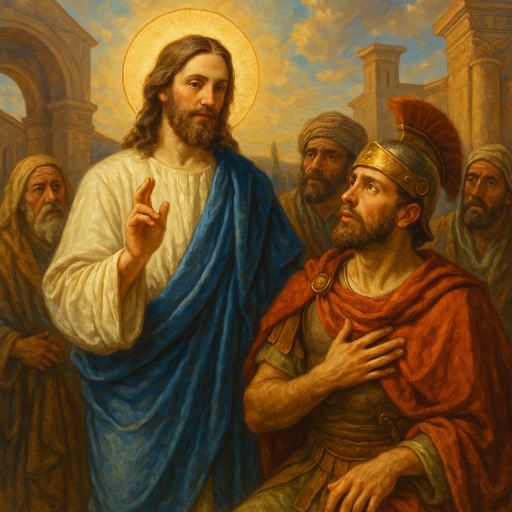
"When Jesus heard it, he marvelled, and said to them that followed, Verily I say unto you, I have not found so great faith, no, not in Israel." - Matthew 8:10
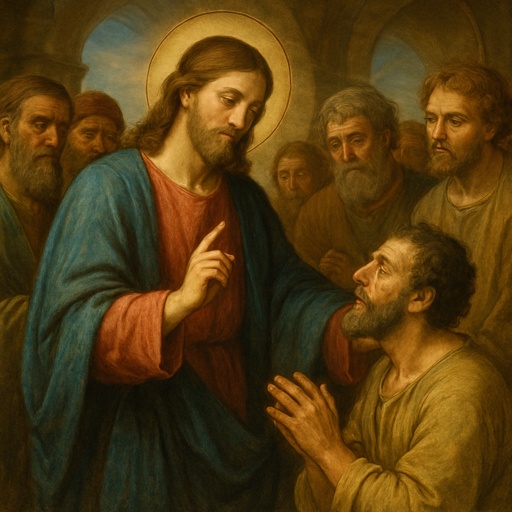
When Jesus heard it, he marvelled, and said to them that followed, Verily I say unto you, I have not found so great faith, no, not in Israel. Matthew 8:10
"When Jesus heard it, he marvelled, and said to them that followed, Verily I say unto you, I have not found so great faith, no, not in Israel." - Matthew 8:10

Matthew 10:8 - "Heal the sick, cleanse the lepers, raise the dead, cast out devils: freely ye have received, freely give."

matthew 15 matthew 15:10

Matthew 28:8-10 8 And they departed quickly from the sepulchre with fear and great joy; and did run to bring his disciples word. 9 And as they went to tell his disciples, behold, Jesus met them, saying, All hail. And they came and held him by the feet, and worshipped him. 10 Then said Jesus unto them, Be not afraid: go tell my brethren that they go into Galilee, and there shall they see me.

Matthew 8:13

Matthew 8:13

Matthew 8:13

Matthew 8:32

Matthew 8:32

Matthew 8:32

Matthew 28:8-10 8 And the women departed quickly from the sepulchre with fear and great joy; and did run to bring his disciples word. 9 And as they went to tell his disciples, behold, Jesus met them, saying, All hail. And they came and held him by the feet, and worshipped him. 10 Then said Jesus unto them, Be not afraid: go tell my brethren that they go into Galilee, and there shall they see me.

Matthew 28:8-10 8 And the women departed quickly from the sepulchre with fear and great joy; and did run to bring his disciples word. 9 And as they went to tell his disciples, behold, Jesus met them, saying, All hail. And they came and held him by the feet, and worshipped him. 10 Then said Jesus unto them, Be not afraid: go tell my brethren that they go into Galilee, and there shall they see me.

Matthew 28:8-10 8 And the women departed quickly from the sepulchre with fear and great joy; and did run to bring his disciples word. 9 And as they went to tell his disciples, behold, Jesus met them, saying, All hail. And they came and held him by the feet, and worshipped him. 10 Then said Jesus unto them, Be not afraid: go tell my brethren that they go into Galilee, and there shall they see me.

Matthew 1:10

Matthew 18:10

Matthew 1:10

Matthew 24:8

Matthew 13:8

matthew 8:28

Matthew 4:10
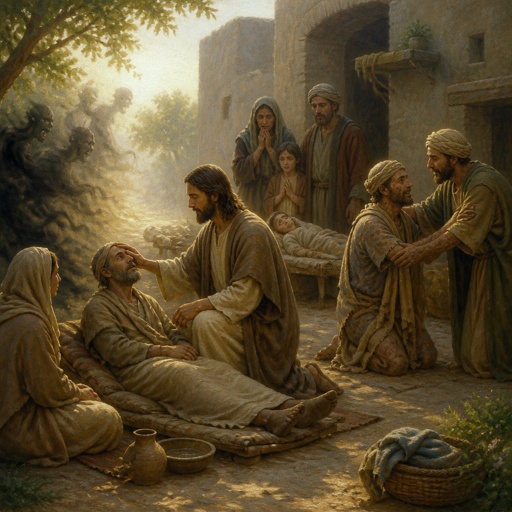
"Heal the sick, cleanse the lepers, raise the dead, cast out devils: freely ye have received, freely give." - Matthew 10:8

Matthew 10:3 - "Philip, and Bartholomew; Thomas, and Matthew the publican; James the son of Alphaeus, and Lebbaeus, whose surname was Thaddaeus;"

for the workman is worthy his meat Matthew 10:10

for the workman is worthy of his meat Matthew 10:10

for the workman is worthy of his meat Matthew 10:10

for the workman is worthy of his meat Matthew 10:10

for the disciple is worthy of his meat Matthew 10:10