What does Nehemiah 12:29 mean?
“Also from the house of Gilgal, and out of the fields of Geba and Azmaveth: for the singers had builded them villages round about Jerusalem.” — Nehemiah 12:29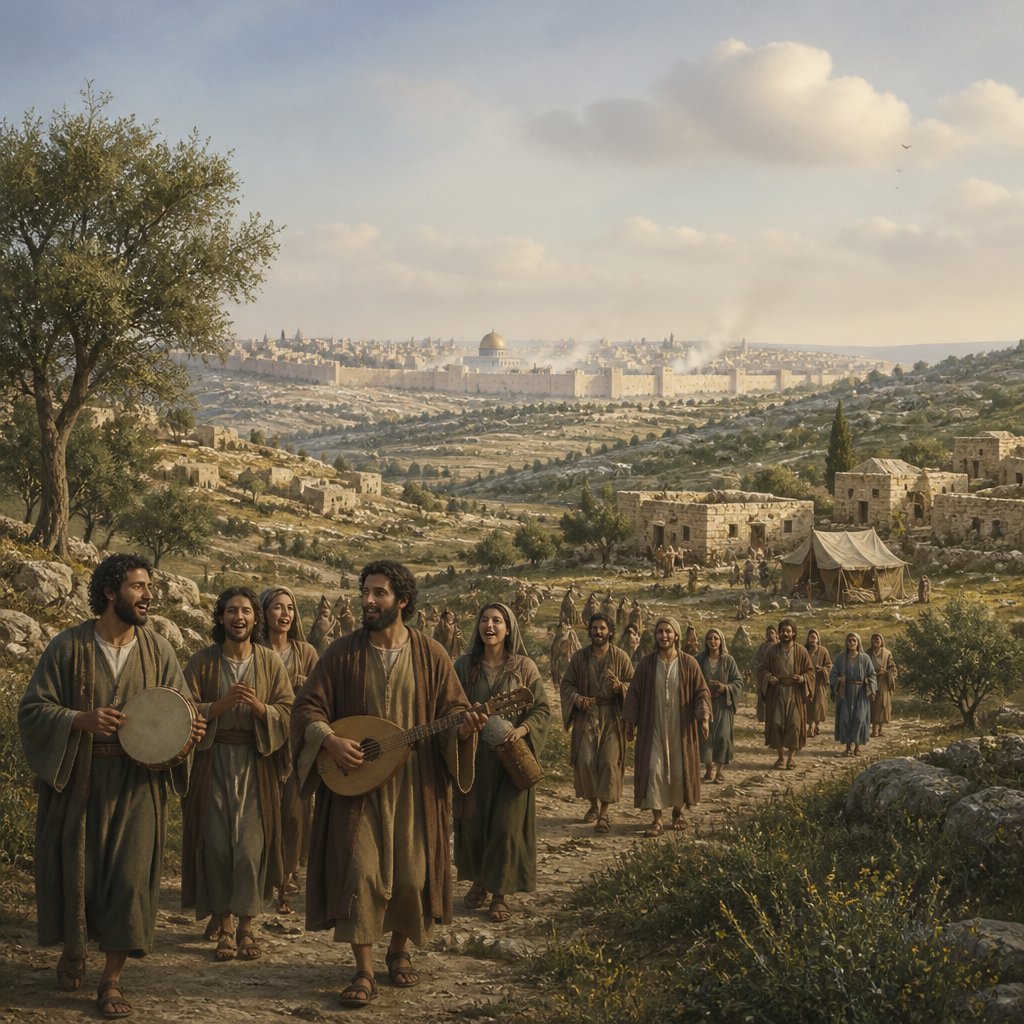
The Bible verse Nehemiah 12:29 from the King James Version (KJV) reads, "Also from the house of Gilgal, and out of the fields of Geba and Azmaveth: for the singers had builded them villages round about Jerusalem."
This verse is part of the book of Nehemiah, which is a historical account of the rebuilding of Jerusalem's walls and the restoration of the city following the Babylonian exile. The Book of Nehemiah is named after its protagonist, who was a cupbearer to the Persian king Artaxerxes but held a deep love for and connection to his homeland. Nehemiah's primary goal was to restore Jerusalem's physical and spiritual integrity, as well as to reestablish the Jewish people's identity and commitment to God.
In the context of this verse, Nehemiah 12 is focused on the dedication of the city wall and the celebration that followed. The verse in question specifically mentions the singers who had built villages around Jerusalem. This detail may seem minor in the grand scheme of the book, but it holds significant meaning and symbolism.
Firstly, the mention of singers indicates the importance of music and worship in the life of the Jewish people. Singing and music have always held a vital role in Jewish religious and cultural traditions. In this context, the singers represent the community's devotion to God and their desire to praise and worship Him through their musical talents. This also underscores the importance of the arts and culture in the life of the Jewish people, as well as the role they play in their spiritual practices.
Furthermore, the fact that the singers had built villages around Jerusalem highlights the commitment and dedication of the people to their city and their faith. These singers did not simply reside in Jerusalem; they actively participated in its expansion, growth, and preservation. By building villages around the city, they were not only ensuring its safety and prosperity but also reinforcing the importance of community and solidarity in their faith.
Symbolically, this verse can also be seen as a representation of the broader theme of restoration and renewal that permeates the book of Nehemiah. The city of Jerusalem had been devastated and its walls demolished during the Babylonian exile, and the process of rebuilding was not merely physical but also spiritual and emotional. The construction of villages around the city by the singers can be seen as an act of reclaiming and reviving the land, as well as establishing a new beginning for the Jewish people.
In a broader sense, this verse also speaks to the importance of community and collaboration in the believers' journey. The singers did not work in isolation but as a unified group, contributing their talents and efforts for the greater good. This serves as a reminder that we are stronger together, and that collective action and support are crucial in building and maintaining the foundations of faith and community.
In conclusion, Nehemiah 12:29 from the King James Version provides a glimpse into the dedication and commitment of the singers who not only praised God with their music but also actively participated in the expansion and preservation of Jerusalem. The verse holds significant symbolism in relation to the themes of restoration, worship, community, and collaboration that are central to the book of Nehemiah and the broader Christian faith. It is a reminder of the power of unity, creativity, and devotion in the believers' journey, and the lasting impact that these values can have on the spiritual and physical landscape.
Get our apps


Artwork for Nehemiah 12:29

Nehemiah 12:29 - "Also from the house of Gilgal, and out of the fields of Geba and Azmaveth: for the singers had builded them villages round about Jerusalem."
"Also from the house of Gilgal, and out of the fields of Geba and Azmaveth: for the singers had builded them villages round about Jerusalem." - Nehemiah 12:29

Nehemiah 11:29 - "And at En-rimmon, and at Zareah, and at Jarmuth,"

Nehemiah 7:29 - "The men of Kirjath-jearim, Chephirah, and Beeroth, seven hundred forty and three."

"And at En-rimmon, and at Zareah, and at Jarmuth," - Nehemiah 11:29

Nehemiah 12:26 - "These were in the days of Joiakim the son of Jeshua, the son of Jozadak, and in the days of Nehemiah the governor, and of Ezra the priest, the scribe."

Nehemiah 12:33 - "And Azariah, Ezra, and Meshullam,"

Nehemiah 12:5 - "Miamin, Maadiah, Bilgah,"

Nehemiah 12:2 - "Amariah, Malluch, Hattush,"

Nehemiah 12:4 - "Iddo, Ginnetho, Abijah,"

Nehemiah 12:3 - "Shechaniah, Rehum, Meremoth,"

Nehemiah 10:12 - "Zaccur, Sherebiah, Shebaniah,"

Nehemiah 12:6 - "Shemaiah, and Joiarib, Jedaiah,"

Nehemiah 13:29 - "Remember them, O my God, because they have defiled the priesthood, and the covenant of the priesthood, and of the Levites."

Nehemiah 12:12 - "And in the days of Joiakim were priests, the chief of the fathers: of Seraiah, Meraiah; of Jeremiah, Hananiah;"

Nehemiah 12:16 - "Of Iddo, Zechariah; of Ginnethon, Meshullam;"

Nehemiah 12:13 - "Of Ezra, Meshullam; of Amariah, Jehohanan;"

Nehemiah 12:20 - "Of Sallai, Kallai; of Amok, Eber;"

Nehemiah 12:19 - "And of Joiarib, Mattenai; of Jedaiah, Uzzi;"

Nehemiah 12:34 - "Judah, and Benjamin, and Shemaiah, and Jeremiah,"

Nehemiah 12:15 - "Of Harim, Adna; of Meraioth, Helkai;"

Nehemiah 12:18 - "Of Bilgah, Shammua; of Shemaiah, Jehonathan;"

Nehemiah 12:14 - "Of Melicu, Jonathan; of Shebaniah, Joseph;"

Nehemiah 12:21 - "Of Hilkiah, Hashabiah; of Jedaiah, Nethaneel."

Nehemiah 12:17 - "Of Abijah, Zichri; of Miniamin, of Moadiah, Piltai;"

Nehemiah 12:11 - "And Joiada begat Jonathan, and Jonathan begat Jaddua."

Nehemiah 7:12 - "The children of Elam, a thousand two hundred fifty and four."

Nehemiah 12:32 - "And after them went Hoshaiah, and half of the princes of Judah,"

"Miamin, Maadiah, Bilgah," - Nehemiah 12:5

"Shemaiah, and Joiarib, Jedaiah," - Nehemiah 12:6