What does Nehemiah 3:12 mean?
“And next unto him repaired Shallum the son of Halohesh, the ruler of the half part of Jerusalem, he and his daughters.” — Nehemiah 3:12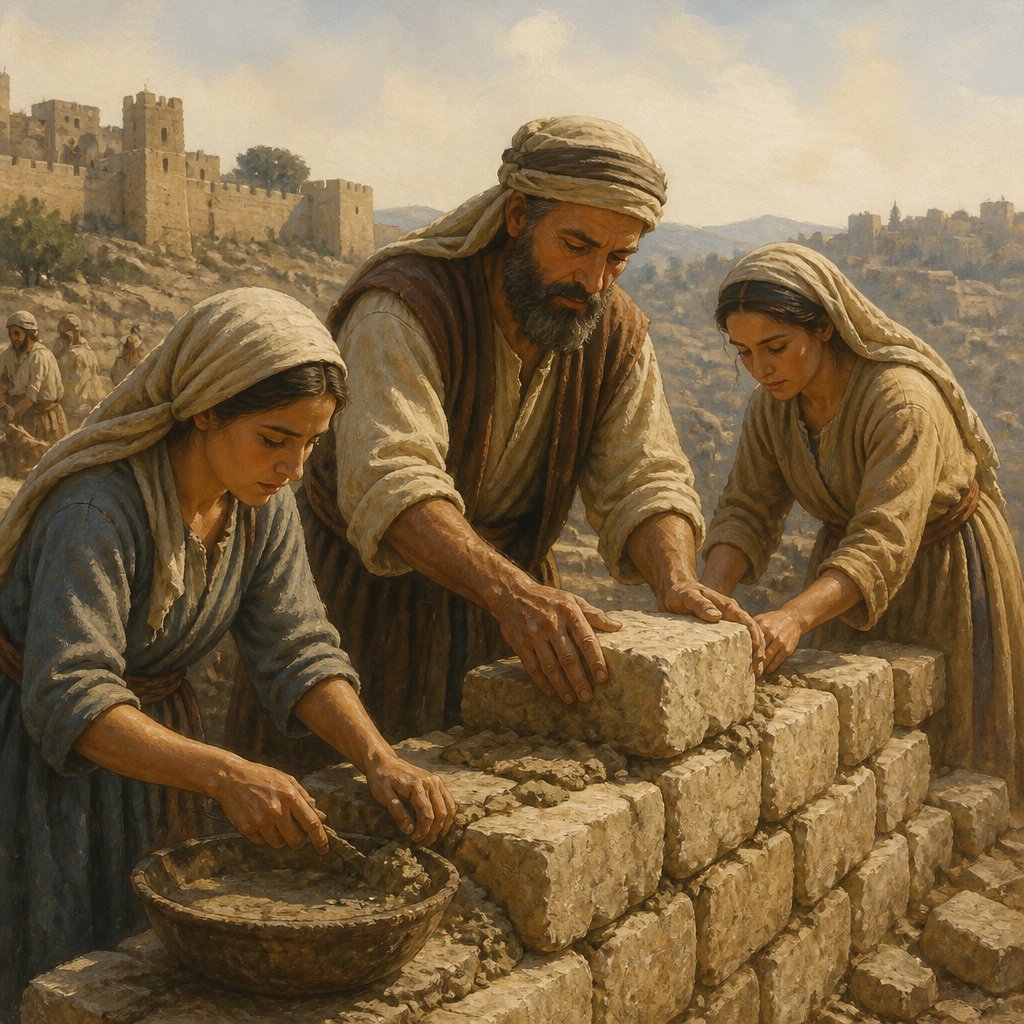
Nehemiah 3:12 (KJV) reads: "And next unto him repaired Shallum the son of Halohesh, the ruler of the half part of Jerusalem, he and his daughters."
The book of Nehemiah tells the story of the restoration of Jerusalem's walls, which had been destroyed during the Babylonian exile. This verse is part of a detailed account of the various individuals and groups who participated in the rebuilding of the city walls.
In this specific verse, we read about Shallum, the son of Halohesh, who played a significant role in the restoration process. Shallum is described as the ruler of the half part of Jerusalem, and he, along with his daughters, was involved in repairing the walls. The fact that his daughters were mentioned in the verse is noteworthy, as it indicates that they were actively contributing to the reconstruction effort alongside their father. This detail serves as a powerful example of the inclusive nature of the rebuilding project, which involved both men and women working together for a common cause.
The verse also highlights the diverse group of people who participated in the reconstruction of Jerusalem. Shallum's role as a ruler demonstrates that individuals from different backgrounds and social statuses came together to contribute to the restoration project. This inclusivity and collaboration among people of varying positions in society convey the overarching theme of unity and cooperation in the face of adversity. Despite their differences, the people of Jerusalem rallied together to rebuild their city and protect it from external threats.
From a historical and contextual perspective, this verse provides valuable insights into the social dynamics and leadership structure of Jerusalem during the time of Nehemiah. It sheds light on the administrative organization of the city and the role of community leaders in overseeing the reconstruction efforts. Additionally, the mention of Shallum's specific position as the ruler of a portion of Jerusalem underscores the decentralized nature of the city's governance, where different leaders were responsible for governing various parts of the city.
The symbolism present in this verse is multi-layered and rich with meaning. Shallum's leadership role and his active involvement in the restoration process symbolize the importance of strong and dedicated leadership in overcoming challenges and achieving collective goals. His daughters' participation reflects the idea of empowerment and the valuable contributions of women in communal endeavors. The portrayal of Shallum and his daughters working side by side exemplifies a family unit united in a shared purpose, emphasizing the significance of familial support and unity in times of hardship.
Furthermore, the verse can be seen as a metaphor for the broader concept of spiritual rebuilding and renewal. Just as Shallum and his fellow citizens were devoted to reconstructing Jerusalem's walls, believers are called to engage in the ongoing process of spiritual growth and revitalization. The verse serves as a reminder of the importance of active participation and collaboration in endeavors aimed at strengthening and fortifying one's faith and community.
In conclusion, Nehemiah 3:12 presents a compelling narrative of collaboration, leadership, and unity in the face of adversity. It offers valuable insights into the social dynamics and organizational structure of Jerusalem during the time of its restoration. The verse's symbolism speaks to the timeless themes of collective effort, inclusivity, and spiritual renewal, making it a meaningful and relevant passage for readers seeking inspiration and guidance in their own pursuits of restoration and growth.
Get our apps


Artwork for Nehemiah 3:12

Nehemiah 3:12 - "And next unto him repaired Shallum the son of Halohesh, the ruler of the half part of Jerusalem, he and his daughters."
"And next unto him repaired Shallum the son of Halohesh, the ruler of the half part of Jerusalem, he and his daughters." - Nehemiah 3:12

Nehemiah 12:3 - "Shechaniah, Rehum, Meremoth,"

"Shechaniah, Rehum, Meremoth," - Nehemiah 12:3

Nehemiah 12:26 - "These were in the days of Joiakim the son of Jeshua, the son of Jozadak, and in the days of Nehemiah the governor, and of Ezra the priest, the scribe."

Nehemiah 12:5 - "Miamin, Maadiah, Bilgah,"

Nehemiah 12:33 - "And Azariah, Ezra, and Meshullam,"

Nehemiah 12:4 - "Iddo, Ginnetho, Abijah,"

Nehemiah 12:2 - "Amariah, Malluch, Hattush,"

Nehemiah 10:12 - "Zaccur, Sherebiah, Shebaniah,"

Nehemiah 12:6 - "Shemaiah, and Joiarib, Jedaiah,"

Nehemiah 12:12 - "And in the days of Joiakim were priests, the chief of the fathers: of Seraiah, Meraiah; of Jeremiah, Hananiah;"

Nehemiah 12:13 - "Of Ezra, Meshullam; of Amariah, Jehohanan;"

Nehemiah 12:16 - "Of Iddo, Zechariah; of Ginnethon, Meshullam;"

Nehemiah 12:20 - "Of Sallai, Kallai; of Amok, Eber;"

Nehemiah 12:19 - "And of Joiarib, Mattenai; of Jedaiah, Uzzi;"

Nehemiah 12:34 - "Judah, and Benjamin, and Shemaiah, and Jeremiah,"

Nehemiah 12:15 - "Of Harim, Adna; of Meraioth, Helkai;"

Nehemiah 12:18 - "Of Bilgah, Shammua; of Shemaiah, Jehonathan;"

Nehemiah 12:21 - "Of Hilkiah, Hashabiah; of Jedaiah, Nethaneel."

Nehemiah 12:14 - "Of Melicu, Jonathan; of Shebaniah, Joseph;"

Nehemiah 12:17 - "Of Abijah, Zichri; of Miniamin, of Moadiah, Piltai;"

Nehemiah 12:11 - "And Joiada begat Jonathan, and Jonathan begat Jaddua."

Nehemiah 10:3 - "Pashur, Amariah, Malchijah,"

Nehemiah 7:12 - "The children of Elam, a thousand two hundred fifty and four."

Nehemiah 12:32 - "And after them went Hoshaiah, and half of the princes of Judah,"

"Miamin, Maadiah, Bilgah," - Nehemiah 12:5

"Shemaiah, and Joiarib, Jedaiah," - Nehemiah 12:6

"Iddo, Ginnetho, Abijah," - Nehemiah 12:4

"Zaccur, Sherebiah, Shebaniah," - Nehemiah 10:12