What does Nehemiah 4:12 mean?
“And it came to pass, that when the Jews which dwelt by them came, they said unto us ten times, From all places whence ye shall return unto us they will be upon you.” — Nehemiah 4:12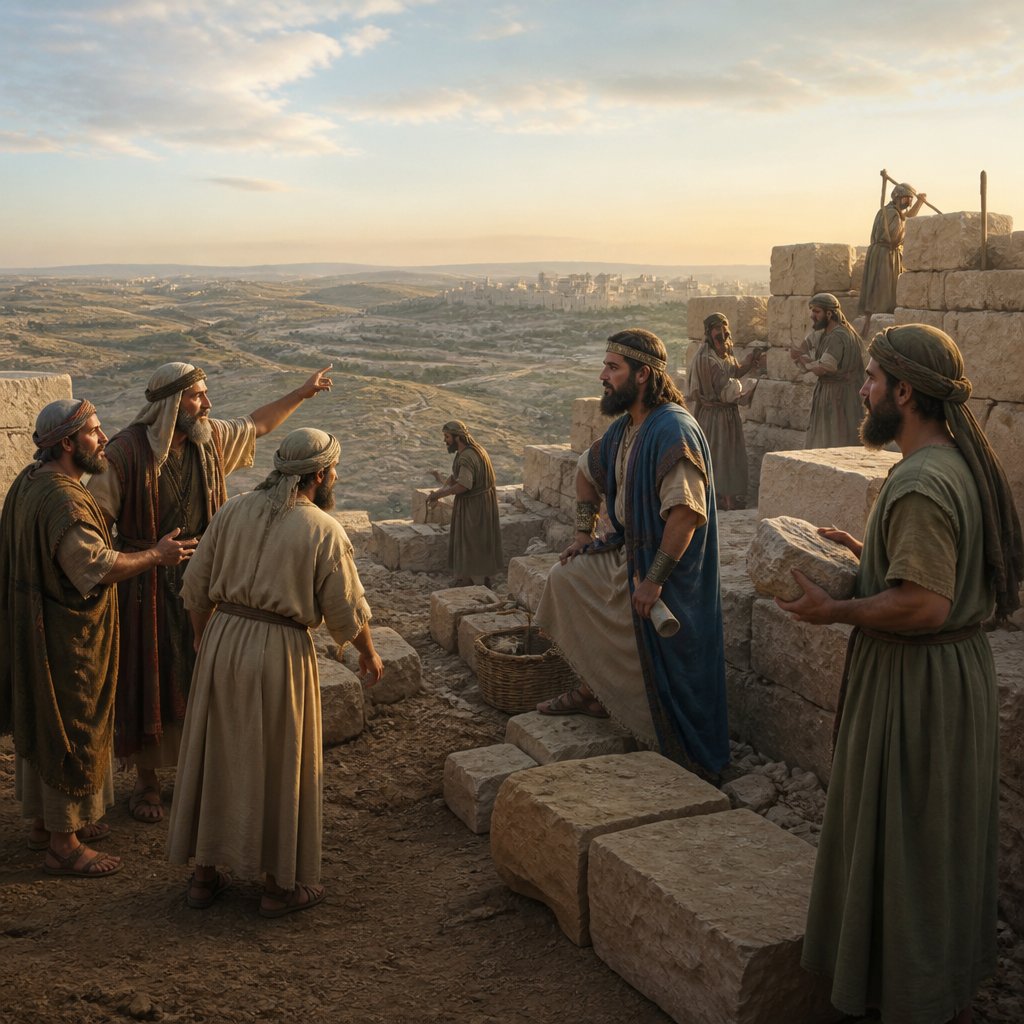
Nehemiah 4:12 in the King James Version (KJV) of the Bible reads, "And it came to pass, that, when the Jews which dwelt by them came, they said unto us ten times, From all places whence ye shall return unto us they will be upon you."
This verse comes from the book of Nehemiah, which is part of the Old Testament. The book of Nehemiah tells the story of a man named Nehemiah who was a cupbearer to the Persian king Artaxerxes. He received word that the walls of Jerusalem were in ruins, and he was burdened to do something about it. With the king's permission and support, Nehemiah returned to Jerusalem and led the people in rebuilding the city walls.
In Nehemiah 4:12, we see the Jews facing opposition as they work to rebuild the wall. The verse mentions that the Jews who lived nearby warned them ten times that their enemies would attack from all directions. Despite this warning, Nehemiah and the people continued to work diligently to rebuild the wall, trusting in God's protection and guidance.
One of the key themes in this verse is opposition and perseverance. The Jews faced external threats and intimidation from their neighbors, who attempted to discourage them from rebuilding the wall. However, Nehemiah and the people remained steadfast in their determination to complete the task at hand. This theme of perseverance in the face of opposition is a common motif throughout the Bible, reminding believers to remain steadfast in their faith and trust in God's provision, even in the midst of trials and challenges.
The context of this verse is important in understanding the significance of the Jews' situation. The city of Jerusalem had been destroyed, and the walls lay in ruins. This left the city vulnerable to attack and compromise. Nehemiah recognized the urgent need to rebuild the walls to protect the city and its inhabitants. However, the task was not without its challenges, as the Jews faced opposition and threats from their neighbors as they worked to rebuild.
The symbolism in this verse is significant as well. The warning from the Jews' neighbors can be seen as a representation of the spiritual battles that believers face. Just as the Jews were warned of impending attacks, Christians are also warned of the spiritual warfare that they will face as they seek to follow God's will and build up His kingdom. The threat of attack from all directions serves as a reminder that the enemy is always looking for ways to hinder and sabotage the work of God.
Despite the warning and the threats, Nehemiah and the people did not waver in their determination to rebuild the wall. Their commitment to the task and their reliance on God's strength and protection serves as an example for believers today. It is a reminder to press on in the face of opposition and to trust in God's faithfulness to see us through every trial and challenge.
In conclusion, Nehemiah 4:12 in the King James Version of the Bible conveys a powerful message of perseverance and trust in God's provision. The verse serves as an encouragement to believers to remain steadfast in their faith, even in the face of opposition and trials. It also serves as a reminder of the spiritual warfare that believers face, and the need to rely on God's strength and protection to see us through. The story of Nehemiah and the rebuilding of the wall serves as a timeless example of faith, determination, and reliance on God in the midst of adversity.
Get our apps


Artwork for Nehemiah 4:12

Nehemiah 4:12 - "And it came to pass, that when the Jews which dwelt by them came, they said unto us ten times, From all places whence ye shall return unto us they will be upon you."
"And it came to pass, that when the Jews which dwelt by them came, they said unto us ten times, From all places whence ye shall return unto us they will be upon you." - Nehemiah 4:12

Nehemiah 12:4 - "Iddo, Ginnetho, Abijah,"

"Iddo, Ginnetho, Abijah," - Nehemiah 12:4

Nehemiah 12:26 - "These were in the days of Joiakim the son of Jeshua, the son of Jozadak, and in the days of Nehemiah the governor, and of Ezra the priest, the scribe."

Nehemiah 12:5 - "Miamin, Maadiah, Bilgah,"

Nehemiah 12:33 - "And Azariah, Ezra, and Meshullam,"

Nehemiah 12:2 - "Amariah, Malluch, Hattush,"

Nehemiah 12:3 - "Shechaniah, Rehum, Meremoth,"

Nehemiah 10:12 - "Zaccur, Sherebiah, Shebaniah,"

Nehemiah 12:6 - "Shemaiah, and Joiarib, Jedaiah,"

Nehemiah 12:12 - "And in the days of Joiakim were priests, the chief of the fathers: of Seraiah, Meraiah; of Jeremiah, Hananiah;"

Nehemiah 4:6

Nehemiah 4:6

Nehemiah 12:13 - "Of Ezra, Meshullam; of Amariah, Jehohanan;"

Nehemiah 12:16 - "Of Iddo, Zechariah; of Ginnethon, Meshullam;"

Nehemiah 12:20 - "Of Sallai, Kallai; of Amok, Eber;"

Nehemiah 4:6

Nehemiah 12:19 - "And of Joiarib, Mattenai; of Jedaiah, Uzzi;"

Nehemiah 12:34 - "Judah, and Benjamin, and Shemaiah, and Jeremiah,"

Nehemiah 12:15 - "Of Harim, Adna; of Meraioth, Helkai;"

Nehemiah 12:18 - "Of Bilgah, Shammua; of Shemaiah, Jehonathan;"

Nehemiah 12:21 - "Of Hilkiah, Hashabiah; of Jedaiah, Nethaneel."

Nehemiah 12:14 - "Of Melicu, Jonathan; of Shebaniah, Joseph;"

Nehemiah 12:17 - "Of Abijah, Zichri; of Miniamin, of Moadiah, Piltai;"

Nehemiah 12:11 - "And Joiada begat Jonathan, and Jonathan begat Jaddua."

Nehemiah 10:4 - "Hattush, Shebaniah, Malluch,"

Nehemiah 7:12 - "The children of Elam, a thousand two hundred fifty and four."

Nehemiah 12:32 - "And after them went Hoshaiah, and half of the princes of Judah,"

"Miamin, Maadiah, Bilgah," - Nehemiah 12:5