What does Nehemiah 5:16 mean?
“Yea, also I continued in the work of this wall, neither bought we any land: and all my servants were gathered thither unto the work.” — Nehemiah 5:16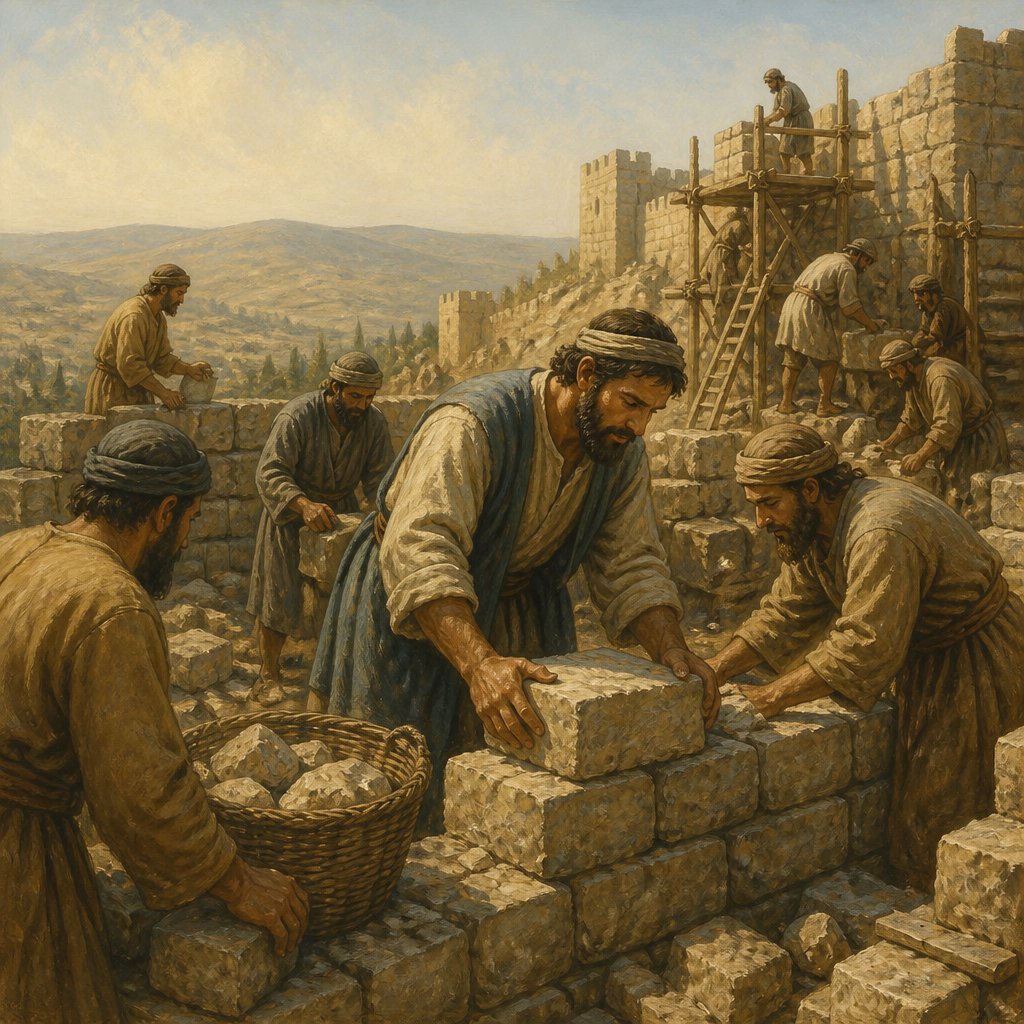
Nehemiah 5:16 in the King James Version of the Bible reads: "Yea, also I continued in the work of this wall, neither bought we any land: and all my servants were gathered thither unto the work."
The book of Nehemiah is a powerful and inspiring account of the leadership, faith, and determination of Nehemiah as he led the people of Israel in rebuilding the walls of Jerusalem after their return from exile. This verse is a reflection of Nehemiah's commitment to the work at hand and his integrity in managing affairs related to the project.
One of the key themes of this verse is the commitment to the work of the Lord. Nehemiah's dedication to the task of rebuilding the wall of Jerusalem is evident in his statement "I continued in the work of this wall." Despite facing opposition, conflict, and various challenges, Nehemiah remained steadfast in his commitment to seeing the project through to completion. This serves as a powerful example for believers today, to remain steadfast in the work that God has called them to, even in the face of adversity.
Furthermore, Nehemiah's refusal to buy any land during the project reflects his focus and commitment to the immediate task at hand. He avoided any distractions that would take his focus away from the work of God. This could also be interpreted as a demonstration of good stewardship, using resources wisely and responsibly to ensure the completion of the task to which he was called.
Additionally, the gathering of Nehemiah's servants to work on the wall reveals his leadership and organizational skills. He was able to rally and mobilize his team to work towards a common goal, and this speaks to his abilities as a leader and manager. This demonstrates the importance of leadership and teamwork in achieving the goals set before them.
In its broader context, the book of Nehemiah is not just a historical account of the restoration of the walls of Jerusalem, but it also serves as a powerful metaphor for spiritual renewal and rebuilding. The broken walls of Jerusalem symbolize the brokenness and vulnerability of the people of Israel, while the act of rebuilding signifies the restoration and renewal of their faith and identity. Nehemiah's leadership and dedication serve as a model for believers to follow in their own lives, as they seek to restore and renew their relationship with God.
Symbolically, the wall itself represents protection, security, and identity. In the same way, as believers, we are called to build up the walls of our faith and commitment to God, to protect ourselves from the attacks of the enemy and to stand firm in our identity as children of God. Nehemiah's unwavering commitment to the wall serves as a reminder to believers to fortify and strengthen their faith in God.
In conclusion, Nehemiah 5:16 is a powerful verse that reflects Nehemiah's commitment, integrity, and leadership in the work of rebuilding the walls of Jerusalem. It serves as a timeless example for believers today, to remain dedicated and steadfast in their faith and commitment to the work that God has called them to. It also speaks to the importance of good stewardship, leadership, and teamwork in achieving the goals set before us. Ultimately, the rebuilding of the walls of Jerusalem serves as a powerful metaphor for the spiritual renewal and restoration that believers are called to pursue in their own lives.
Get our apps


Artwork for Nehemiah 5:16

Nehemiah 5:16 - "Yea, also I continued in the work of this wall, neither bought we any land: and all my servants were gathered thither unto the work."
"Yea, also I continued in the work of this wall, neither bought we any land: and all my servants were gathered thither unto the work." - Nehemiah 5:16

Nehemiah 10:16 - "Adonijah, Bigvai, Adin,"

Nehemiah 12:16 - "Of Iddo, Zechariah; of Ginnethon, Meshullam;"

Nehemiah 10:5 - "Harim, Meremoth, Obadiah,"

Nehemiah 12:5 - "Miamin, Maadiah, Bilgah,"

Nehemiah 7:16 - "The children of Bebai, six hundred twenty and eight."

"Adonijah, Bigvai, Adin," - Nehemiah 10:16

Nehemiah 3:16 - "After him repaired Nehemiah the son of Azbuk, the ruler of the half part of Beth-zur, unto the place over against the sepulchres of David, and to the pool that was made, and unto the house of the mighty."

Nehemiah 9:16 - "But they and our fathers dealt proudly, and hardened their necks, and hearkened not to thy commandments,"

"Of Iddo, Zechariah; of Ginnethon, Meshullam;" - Nehemiah 12:16

Nehemiah 5:1 - "And there was a great cry of the people and of their wives against their brethren the Jews."

Nehemiah 11:16 - "And Shabbethai and Jozabad, of the chief of the Levites, had the oversight of the outward business of the house of God."

"Harim, Meremoth, Obadiah," - Nehemiah 10:5

"Miamin, Maadiah, Bilgah," - Nehemiah 12:5

Nehemiah 5:6 - "¶ And I was very angry when I heard their cry and these words."

Nehemiah 3:5 - "And next unto them the Tekoites repaired; but their nobles put not their necks to the work of their Lord."

"The children of Bebai, six hundred twenty and eight." - Nehemiah 7:16

Nehemiah 5:19 - "Think upon me, my God, for good, according to all that I have done for this people."

Nehemiah 5:4 - "There were also that said, We have borrowed money for the king's tribute, and that upon our lands and vineyards."

Nehemiah 13:16 - "There dwelt men of Tyre also therein, which brought fish, and all manner of ware, and sold on the sabbath unto the children of Judah, and in Jerusalem."

Nehemiah 6:5 - "Then sent Sanballat his servant unto me in like manner the fifth time with an open letter in his hand;"

Nehemiah 4:5 - "And cover not their iniquity, and let not their sin be blotted out from before thee: for they have provoked thee to anger before the builders."

Nehemiah 11:5 - "And Maaseiah the son of Baruch, the son of Col-hozeh, the son of Hazaiah, the son of Adaiah, the son of Joiarib, the son of Zechariah, the son of Shiloni."

"And there was a great cry of the people and of their wives against their brethren the Jews." - Nehemiah 5:1

A biblical scene from Nehemiah 1:5-11 - Nehemiah, a Caucasian male in middle-eastern garb, is depicted respectfully requesting time from the king, a Middle-Eastern male seated at the dinner table while Nehemiah is serving his drink. He is asking for the opportunity to return to Judah and help his people build a wall. The setting is a grand royal court marked by golden hues, opulent textiles, and architecturally rich columns.

"But they and our fathers dealt proudly, and hardened their necks, and hearkened not to thy commandments," - Nehemiah 9:16

Nehemiah 5:3 - "Some also there were that said, We have mortgaged our lands, vineyards, and houses, that we might buy corn, because of the dearth."

Nehemiah 5:9 - "Also I said, It is not good that ye do: ought ye not to walk in the fear of our God because of the reproach of the heathen our enemies?"

Nehemiah 8:5 - "And Ezra opened the book in the sight of all the people; (for he was above all the people;) and when he opened it, all the people stood up:"