What does Psalms 110:3 mean?
“Thy people shall be willing in the day of thy power, in the beauties of holiness from the womb of the morning: thou hast the dew of thy youth.” — Psalms 110:3
``Thy people shall be willing in the day of thy power, in the beauties of holiness from the womb of the morning: thou hast the dew of thy youth.''
Psalm 110:3 is a powerful and enigmatic verse that speaks to the willingness of the people to follow and serve God in the day of His power. This verse is part of a larger psalm that is attributed to King David and is known for its Messianic implications. The verse is rich in themes of obedience, holiness, and the eternal reign of God.
The psalm begins with the famous declaration, "The Lord said to my Lord, 'Sit at my right hand, until I make your enemies your footstool'", which is quoted in the New Testament multiple times and is understood to be a reference to Jesus as the coming Messiah. Therefore, this psalm is often interpreted as a prophetic revelation of the reign and power of Christ.
In verse 3, the imagery of "the beauties of holiness from the womb of the morning" conjures a vivid and poetic picture of the people willingly submitting to God's power. The phrase "the womb of the morning" suggests a new beginning, a fresh start, and a renewal of life. This imagery conveys the idea that in the dawn of each new day, the people are filled with a sense of awe and reverence for God's holiness and power. The mention of "the beauties of holiness" reinforces the idea that God's power and authority are not just to be feared, but also admired and revered for their moral and spiritual beauty.
It is also significant that the verse speaks of "the day of thy power", indicating a specific moment in time when God's authority and sovereignty will be fully revealed. This could be seen as referring to the Second Coming of Christ, a day when all will recognize and acknowledge His divine authority. In that day, the people will willingly and eagerly follow Him, recognizing His holiness and righteousness as the epitome of beauty and truth.
The phrase "thou hast the dew of thy youth" is also rich in symbolism. Dew is often used in the Bible to represent blessings, refreshment, and fertility. In this context, it could symbolize the eternal youth and vitality of God's power. It suggests that His power is always fresh, always new, and always potent, never fading or diminishing. This reinforces the idea that the people's willingness to follow Him is not based on coercion or fear, but is a result of the continual and ever-renewing nature of God's power and presence.
The themes of obedience, holiness, and the eternal reign of God are central to this verse. It speaks to the willing submission of the people to God's power, not out of compulsion, but out of admiration and reverence for His holiness. It also points to the timeless and unchanging nature of God's authority, as well as the promise of a future day when His power will be fully and universally recognized.
In the broader context of the psalm, this verse is a powerful declaration of the sovereignty and majesty of God, as well as a prophetic announcement of the coming Messiah. It is a call to worship and a reminder of the eternal nature of God's reign. Overall, Psalm 110:3 is a beautiful and profound expression of the awe-inspiring nature of God's power and the willing obedience of His people.
Get our apps


Artwork for Psalms 110:3

Psalms 110:3 - "Thy people shall be willing in the day of thy power, in the beauties of holiness from the womb of the morning: thou hast the dew of thy youth."

"Thy people shall be willing in the day of thy power, in the beauties of holiness from the womb of the morning: thou hast the dew of thy youth." - Psalms 110:3

Psalms 110:4 - "The LORD hath sworn, and will not repent, Thou art a priest for ever after the order of Melchizedek."

Psalms 110:7 - "He shall drink of the brook in the way: therefore shall he lift up the head."

Psalms 119:110 - "The wicked have laid a snare for me: yet I erred not from thy precepts."

Psalms 110:5 - "The Lord at thy right hand shall strike through kings in the day of his wrath."

Psalms 110:2 - "The LORD shall send the rod of thy strength out of Zion: rule thou in the midst of thine enemies."

Psalms 110:6 - "He shall judge among the heathen, he shall fill the places with the dead bodies; he shall wound the heads over many countries."

Psalms 110:1 - "The LORD said unto my Lord, Sit thou at my right hand, until I make thine enemies thy footstool."

"The LORD said unto my Lord, Sit thou at my right hand, until I make thine enemies thy footstool." - Psalms 110:1

"The wicked have laid a snare for me: yet I erred not from thy precepts." - Psalms 119:110

"He shall drink of the brook in the way: therefore shall he lift up the head." - Psalms 110:7

"He shall judge among the heathen, he shall fill the places with the dead bodies; he shall wound the heads over many countries." - Psalms 110:6

"The LORD hath sworn, and will not repent, Thou art a priest for ever after the order of Melchizedek." - Psalms 110:4

"The Lord at thy right hand shall strike through kings in the day of his wrath." - Psalms 110:5

"The LORD shall send the rod of thy strength out of Zion: rule thou in the midst of thine enemies." - Psalms 110:2
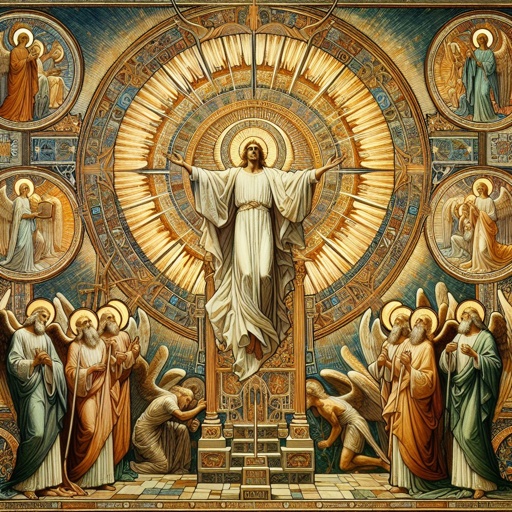
Psalms 111:3 - "His work is honourable and glorious: and his righteousness endureth for ever."
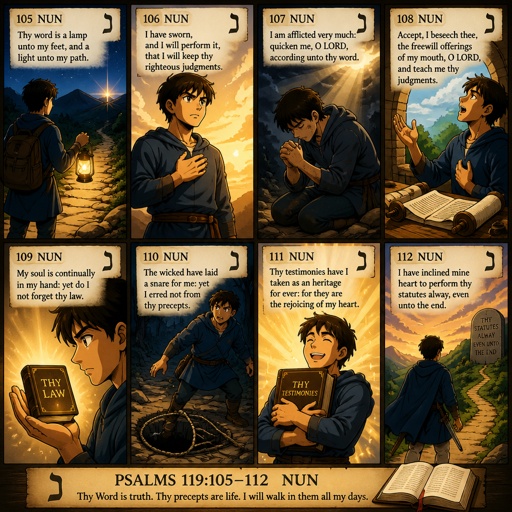
Psalms 119:105 NUN. Thy word is a lamp unto my feet, and a light unto my path. Psalms 119:106 I have sworn, and I will perform it, that I will keep thy righteous judgments. Psalms 119:107 I am afflicted very much: quicken me, O LORD, according unto thy word. Psalms 119:108 Accept, I beseech thee, the freewill offerings of my mouth, O LORD, and teach me thy judgments. Psalms 119:109 My soul is continually in my hand: yet do I not forget thy law. Psalms 119:110 The wicked have laid a snare for me: yet I erred not from thy precepts. Psalms 119:111 Thy testimonies have I taken as an heritage for ever: for they are the rejoicing of my heart. Psalms 119:112 I have inclined mine heart to perform thy statutes alway, even unto the end.

Psalms 88:3 - "For my soul is full of troubles: and my life draweth nigh unto the grave."

Psalms 103:3 - "Who forgiveth all thine iniquities; who healeth all thy diseases;"

Psalms 87:3 - "Glorious things are spoken of thee, O city of God. Selah."

Psalms 116:3 - "The sorrows of death compassed me, and the pains of hell gat hold upon me: I found trouble and sorrow."

"The sea saw it, and fled: Jordan was driven back." - Psalms 114:3

Psalms 67:3 - "Let the people praise thee, O God; let all the people praise thee."

Psalms 138:3 - "In the day when I cried thou answeredst me, and strengthenedst me with strength in my soul."

"There is no speech nor language, where their voice is not heard." - Psalms 19:3

"Great is the LORD, and greatly to be praised; and his greatness is unsearchable." - Psalms 145:3

"He healeth the broken in heart, and bindeth up their wounds." - Psalms 147:3

"Lo, children are an heritage of the LORD: and the fruit of the womb is his reward." - Psalms 127:3

"Let the house of Aaron now say, that his mercy endureth for ever." - Psalms 118:3