What does Song of Solomon 2:4 mean?
“He brought me to the banqueting house, and his banner over me was love.” — Song of Solomon 2:4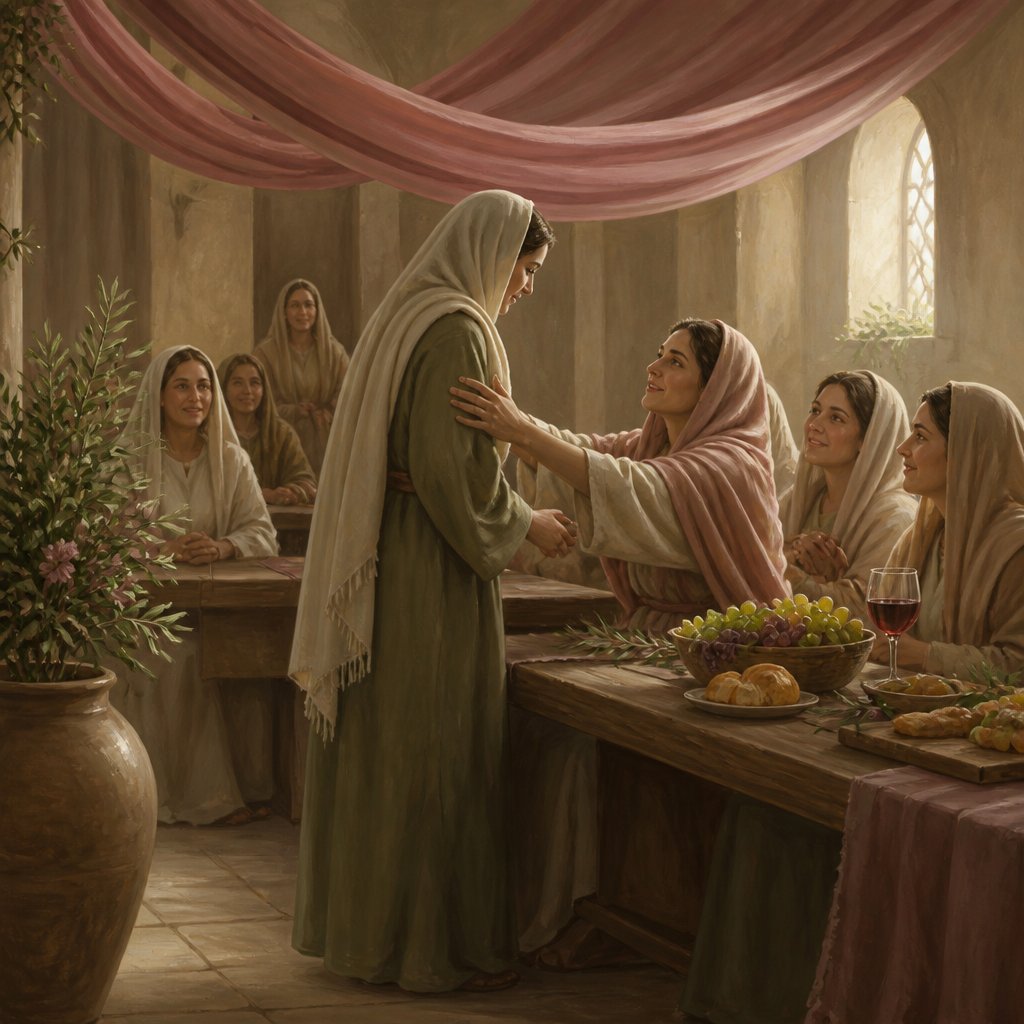
“Song of Songs 2:4” in the King James Version reads, “He brought me to the banqueting house, and his banner over me was love.”
In its immediate setting within the Song, this line is spoken in the voice of the bride as she recounts what her beloved has done for her. The surrounding verses (Song 2:3–5) keep the scene intimate and vivid: she delights in his presence like one who sits under a fruitful tree’s shade, she is refreshed by the “flagons” and “apples” of love, and she confesses herself “sick of love,” overwhelmed not with illness but with desire and longing. Verse 4 stands as the center of that experience: he brings her in, he hosts her, and he places over her a public sign that defines what she is to him.
The “banqueting house” is the place of feasting, welcome, and abundance. In a love poem, it suggests more than a literal dining room. It evokes the idea of being received into the beloved’s provision and delight—an invitation into a space where love is not merely whispered privately but expressed in tangible generosity. The beloved does not meet her only at the threshold or in secrecy; he “brought” her in. The verb is personal and active, emphasizing initiative and care. She is not depicted as forcing entry or earning her place at the table; she is led there. The mood is celebratory and secure: love here is not bare survival, but communion, pleasure, and fullness.
The second clause adds the verse’s most striking image: “his banner over me was love.” A banner in Scripture and in the world of ancient imagery functions as a lifted standard—a sign visible over a people, an emblem of identity, a declaration of allegiance and protection. It can mark who belongs to whom, where one stands, and under what name one gathers. In the Song’s romantic frame, the banner communicates that his love is not only an inward feeling but an outward claim. Over her—covering, identifying, and, in a sense, guarding her—is not shame, not coercion, not mere passion, but “love.” The beloved’s “banner” signals that the relationship is defined by love as its ruling principle, the name written over the whole encounter.
The symbolism also carries a paradox that deepens the verse. A banner is often associated with battle, ranks, and public conflict, yet here it is associated with a feast and intimacy. The Song fuses these worlds to say that love is both celebratory and strong. The bride is not only entertained; she is also, in a manner of speaking, gathered and kept. The “over me” language suggests covering and belonging—an atmosphere under which she can rest. Love is portrayed as something that can be “over” a person like a canopy or standard, shaping the space around them, declaring their safety and status.
Within the Song of Songs as a whole, this verse contributes to the book’s recurring themes of mutual desire, delight, and the goodness of love expressed without embarrassment. The bride’s voice is not muted; she testifies to what has been done for her and what she experiences. The relationship is pictured as a movement from longing to nearness, from seeking to being brought in. The setting of a banquet anticipates the Song’s repeated emphasis on fragrance, taste, and beauty—love that engages the whole person and is experienced as richness, not as mere duty.
For readers who approach the Song not only as human romance but also as Scripture that has long been read with spiritual resonance, the verse has commonly been understood as depicting the gracious welcome of the Beloved toward the beloved soul, and, in Christian reading, Christ’s love toward His people. In that light, “He brought me” suggests divine initiative; the “banqueting house” suggests fellowship and joy in His presence; and the “banner” suggests a name and claim placed upon the believer that is fundamentally love. Even without leaving the KJV’s wording, the verse’s structure supports such an understanding: the action begins with “He,” and what is placed “over” the speaker is not threat but love.
The significance of Song of Songs 2:4, then, lies in how it compresses an entire theology of love into one poetic moment. Love is shown as inviting rather than excluding, abundant rather than stingy, public in its declaration rather than merely private in its emotion, and strong enough to be called a banner—something that can be lifted high, recognized, and trusted. The bride’s memory of being brought into the banqueting house and living under the banner of love becomes a picture of belonging: not simply being near the beloved, but being received, named, and encompassed by love itself.
Get our apps


Artwork for Song of Solomon 2:4

Song of Solomon 2:4 - "He brought me to the banqueting house, and his banner over me was love."
"He brought me to the banqueting house, and his banner over me was love." - Song of Solomon 2:4
!["He brought me to the banqueting house, and his banner over me [was] love." - Song of Solomon 2:4](https://media.bible.art/bd0457ec-32cc-4654-9106-4fc12fea703b-thumbnail.jpg)
"He brought me to the banqueting house, and his banner over me [was] love." - Song of Solomon 2:4

Song of Solomon 2:3

Song of Solomon 2:15

Song of Solomon 2:15

Song of Solomon 1:4

Song of Solomon 3:4

Song of Solomon 1:4

Song of Solomon 2:2 - "As the lily among thorns, so is my love among the daughters."

Song of Solomon 2:11 - "For, lo, the winter is past, the rain is over and gone;"

Song of Solomon 2:1 - "I am the rose of Sharon, and the lily of the valleys."

Song of Solomon 2:5 - "Stay me with flagons, comfort me with apples: for I am sick of love."

Song of Solomon 2:16 - "¶ My beloved is mine, and I am his: he feedeth among the lilies."

Song of Solomon 2:6 - "His left hand is under my head, and his right hand doth embrace me."

Song of Solomon 2:8 - "¶ The voice of my beloved! behold, he cometh leaping upon the mountains, skipping upon the hills."

Song of Solomon 2:10 - "My beloved spake, and said unto me, Rise up, my love, my fair one, and come away."

Song of Solomon 2:15 - "Take us the foxes, the little foxes, that spoil the vines: for our vines have tender grapes."

Song of Solomon 2:1 – "I am a rose of Sharon, a lily of the valleys."

"I am the rose of Sharon, and the lily of the valleys." - Song of Solomon 2:1

Song of Solomon 4:13 - "Thy plants are an orchard of pomegranates, with pleasant fruits; camphire, with spikenard,"

Song of Solomon 4:7 - "Thou art all fair, my love; there is no spot in thee."

Song of Solomon 4:15 - "A fountain of gardens, a well of living waters, and streams from Lebanon."

Song of Solomon 4:2 - "Thy teeth are like a flock of sheep that are even shorn, which came up from the washing; whereof every one bear twins, and none is barren among them."

Songs of Solomon 1:2

"As the lily among thorns, so is my love among the daughters." - Song of Solomon 2:2

"For, lo, the winter is past, the rain is over and gone;" - Song of Solomon 2:11

"I am the rose of Sharon, and the lily of the valleys." - Song of Solomon 2:1

"¶ My beloved is mine, and I am his: he feedeth among the lilies." - Song of Solomon 2:16

Song of Solomon 4:4 - "Thy neck is like the tower of David builded for an armoury, whereon there hang a thousand bucklers, all shields of mighty men."