The Altar of Our Hearts: Choosing the Right Fire
“And Elijah said unto the prophets of Baal, Choose you one bullock for yourselves, and dress it first; for ye are many; and call on the name of your gods, but put no fire under.” — 1 Kings 18:25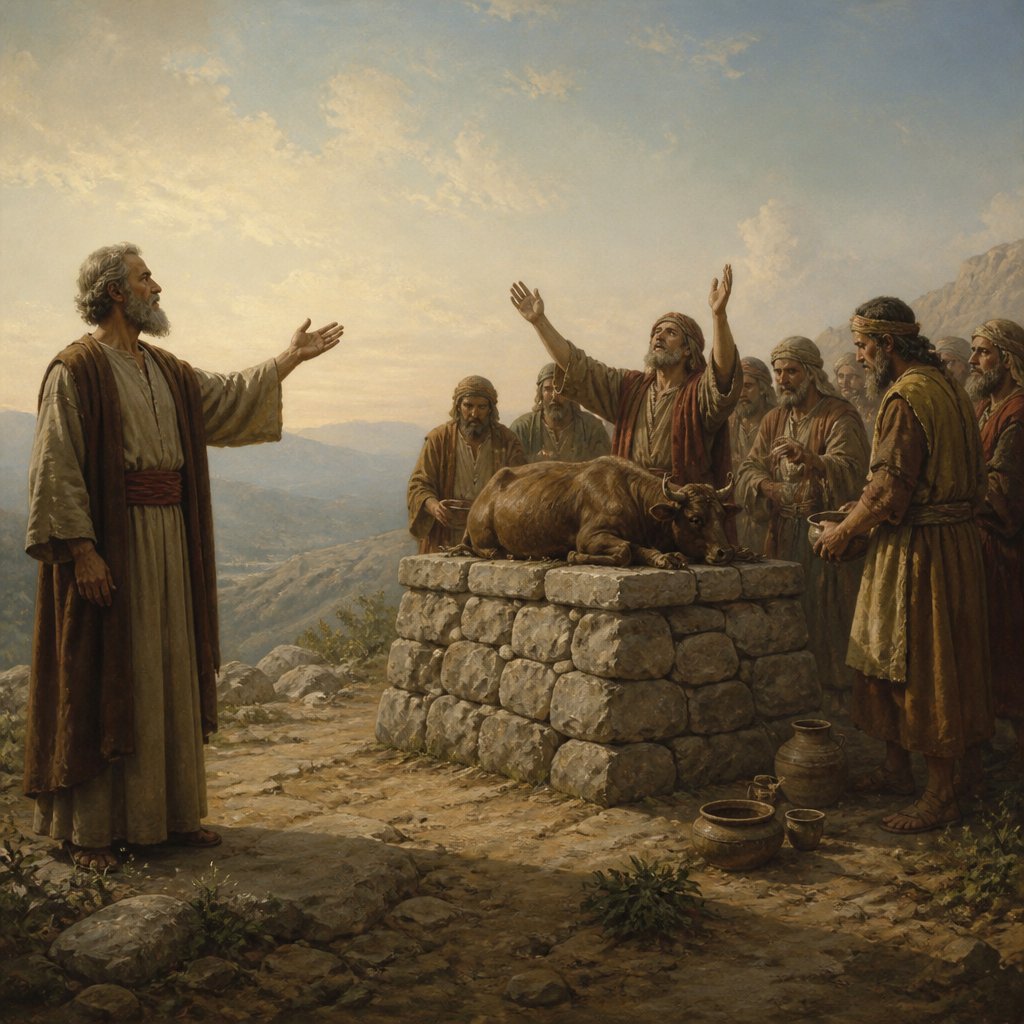
In 1 Kings 18:25, we encounter a powerful moment in the prophetic ministry of Elijah: "And Elijah said unto the prophets of Baal, Choose you one bullock for yourselves, and dress it first; for ye are many; and call on the name of your gods, but put no fire under." This verse is nestled within the dramatic narrative of Mount Carmel, where the battle of faith is depicted between the one true God of Israel and the false god Baal.
The context here is deeply significant. Israel was in spiritual turmoil; they worshipped Baal, a false god who represented fertility and prosperity, rather than the Lord God Almighty. The decision to confront the prophets of Baal by Elijah was not only a challenge to their belief system but also a call for the people of Israel to rethink whom they chose to serve. In doing so, we uncover critical lessons applicable in our modern journey of faith.
**The Choice of Sacrifice**
When Elijah instructs the prophets of Baal to choose a bullock and dress it, he places the emphasis on the sacrificial act. Each bullock represents something of value—our sacrifices, our priorities, and the offerings we lay before the Lord. What do we choose to place on the altar of our lives? In the faces of competing priorities and beliefs, our response to this question reveals much about our allegiance. The bullock signifies not just a choice but an intentional act of worship, drawing attention to how significant the object of our devotion may be.
When the prophets were to “call on the name of your gods,” this highlights a pivotal action: the act of invocation, of seeking. What names do we call upon in our times of crisis or need? Are they the names of social media, money, relationships, or perhaps distractions that lure us away from the core of our faith? In this moment, we witness the intensity of their dedication: they cried out, they danced, they cut themselves as part of their fervent devotion. Yet despite their passionate endeavors, nothing happened.
**The Absence of Fire**
The instruction to “put no fire under” takes on profound implications. Fire symbolizes the divine presence, God’s action, and the power of change. In choosing not to ignite their own fire, the prophets of Baal were left with the cold reality of their empty prayers and futile efforts. This absence of fire serves as a metaphor for a life devoid of God’s Spirit—a life where all religious activity exists but lacks true substance and transformation.
As believers today, we often find ourselves in the throes of spiritual enthusiasm. However, are we inviting the right fire into our lives, or are we merely performing? Are we consumed with the activity of worship while neglecting the presence of God? God desires our hearts dressed in worship, but He also yearns for them to be ignited with His love, a passion that transcends mere ritualistic practices.
**Turning Our Hearts Back**
Ultimately, the challenge of Elijah to the prophets—and to us—is a clarion call to evaluate our commitments and loyalties in the face of competing ideologies and distractions. The subsequent events on Mount Carmel further illuminate God’s response to Elijah’s fervent prayer, where fire from heaven consumed the sacrifice, restoring the people’s hearts back to God.
As we reflect on this powerful narrative, consider what you have placed upon the altar of your heart. Are there bullocks of doubt, pride, or self-reliance that you need to address? Are you allowing the divine fire of God’s presence to consume those areas? In every situation, may we proclaim the supremacy of our Lord and seek His transforming power. Let us walk in the light of the Holy Spirit, ensuring that our lives burn brightly amid the shadows of falsehood, so that when we call, it is the one true God we invoke.
May we, like Elijah, challenge the status quo, understand the depth of our sacrifices, and earnestly seek the fire that ignites our faith with life and purpose.
Get our apps


Artwork for 1 Kings 18:25

1 Kings 18:25 - "And Elijah said unto the prophets of Baal, Choose you one bullock for yourselves, and dress it first; for ye are many; and call on the name of your gods, but put no fire under."
"And Elijah said unto the prophets of Baal, Choose you one bullock for yourselves, and dress it first; for ye are many; and call on the name of your gods, but put no fire under." - 1 Kings 18:25

Genesis 18:25

2 Kings 25:18 - "¶ And the captain of the guard took Seraiah the chief priest, and Zephaniah the second priest, and the three keepers of the door:"

Jeremiah 25:18 - "To wit, Jerusalem, and the cities of Judah, and the kings thereof, and the princes thereof, to make them a desolation, an astonishment, an hissing, and a curse; as it is this day;"

1 Kings 19:1-18

2 Kings 18:25 - "Am I now come up without the LORD against this place to destroy it? The LORD said to me, Go up against this land, and destroy it."
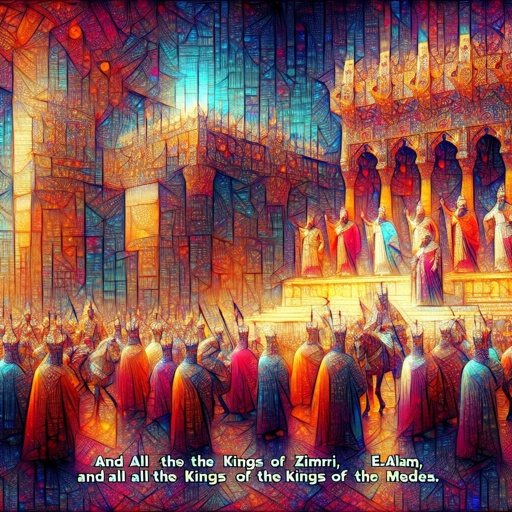
Jeremiah 25:25 - "And all the kings of Zimri, and all the kings of Elam, and all the kings of the Medes,"

1 Kings 4:18 - "Shimei the son of Elah, in Benjamin:"

1 Kings 9:18 - "And Baalath, and Tadmor in the wilderness, in the land,"

2 Kings 1:18 - "Now the rest of the acts of Ahaziah which he did, are they not written in the book of the chronicles of the kings of Israel?"

1 Kings 1:18 - "And now, behold, Adonijah reigneth; and now, my lord the king, thou knowest it not:"

1 Chronicles 25:18 - "The eleventh to Azareel, he, his sons, and his brethren, were twelve:"

1 Kings 3:25 - "And the king said, Divide the living child in two, and give half to the one, and half to the other."

1 Kings 14:25 - "¶ And it came to pass in the fifth year of king Rehoboam, that Shishak king of Egypt came up against Jerusalem:"

1 Kings 10:18 - "¶ Moreover the king made a great throne of ivory, and overlaid it with the best gold."

1 Kings 6:25 - "And the other cherub was ten cubits: both the cherubims were of one measure and one size."

2 Kings 25:1 show King Nebuchadnezzar in war zone

2 Kings 25:1 show King Nebuchadnezzar and the army and the Temple

1 Kings 2:25 - "And king Solomon sent by the hand of Benaiah the son of Jehoiada; and he fell upon him that he died."

1 Kings 2:18 - "And Bath-sheba said, Well; I will speak for thee unto the king."

1 Kings 16:25 - "¶ But Omri wrought evil in the eyes of the LORD, and did worse than all that were before him."

Elijah in the scene 1 Kings 18:36–38

"And all the kings of Zimri, and all the kings of Elam, and all the kings of the Medes," - Jeremiah 25:25

1 Kings 18:2 - "And Elijah went to shew himself unto Ahab. And there was a sore famine in Samaria."

1 Kings 12:25 - "¶ Then Jeroboam built Shechem in mount Ephraim, and dwelt therein; and went out from thence, and built Penuel."

1 Kings 18:35 - "And the water ran round about the altar; and he filled the trench also with water."

1 Kings 18:11 - "And now thou sayest, Go, tell thy lord, Behold, Elijah is here."

1 Kings 18:18 - "And he answered, I have not troubled Israel; but thou, and thy father's house, in that ye have forsaken the commandments of the LORD, and thou hast followed Baalim."

"Shimei the son of Elah, in Benjamin:" - 1 Kings 4:18