The Transforming Power of Faith: A Lesson from Elisha's Pot
“But he said, Then bring meal. And he cast it into the pot; and he said, Pour out for the people, that they may eat. And there was no harm in the pot.” — 2 Kings 4:41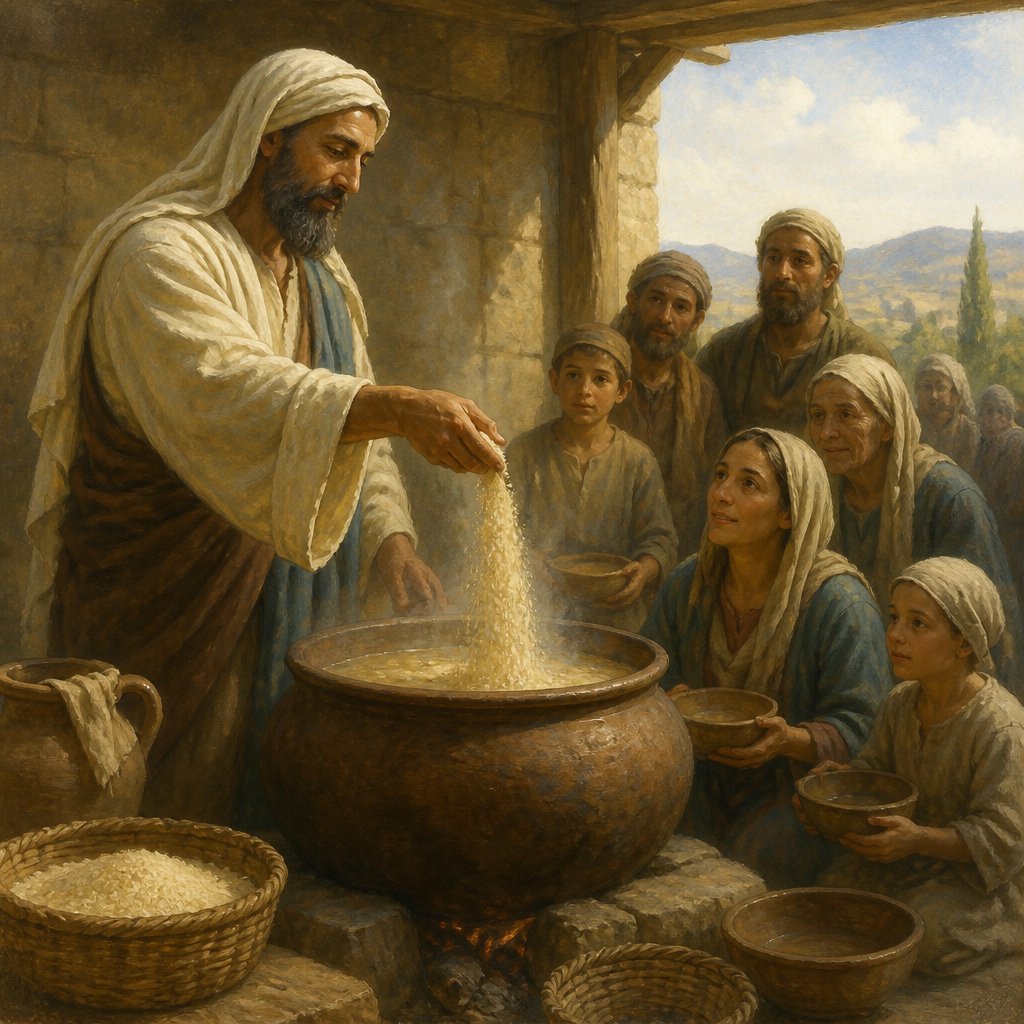
In the realm of biblical miracles, few stories resonate with profound simplicity and depth like the account of Elisha and the poisoned stew in 2 Kings 4:41. The verse states, "But he said, Then bring meal. And he cast it into the pot; and he said, Pour out for the people, that they may eat. And there was no harm in the pot." This narrative encapsulates the essence of faith, God's provision, and the miraculous transformation possible when we surrender our limitations to the Divine.
To grasp the significance of this event, we must first understand the context of Elisha's ministry. Elisha succeeded Elijah as a prophet in Israel, inheriting not only the mantle of prophetic authority but also the responsibility to guide God’s people through tumultuous times. He was a beacon of hope and a vessel of miraculous works. In this particular episode, Elisha encounters a dire situation; the members of a community of prophets are suffering from a deadly stew, tainted by wild gourds. This was a moment filled with desperation, reflecting the human condition when faced with seemingly insurmountable challenges.
Elisha’s response, however, is strikingly different from that of a typical leader who would offer comfort or lament the circumstances. Instead, he asks for meal to be brought to him. This ingredient, so mundane in its own right, symbolizes faith and obedience to God's wisdom. The act of bringing meal is an implicit acknowledgment of God’s ability to intervene and transform our dire situations. It encourages us to bring what we have—our resources, our skills, and our faith—into God’s hands, trusting Him to use it for His glory.
Upon receiving the meal, Elisha casts it into the pot. This action is both literal and metaphorical. In casting the meal, he infuses the contaminated stew with something pure and wholesome, reminding us that God’s intervention can cleanse and redeem even the most toxic of circumstances in our lives. This underlines a crucial theological principle: that God can transform the poisonous ingredients of our failures, fears, and shortcomings through His miraculous grace. It teaches us that what appears hopeless in our human sight can be redeemed by divine intervention if we only bring it to the Lord in faith.
When Elisha commands, "Pour out for the people, that they may eat," we witness not just a miracle for the few but a provision for the many. God’s grace is abundant and communal in nature. It serves to nourish those around us, emphasizing that when we experience personal transformation, it doesn’t just stop with us; it spreads to our community. Therefore, as believers, we are called to be conduits of God’s blessing, sharing the transformative power of His love and provision with those who find themselves in spiritual or physical want.
The closing statement of our verse, "And there was no harm in the pot," speaks volumes of assurance and deliverance. It signifies not only the absence of poison in the stew but also the safety and salvation found in God’s promises. It invites us to trust in His sovereign nature and the reality that God can nullify the effects of our past mistakes and the bitterness of our trials when we lay them before Him.
In our lives today, we often come across bitter pots—of failure, trauma, or sin. The call is to bring a "meal" to those pots; the meal can be our faith, our prayer, or our willingness to serve. In doing so, we can expect God’s miraculous touch. Let us remember that Elisha’s act of faith transformed poisoned stew into nourishment. Similarly, our faith, rooted in God’s promises, can bring healing, wholeness, and restoration in all circumstances, proving once again that nothing is beyond the reach of God’s redemptive hand.
Get our apps


Artwork for 2 Kings 4:41

2 Kings 4:41 - "But he said, Then bring meal. And he cast it into the pot; and he said, Pour out for the people, that they may eat. And there was no harm in the pot."
"But he said, Then bring meal. And he cast it into the pot; and he said, Pour out for the people, that they may eat. And there was no harm in the pot." - 2 Kings 4:41

1 Kings 2:41 - "And it was told Solomon that Shimei had gone from Jerusalem to Gath, and was come again."

1 Kings 4:1 - "So king Solomon was king over all Israel."

"So king Solomon was king over all Israel." - 1 Kings 4:1

2 Kings 17:41 - "So these nations feared the LORD, and served their graven images, both their children, and their children's children: as did their fathers, so do they unto this day."

2 Kings 4:4-5

2 Kings 4:1 - "Now there cried a certain woman of the wives of the sons of the prophets unto Elisha, saying, Thy servant my husband is dead; and thou knowest that thy servant did fear the LORD: and the creditor is come to take unto him my two sons to be bondmen."

"And it was told Solomon that Shimei had gone from Jerusalem to Gath, and was come again." - 1 Kings 2:41

Mark 4:41

Mark 4:41

Mark 4:41

Mark 4:41

2 Kings 10:4 - "But they were exceedingly afraid, and said, Behold, two kings stood not before him: how then shall we stand?"

Mark 4:35-41

1 Kings 22:41 - "¶ And Jehoshaphat the son of Asa began to reign over Judah in the fourth year of Ahab king of Israel."

Isaiah 41:2 - "Who raised up the righteous man from the east, called him to his foot, gave the nations before him, and made him rule over kings? he gave them as the dust to his sword, and as driven stubble to his bow."

2 Kings 4:11 - "And it fell on a day, that he came thither, and he turned into the chamber, and lay there."

1 Kings 4:2 - "And these were the princes which he had; Azariah the son of Zadok the priest,"

Acts 2:41

2 Kings 6:4 - "So he went with them. And when they came to Jordan, they cut down wood."

2 Kings 9:4 - "¶ So the young man, even the young man the prophet, went to Ramoth-gilead."

1 Kings 18:41 - "¶ And Elijah said unto Ahab, Get thee up, eat and drink; for there is a sound of abundance of rain."

1 Kings 11:41 - "¶ And the rest of the acts of Solomon, and all that he did, and his wisdom, are they not written in the book of the acts of Solomon?"

1 Kings 20:41 - "And he hasted, and took the ashes away from his face; and the king of Israel discerned him that he was of the prophets."

Deuteronomy 4:41 - "¶ Then Moses severed three cities on this side Jordan toward the sunrising;"

John 4:41 - "And many more believed because of his own word;"

2 Kings 4:15 - "And he said, Call her. And when he had called her, she stood in the door."

2 Kings 16:4 - "And he sacrificed and burnt incense in the high places, and on the hills, and under every green tree."

2 Kings 4:33 - "He went in therefore, and shut the door upon them twain, and prayed unto the LORD."