What does 2 Kings 4:41 mean?
“But he said, Then bring meal. And he cast it into the pot; and he said, Pour out for the people, that they may eat. And there was no harm in the pot.” — 2 Kings 4:41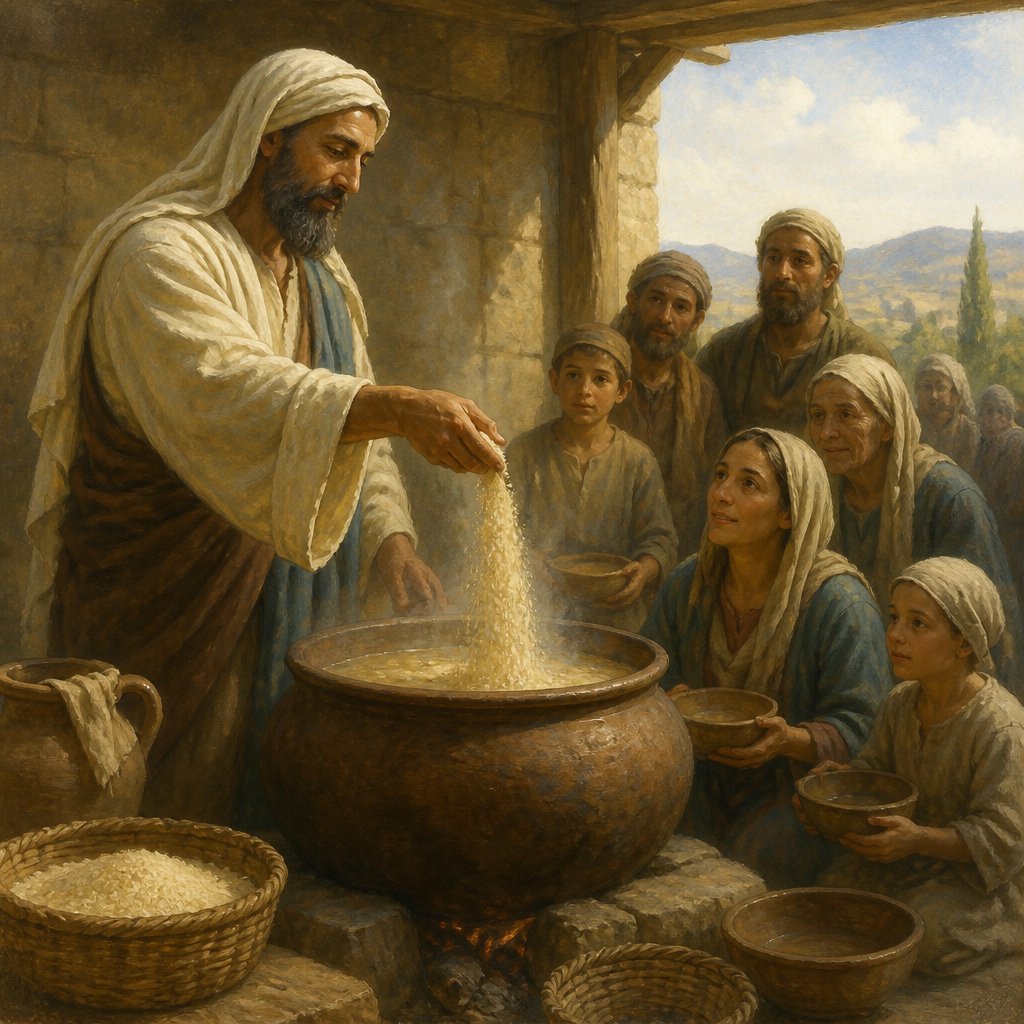
2 Kings 4:41 (KJV) "But he said, Then bring meal. And he cast it into the pot; and he said, Pour out for the people, that they may eat. And there was no harm in the pot."
This verse comes from the Old Testament Book of 2 Kings, which chronicles the history of the kings of Israel and Judah. The specific context of this verse is the story of Elisha, a prophet who performed numerous miracles during his ministry. In this particular story, a pot of stew has been poisoned with a harmful substance, causing those who ate it to become ill. In response, Elisha instructs his servant to bring meal (flour) and cast it into the pot, after which he tells the people to pour out the stew and eat it, assuring them that there will be no harm in it.
This verse is significant on a number of levels, and it offers several key themes and interpretations that can be applied to both the historical and spiritual aspects of the text. One of the central themes of this verse is the idea of restoration and transformation. The poison in the pot represents a harmful and destructive element that threatens the well-being of the people. However, through the intervention of Elisha and the addition of the meal, the harmful substance is neutralized and the food becomes safe to eat. This can be seen as a metaphor for how God has the power to redeem and restore what has been tainted or corrupted in our lives. In the same way that the meal transformed the stew, God has the ability to transform our pain, suffering, and brokenness into something good and wholesome, ultimately bringing about healing and wholeness.
Another important theme in this verse is the abundance of God's provision. Despite the initial contamination of the stew, there is enough meal to purify it and provide sustenance for the people. This speaks to the idea that God's resources are abundant and more than sufficient to meet our needs. It also emphasizes the idea of God's grace and mercy in the face of adversity. Even when we encounter difficulties and challenges, God is able to provide a way out and supply us with what we need to overcome.
From a symbolic perspective, the meal that Elisha casts into the pot can be seen as a representation of God's Word. Throughout the Bible, meal is often used as a metaphor for the Word of God, which has the power to purify and nourish our souls. In this sense, the meal in the story functions as a symbol of the transformative and life-giving nature of Scripture. Just as the meal made the stew safe to eat, the Word of God has the power to cleanse and renew our hearts and minds, ultimately bringing about spiritual nourishment and sustenance.
In addition, this verse can also be viewed in the context of Christ's ministry. As Christians, we see the story of Elisha and the poisoned stew as a foreshadowing of Christ's ultimate act of redemption through his death and resurrection. Just as Elisha's intervention saved the people from harm, Christ's sacrifice on the cross has saved us from the destructive power of sin and death. The meal can be seen as a prefiguration of the Eucharist, where the bread and wine are transformed into the body and blood of Christ, providing spiritual nourishment and healing for believers.
In conclusion, 2 Kings 4:41 offers a rich and multi-layered interpretation, touching on themes of restoration, provision, and the redemptive power of God. It also provides a powerful symbolism of the transformative nature of God's Word and points to the ultimate act of redemption through Christ. This verse serves as a reminder of God's ability to bring about healing and renewal in our lives, even in the midst of adversity and challenges.
Get our apps


Artwork for 2 Kings 4:41

2 Kings 4:41 - "But he said, Then bring meal. And he cast it into the pot; and he said, Pour out for the people, that they may eat. And there was no harm in the pot."
"But he said, Then bring meal. And he cast it into the pot; and he said, Pour out for the people, that they may eat. And there was no harm in the pot." - 2 Kings 4:41

1 Kings 2:41 - "And it was told Solomon that Shimei had gone from Jerusalem to Gath, and was come again."

1 Kings 4:1 - "So king Solomon was king over all Israel."

"So king Solomon was king over all Israel." - 1 Kings 4:1

2 Kings 17:41 - "So these nations feared the LORD, and served their graven images, both their children, and their children's children: as did their fathers, so do they unto this day."

2 Kings 4:4-5

2 Kings 4:1 - "Now there cried a certain woman of the wives of the sons of the prophets unto Elisha, saying, Thy servant my husband is dead; and thou knowest that thy servant did fear the LORD: and the creditor is come to take unto him my two sons to be bondmen."

"And it was told Solomon that Shimei had gone from Jerusalem to Gath, and was come again." - 1 Kings 2:41

Mark 4:41

Mark 4:41

Mark 4:41

Mark 4:41

2 Kings 10:4 - "But they were exceedingly afraid, and said, Behold, two kings stood not before him: how then shall we stand?"

Mark 4:35-41

1 Kings 22:41 - "¶ And Jehoshaphat the son of Asa began to reign over Judah in the fourth year of Ahab king of Israel."

Isaiah 41:2 - "Who raised up the righteous man from the east, called him to his foot, gave the nations before him, and made him rule over kings? he gave them as the dust to his sword, and as driven stubble to his bow."

2 Kings 4:11 - "And it fell on a day, that he came thither, and he turned into the chamber, and lay there."

1 Kings 4:2 - "And these were the princes which he had; Azariah the son of Zadok the priest,"

Acts 2:41

2 Kings 6:4 - "So he went with them. And when they came to Jordan, they cut down wood."

2 Kings 9:4 - "¶ So the young man, even the young man the prophet, went to Ramoth-gilead."

1 Kings 18:41 - "¶ And Elijah said unto Ahab, Get thee up, eat and drink; for there is a sound of abundance of rain."

1 Kings 11:41 - "¶ And the rest of the acts of Solomon, and all that he did, and his wisdom, are they not written in the book of the acts of Solomon?"

1 Kings 20:41 - "And he hasted, and took the ashes away from his face; and the king of Israel discerned him that he was of the prophets."

Deuteronomy 4:41 - "¶ Then Moses severed three cities on this side Jordan toward the sunrising;"

John 4:41 - "And many more believed because of his own word;"

2 Kings 4:15 - "And he said, Call her. And when he had called her, she stood in the door."

2 Kings 16:4 - "And he sacrificed and burnt incense in the high places, and on the hills, and under every green tree."

2 Kings 4:33 - "He went in therefore, and shut the door upon them twain, and prayed unto the LORD."