The Weight of Justice and Mercy: Understanding Deuteronomy 25:12
“Then thou shalt cut off her hand, thine eye shall not pity her.” — Deuteronomy 25:12
In the profound tapestry of the law given to the Israelites in Deuteronomy, we find a verse that appears harsh at first glance but invites deep contemplation and understanding. Deuteronomy 25:12, as rendered in the King James Version (KJV), states: "Then thou shalt cut off her hand, thine eye shall not pity her." It is a verse that, when removed from its context, seems to resonate with great severity and barbarism. However, when we explore the intricacies of justice, mercy, and community within Biblical scripture, we uncover treasure amidst the rubble.
To grasp the meaning behind this instruction, we must first consider the cultural and historical setting of the Israelites as they journeyed through the wilderness towards the Promised Land. They were not merely a wandering tribe; they were a society emerging from slavery, forming a new identity under God’s covenant. The laws set forth in Deuteronomy were not just meant for individual conduct, but were foundational principles for establishing a just society. This particular command addresses a severe violation—a painful imposition of harm and betrayal.
At that time, a woman's act of unfaithfulness, particularly in the midst of conflict or war—symbolically represented in this verse—was viewed through the dual lenses of fidelity and honor. In the ancient Near Eastern context, loyalty to one’s partner was sacred; thus, the breaking of this bond was not merely personal, but communal, impacting the very fabric of society.
The phrase "cut off her hand" may evoke thoughts of a barbaric punishment, but it is essential to identify that this was not merely physical mutilation. It served as a hyperbolic expression of the utter seriousness of betrayal within the community. God understands that sin—particularly sin that leads to division and distrust—carries with it the weight of communal disgrace. This instruction was intended to maintain the integrity of the people as they prepared to inhabit the land promised to them. The verse: "thine eye shall not pity her" reinforces the call for justice, ensuring that emotions do not cloud one's obligation to uphold the law and protect the community.
In contemporary reflection, we must remember that the legal and cultural judgments of ancient scriptures must be approached with a theological lens. Our God is not only a God of justice but also a God of mercy. Justice without mercy can pave the way to oppression; likewise, mercy without justice can lead to chaos. The tension between these two divine attributes is beautifully reconciled in the person of Jesus Christ, who taught that love transcends the letter of the law (Matthew 5:17-20). He insists that true righteousness stems from the heart and compels us not to merely punish but to restore.
As we navigate our own lives, we encounter circumstances where our sense of justice cries out. Perhaps you have faced betrayal, dishonor, or personal offenses. The call to justice often stirs up a sense of vengeance, yet the mercy extended through Christ challenges us to re-evaluate our responses. Rather than cutting off, can we instead reach out? Rather than passing judgment, can we extend forgiveness?
Hebrews 4:16 offers us a directive: "Let us therefore come boldly unto the throne of grace, that we may obtain mercy, and find grace to help in time of need." As we stand beneath the weight of righteousness, we are beckoned to lean into grace, seeking through prayer and meditation to embody God's character in our dealings with others.
Deuteronomy 25:12, while painting a portrait of justice, ultimately calls us to reflect on the greater narrative of grace. Let us ponder how our understanding of justice can yield to the radical love of Christ, fostering not a culture of retribution, but one of hope, healing, and reconciliation.
Get our apps


Artwork for Deuteronomy 25:12
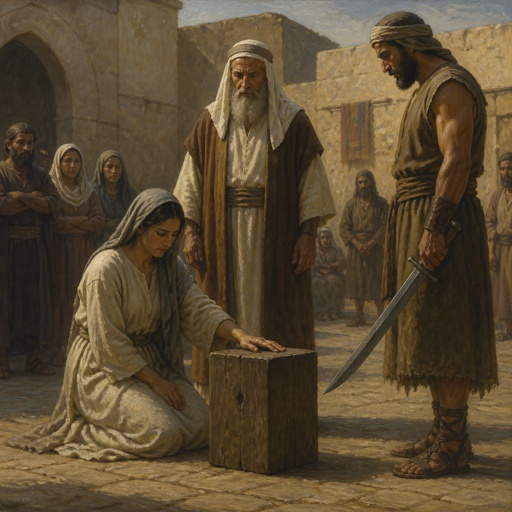
"Then thou shalt cut off her hand, thine eye shall not pity her." - Deuteronomy 25:12

Deuteronomy 12:25 - "Thou shalt not eat it; that it may go well with thee, and with thy children after thee, when thou shalt do that which is right in the sight of the LORD."

Deuteronomy 25:13 - "¶ Thou shalt not have in thy bag divers weights, a great and a small."

Deuteronomy 25:4 - "¶ Thou shalt not muzzle the ox when he treadeth out the corn."

Deuteronomy 31:25 - "That Moses commanded the Levites, which bare the ark of the covenant of the LORD, saying,"

Deuteronomy 25:14 - "Thou shalt not have in thine house divers measures, a great and a small."

Deuteronomy 33:25 - "Thy shoes shall be iron and brass; and as thy days, so shall thy strength be."

Deuteronomy 25:10 - "And his name shall be called in Israel, The house of him that hath his shoe loosed."

Deuteronomy 25:16 - "For all that do such things, and all that do unrighteously, are an abomination unto the LORD thy God."

Genesis 25:12

John 12:25

Luke 12:25

Luke 12:25

"Thou shalt not eat it; that it may go well with thee, and with thy children after thee, when thou shalt do that which is right in the sight of the LORD." - Deuteronomy 12:25

Deuteronomy 27:25 - "Cursed be he that taketh reward to slay an innocent person. And all the people shall say, Amen."

Luke 12:25-26

Luke 12:25-26

Luke 12:25-26

Luke 12:25-26

Luke 12:25-26

Luke 12:25-26

Luke 12:25-26

Deuteronomy 25:17 - "¶ Remember what Amalek did unto thee by the way, when ye were come forth out of Egypt;"

Deuteronomy 14:12 - "But these are they of which ye shall not eat: the eagle, and the ossifrage, and the ospray,"

Deuteronomy 24:12 - "And if the man be poor, thou shalt not sleep with his pledge:"

Deuteronomy 3:25 - "I pray thee, let me go over, and see the good land that is beyond Jordan, that goodly mountain, and Lebanon."

Deuteronomy 25:1 - "If there be a controversy between men, and they come unto judgment, that the judges may judge them; then they shall justify the righteous, and condemn the wicked."

Deuteronomy 32:25 - "The sword without, and terror within, shall destroy both the young man and the virgin, the suckling also with the man of gray hairs."

Deuteronomy 12:4 - "Ye shall not do so unto the LORD your God."

Deuteronomy 25:8 - "Then the elders of his city shall call him, and speak unto him: and if he stand to it, and say, I like not to take her;"