Finding Favor in God’s Presence
“And it was so, when the king saw Esther the queen standing in the court, that she obtained favour in his sight: and the king held out to Esther the golden sceptre that was in his hand. So Esther drew near, and touched the top of the sceptre.” — Esther 5:2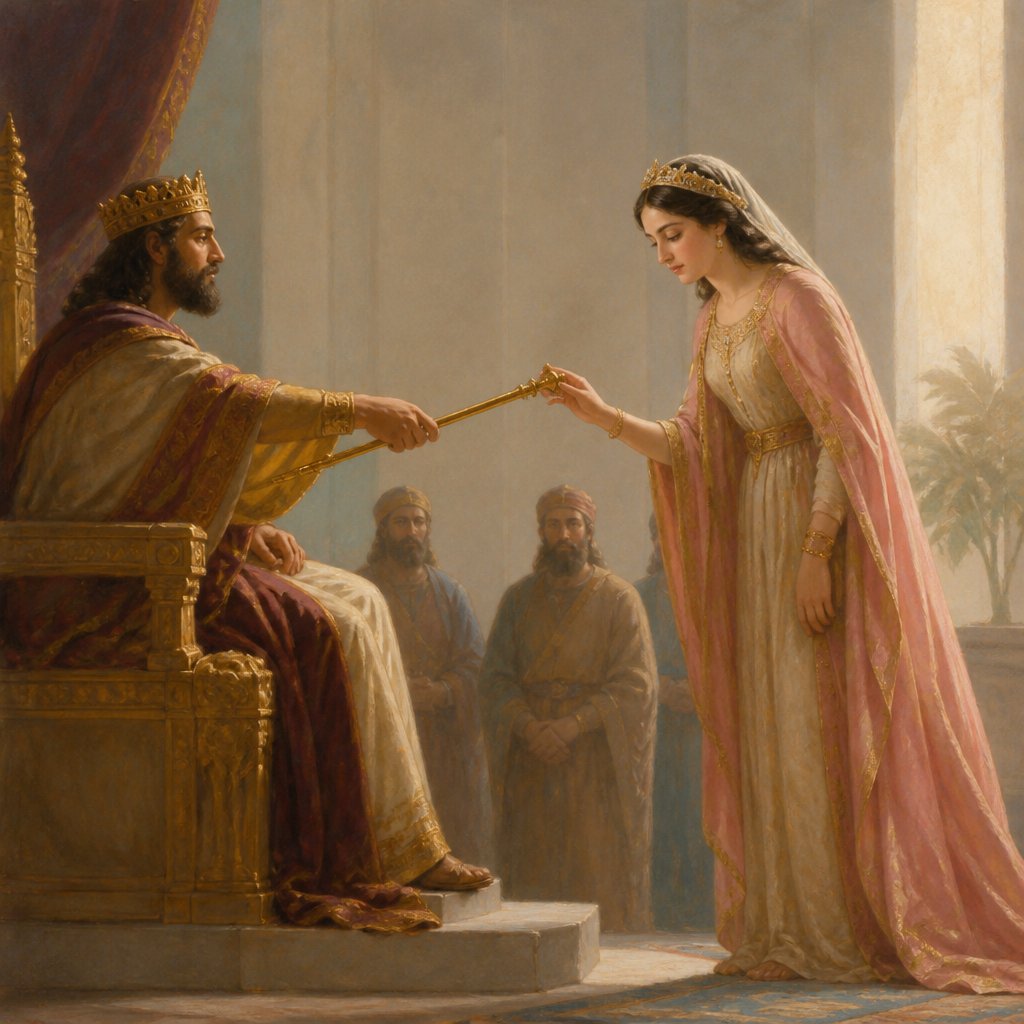
In the book of Esther, the narrative unfolds in a world where power dynamics reign supreme, particularly within the Persian empire. The story of Esther is a tapestry woven with themes of courage, providence, and divine favor. Our focal verse for today, Esther 5:2, reads, "And it was so, when the king saw Esther the queen standing in the court, that she obtained favour in his sight: and the king held out to Esther the golden sceptre that was in his hand. So Esther drew near, and touched the top of the sceptre."
Esther’s act of approaching the king without being summoned was laden with risk. In Persian law, anyone who approached the king unsummoned was subject to death unless the king extended his golden scepter, a token of mercy and favor. Esther’s resolve to intercede for her people demonstrates not just her bravery but also her deep sense of duty and love for her heritage.
As we delve into this pivotal moment, we see several key aspects of finding favor—both in worldly scenarios and within our spiritual walk with God.
**1. Standing before Authority**
Esther stood in the court—imagine the tension! She was no mere subject; she was the queen. Yet, her position did not shield her from fear or the reality of her perilous situation. Often, the calling of God compels us to stand at the threshold of uncertainty. Esther’s posture was not one of arrogance or entitlement but of humility and readiness to serve a greater purpose. When we stand before God, especially in prayer, we embody Esther’s heart, presenting our requests with reverence and earnestness. In making ourselves vulnerable before Him, we give Him the opportunity to show us favor.
**2. The Intersection of Risk and Faith**
Esther's decision to approach the king was steeped in risk; she had to rely on God to grant her favor in a situation that was predominantly against her. This teaches us that faith often requires stepping into the unknown, believing that God's hand is upon us even when circumstances are daunting. The question for us is, are we willing to step forward into the precarious moments of our lives, trusting in His divine providence? When we confront our giants—be it in our families, workplaces, or broader societal issues—God calls us to act in faith, knowing that if we seek Him first, His favor will accompany our steps.
**3. Divine Favor as a Scepter of Grace**
The king extending his golden scepter symbolizes the grace and favor of God towards His children. Just as Esther reached out and touched the scepter, we too must come close to Christ, the embodiment of grace and favor. In a world that often subjects us to criticism and rejection, we have the privilege of approaching the throne of grace with confidence. Hebrews 4:16 encourages us, "Let us therefore come boldly unto the throne of grace, that we may obtain mercy, and find grace to help in time of need."
**4. The Call to Intercede**
Esther’s story unfolds further into a powerful narrative of intercession. Once she was granted favor, her true purpose became evident: to save her people. As believers, we too are called to intercede—not only for our needs but for the needs of others. Esther exemplifies the heart of intercession, stepping into the gap for her people at a colossal risk to herself. Our prayers can change the course of situations, much like Esther did when she prompted the king to act on behalf of the Jews.
In conclusion, Esther 5:2 is a stirring reminder of what it means to find favor in the eyes of God. It challenges us to step out in faith, to come before God with boldness and humility, and to trust in His grace and mercy as we fulfill the roles He calls us to play. Like Esther, we are not merely bystanders in our lives but active participants in God’s grand narrative—invited to approach His throne, extend our hands and hearts, and embrace the favor He so richly offers.
Get our apps


Artwork for Esther 5:2

Esther 5:2

Esther 5:2

Esther 5:2

Esther 5:2 - "And it was so, when the king saw Esther the queen standing in the court, that she obtained favour in his sight: and the king held out to Esther the golden sceptre that was in his hand. So Esther drew near, and touched the top of the sceptre."

Esther 5:2 - "And it was so, when the king saw Esther the queen standing in the court, that she obtained favour in his sight: and the king held out to Esther the golden sceptre that was in his hand. So Esther drew near, and touched the top of the sceptre."
"And it was so, when the king saw Esther the queen standing in the court, that she obtained favour in his sight: and the king held out to Esther the golden sceptre that was in his hand. So Esther drew near, and touched the top of the sceptre." - Esther 5:2

Esther 5:5 - "Then the king said, Cause Haman to make haste, that he may do as Esther hath said. So the king and Haman came to the banquet that Esther had prepared."

Esther 5:7 - "Then answered Esther, and said, My petition and my request is;"

Esther 2:5 - "¶ Now in Shushan the palace there was a certain Jew, whose name was Mordecai, the son of Jair, the son of Shimei, the son of Kish, a Benjamite;"

Esther 2:22 - "And the thing was known to Mordecai, who told it unto Esther the queen; and Esther certified the king thereof in Mordecai's name."

Esther 5:4 - "And Esther answered, If it seem good unto the king, let the king and Haman come this day unto the banquet that I have prepared for him."
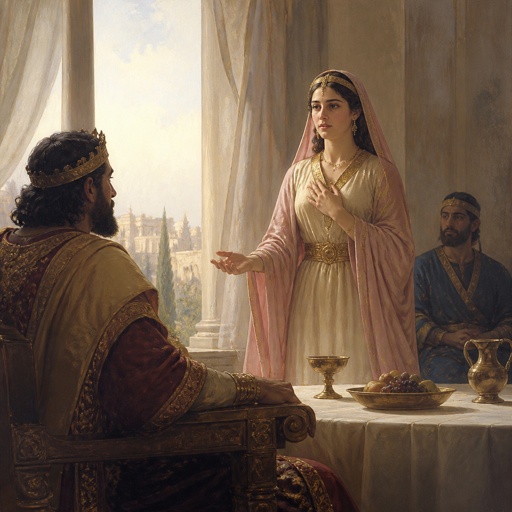
"Then answered Esther, and said, My petition and my request is;" - Esther 5:7

Esther 5:3 - "Then said the king unto her, What wilt thou, queen Esther? and what is thy request? it shall be even given thee to the half of the kingdom."

Esther 7:5 - "¶ Then the king Ahasuerus answered and said unto Esther the queen, Who is he, and where is he, that durst presume in his heart to do so?"
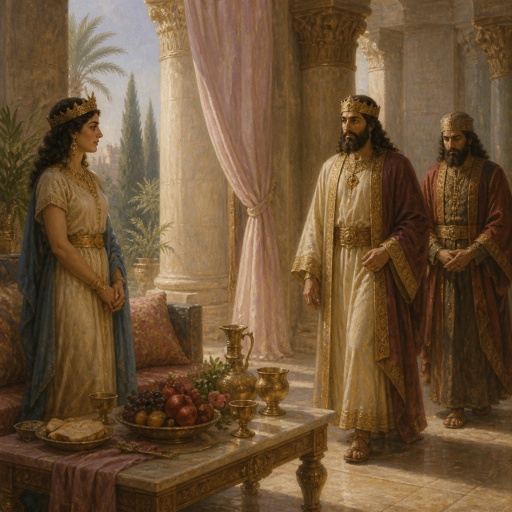
"Then the king said, Cause Haman to make haste, that he may do as Esther hath said. So the king and Haman came to the banquet that Esther had prepared." - Esther 5:5

Esther 4:5 - "Then called Esther for Hatach, one of the king's chamberlains, whom he had appointed to attend upon her, and gave him a commandment to Mordecai, to know what it was, and why it was."

Esther 5:6 - "¶ And the king said unto Esther at the banquet of wine, What is thy petition? and it shall be granted thee: and what is thy request? even to the half of the kingdom it shall be performed."

Esther 7:2 - "And the king said again unto Esther on the second day at the banquet of wine, What is thy petition, queen Esther? and it shall be granted thee: and what is thy request? and it shall be performed, even to the half of the kingdom."

Esther 2:20 - "Esther had not yet shewed her kindred nor her people; as Mordecai had charged her: for Esther did the commandment of Mordecai, like as when she was brought up with him."

Esther 2:11 - "And Mordecai walked every day before the court of the women's house, to know how Esther did, and what should become of her."

Esther 2:10 - "Esther had not shewed her people nor her kindred: for Mordecai had charged her that she should not shew it."

Esther 5:12 - "Haman said moreover, Yea, Esther the queen did let no man come in with the king unto the banquet that she had prepared but myself; and to morrow am I invited unto her also with the king."

"And the thing was known to Mordecai, who told it unto Esther the queen; and Esther certified the king thereof in Mordecai's name." - Esther 2:22

Esther 2:16 - "So Esther was taken unto king Ahasuerus into his house royal in the tenth month, which is the month Tebeth, in the seventh year of his reign."

Esther 8:2 - "And the king took off his ring, which he had taken from Haman, and gave it unto Mordecai. And Esther set Mordecai over the house of Haman."

Esther 3:5 - "And when Haman saw that Mordecai bowed not, nor did him reverence, then was Haman full of wrath."

Esther 5:1 - "Now it came to pass on the third day, that Esther put on her royal apparel, and stood in the inner court of the king's house, over against the king's house: and the king sat upon his royal throne in the royal house, over against the gate of the house."
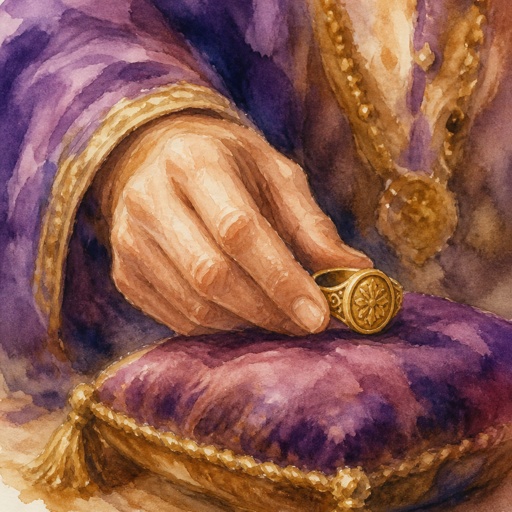
Esther 8:2 focus on the ring

Esther 2:15 - "¶ Now when the turn of Esther, the daughter of Abihail the uncle of Mordecai, who had taken her for his daughter, was come to go in unto the king, she required nothing but what Hegai the king's chamberlain, the keeper of the women, appointed. And Esther obtained favour in the sight of all them that looked upon her."

Esther 6:5 - "And the king's servants said unto him, Behold, Haman standeth in the court. And the king said, Let him come in."