The Power of Confession and Community in Spiritual Restoration
“Now when Ezra had prayed, and when he had confessed, weeping and casting himself down before the house of God, there assembled unto him out of Israel a very great congregation of men and women and children: for the people wept very sore.” — Ezra 10:1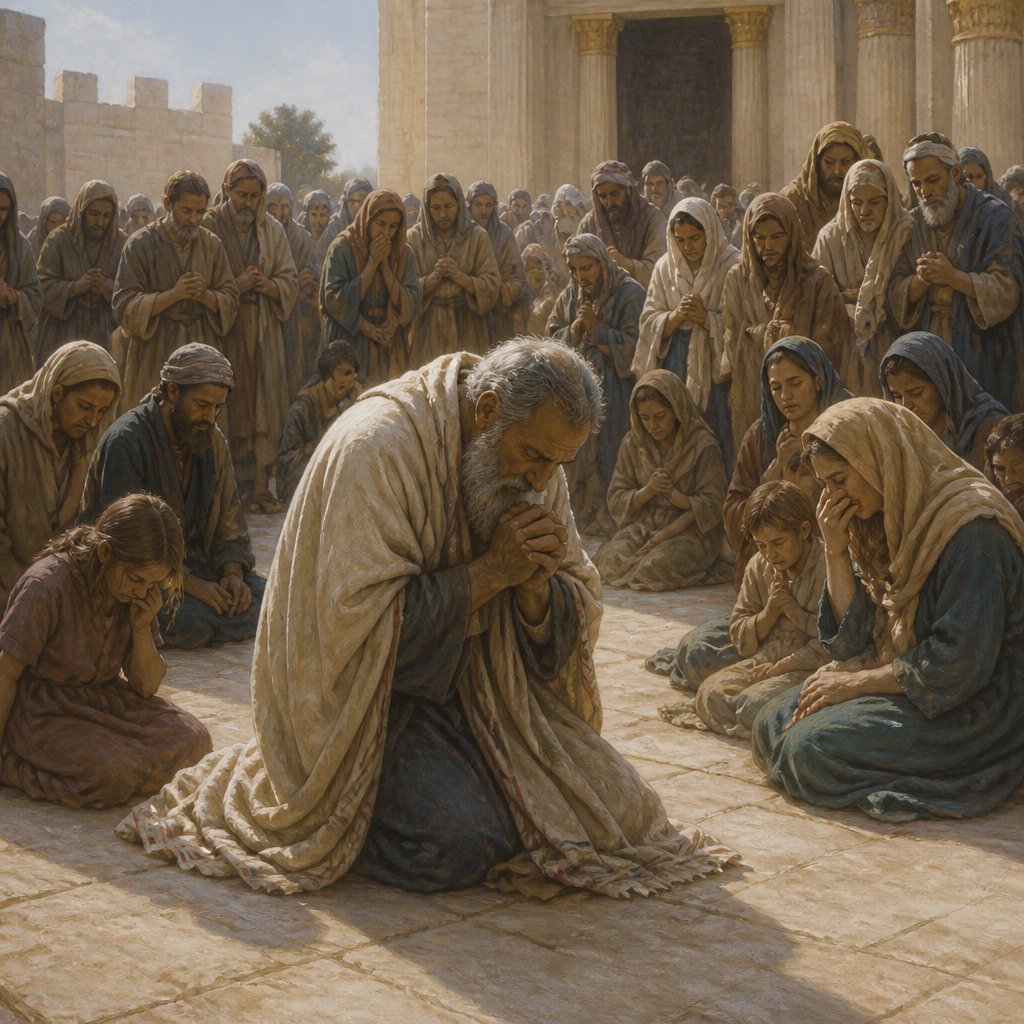
Ezra 10:1 (KJV) tells us, "Now when Ezra had prayed, and when he had confessed, weeping and casting himself down before the house of God, there assembled unto him out of Israel a very great congregation of men and women and children: for the people wept very sore." This poignant verse captures a moment of profound emotional intensity and communal spirituality that speaks volumes to our contemporary Christian life.
Ezra, a priest and scribe, had returned to Jerusalem after the Babylonian exile, with a mission to restore the worship of God and reestablish the people in faithfulness to God’s commandments. However, upon his arrival, Ezra discovered that many Israelites had intermarried with pagan nations, compromising their identity and faith. This revelation led him not just to a place of righteous anger, but rather one of deep sorrow.
The first part of the verse highlights Ezra’s response: he prayed and confessed. In our own spiritual journeys, we too must recognize that confession is a critical step in the restoration process. Confession is more than just a declaration of sins; it represents an act of humility, an acknowledgment of our flaws, and the recognition of our need for God's mercy. Ezra wept, embodying the genuine anguish over the sin of his people. His physical act—casting himself down before the house of God—symbolizes total surrender and reverence. It is a reminder that true repentance often demands a visceral reaction, one that can lead to healing and restoration.
As we meditate on confession, we understand it is not merely a solitary act. It invites community. Ezra’s mourning attracted a great congregation of men, women, and children, illustrating that sin affects not just the individual, but the entire community. As they witnessed Ezra's brokenness, they joined him in his lamentations, weeping sorely. This moment shines a light on the importance of communal repentance in our faith lives. When one member of the Body of Christ suffers, the entire body does. It reminds us of 1 Corinthians 12:26, which says, "And whether one member suffer, all the members suffer with it; or one member be honored, all the members rejoice with it."
Our churches today can learn from Ezra's example. We often seek to maintain an air of perfection, often hiding our shortcomings behind well-prepared facades. However, when we allow ourselves to be vulnerable, confessing our struggles, we create a powerful environment where healing can flourish. Vulnerability fosters authenticity; authenticity cultivates community. When one person admits their failures and seeks forgiveness—publicly or privately—it can encourage others to do the same. It forms a chain reaction of confession and healing, as community members come together to support one another towards restoration.
Moreover, the act of weeping collectively emphasizes the necessity of empathy and compassion within the Body of Christ. Our tears could serve as intercessory prayers for one another, recognizing that sometimes our burdens become too heavy for us to carry alone. It nods to Galatians 6:2, which instructs us to "Bear ye one another's burdens, and so fulfil the law of Christ."
In closing, Ezra's act of prayer, confession, and vulnerability did not just touch him, but it sparked a movement among the people. Their mutual weeping became a catalyst for transformation. We too can initiate similar movements in our lives when we earnestly seek God with penitent hearts and encourage those around us to do the same. Let us not shy away from the emotions that accompany repentance but embrace them as we draw closer to God. Through confession, we can experience individual and communal healing, paving the way for restoration and renewal in our spiritual lives and relationships.
Therefore, let us carry this scripture in our hearts, remembering the weighty power of confession and the beauty of community in our journey of faith. May our gatherings reflect the transparency and grace evident in Ezra's encounter with God.
Get our apps


Artwork for Ezra 10:1

Ezra 10:1 - "Now when Ezra had prayed, and when he had confessed, weeping and casting himself down before the house of God, there assembled unto him out of Israel a very great congregation of men and women and children: for the people wept very sore."
"Now when Ezra had prayed, and when he had confessed, weeping and casting himself down before the house of God, there assembled unto him out of Israel a very great congregation of men and women and children: for the people wept very sore." - Ezra 10:1

Ezra 1:10 - "Thirty basons of gold, silver basons of a second sort four hundred and ten, and other vessels a thousand."

Ezra 10:10-12

Ezra 10:10 - "And Ezra the priest stood up, and said unto them, Ye have transgressed, and have taken strange wives, to increase the trespass of Israel."

Ezra 10:3

Ezra 3:10

Ezra 10:3

Ezra 10:5 - "Then arose Ezra, and made the chief priests, the Levites, and all Israel, to swear that they should do according to this word. And they sware."

Ezra 7:10 - "For Ezra had prepared his heart to seek the law of the LORD, and to do it, and to teach in Israel statutes and judgments."

Ezra 10:38 - "And Bani, and Binnui, Shimei,"

Ezra 10:37 - "Mattaniah, Mattenai, and Jaasau,"

Ezra 10:40 - "Machnadebai, Shashai, Sharai,"

Ezra 10:32 - "Benjamin, Malluch, and Shemariah."

Ezra 10:35 - "Benaiah, Bedeiah, Chelluh,"

Ezra 10:41 - "Azareel, and Shelemiah, Shemariah,"

Ezra 10:36 - "Vaniah, Meremoth, Eliashib,"

Ezra 10:42 - "Shallum, Amariah, and Joseph."

Ezra 10:39 - "And Shelemiah, and Nathan, and Adaiah,"

Ezra 10:20 - "And of the sons of Immer; Hanani, and Zebadiah."

Ezra 10:34 - "Of the sons of Bani; Maadai, Amram, and Uel,"

Ezra 2:10 - "The children of Bani, six hundred forty and two."

Ezra 10:24 - "Of the singers also; Eliashib: and of the porters; Shallum, and Telem, and Uri."

Ezra 10:21 - "And of the sons of Harim; Maaseiah, and Elijah, and Shemaiah, and Jehiel, and Uzziah."

Ezra 10:31 - "And of the sons of Harim; Eliezer, Ishijah, Malchiah, Shemaiah, Shimeon,"

Ezra 10:28 - "Of the sons also of Bebai; Jehohanan, Hananiah, Zabbai, and Athlai."

"Azareel, and Shelemiah, Shemariah," - Ezra 10:41

"And Bani, and Binnui, Shimei," - Ezra 10:38

"And Shelemiah, and Nathan, and Adaiah," - Ezra 10:39

"Vaniah, Meremoth, Eliashib," - Ezra 10:36