What does Ezra 10:1 mean?
“Now when Ezra had prayed, and when he had confessed, weeping and casting himself down before the house of God, there assembled unto him out of Israel a very great congregation of men and women and children: for the people wept very sore.” — Ezra 10:1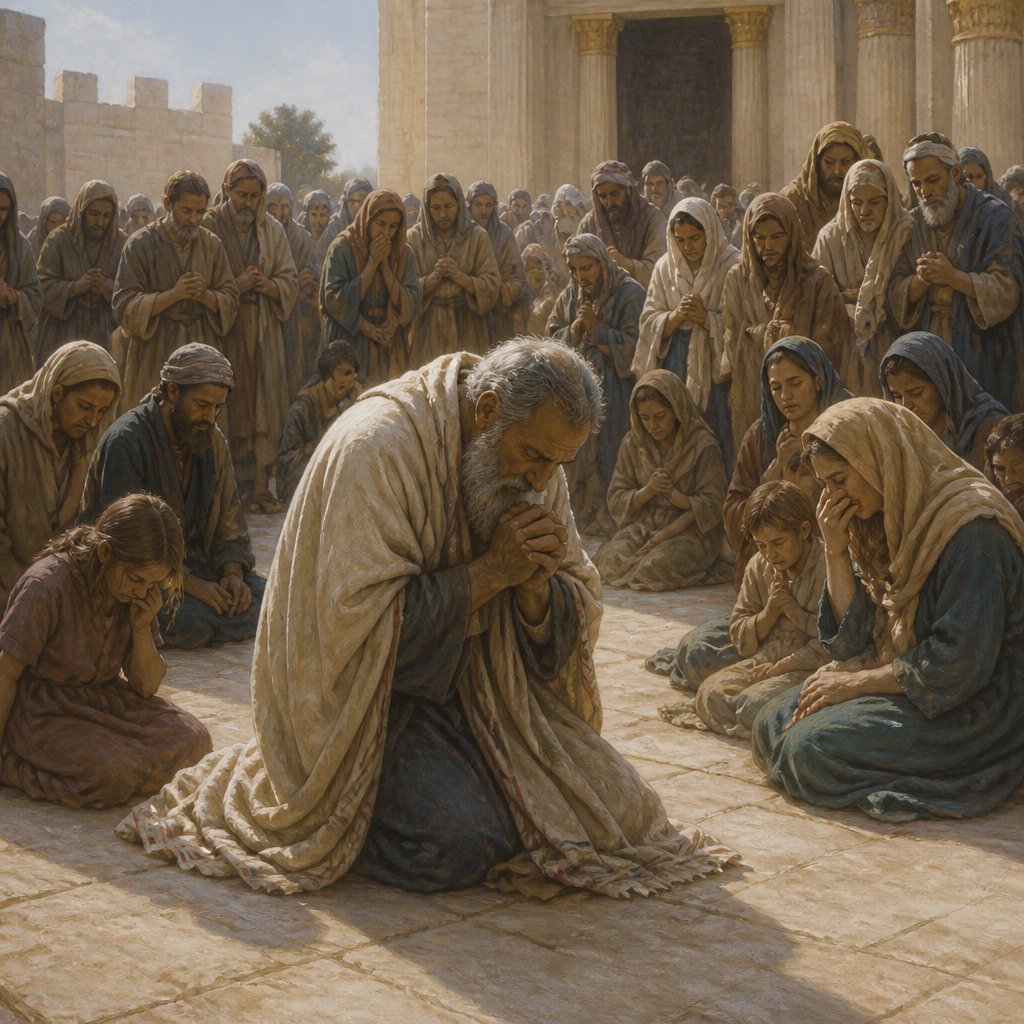
The Bible verse Ezra 10:1 (KJV) reads, "Now when Ezra had prayed, and when he had confessed, weeping and casting himself down before the house of God, there assembled unto him out of Israel a very great congregation of men and women and children: for the people wept very sore." This verse comes from the book of Ezra in the Old Testament, which recounts the return of the Israelites from exile in Babylon and their efforts to rebuild the Temple in Jerusalem.
In order to fully understand the meaning and significance of this verse, it is important to consider the historical and cultural context in which it was written. The book of Ezra takes place during a time when the Israelites had been exiled in Babylon for 70 years, as a punishment for their disobedience to God. After the Babylonian Empire fell to the Persians, King Cyrus of Persia allowed the Israelites to return to their homeland and rebuild the Temple in Jerusalem.
Ezra was a priest and scribe who played a key role in the return of the exiles and the restoration of their religious practices. In this particular verse, we see Ezra's deep sense of remorse and repentance for the sins of the people. His prayer and confession, along with his tears and prostration before the house of God, demonstrate his deep humility and contrition before the Lord. This act of humility and confession was a necessary step in the process of seeking God's forgiveness and restoring the spiritual well-being of the people.
Furthermore, the assembly of men, women, and children who gathered around Ezra is a powerful symbol of communal repentance and renewal. The fact that people of all ages and genders came together to weep and seek God's mercy speaks to the universality of sin and the need for collective repentance. It also highlights the importance of intergenerational and inclusive worship, as the entire community came together to seek restoration and forgiveness from God.
In addition to the themes of repentance and communal worship, this verse also emphasizes the power of prayer and confession. Ezra's act of praying and confessing his sins before God served as a model for the people, showing them the importance of humbly acknowledging their transgressions and seeking God's mercy. It is a reminder that true repentance involves not only recognizing our faults but also turning to God with a genuine desire for change and restoration.
Symbolically, the house of God in this verse represents the presence of God and the central place of worship for the Israelites. Ezra's prostration before the house of God signifies his reverence and submission to God as the ultimate authority. The gathering of the people at the house of God signifies the importance of corporate worship and the communal nature of the Israelite faith.
Overall, Ezra 10:1 (KJV) captures a significant moment of repentance and restoration in the history of the Israelites. It serves as a powerful reminder of the importance of humility, confession, communal worship, and the transformative power of prayer. This verse continues to inspire believers today to seek God's forgiveness and restoration with sincere hearts, both individually and communally.
Get our apps


Artwork for Ezra 10:1

Ezra 10:1 - "Now when Ezra had prayed, and when he had confessed, weeping and casting himself down before the house of God, there assembled unto him out of Israel a very great congregation of men and women and children: for the people wept very sore."
"Now when Ezra had prayed, and when he had confessed, weeping and casting himself down before the house of God, there assembled unto him out of Israel a very great congregation of men and women and children: for the people wept very sore." - Ezra 10:1

Ezra 1:10 - "Thirty basons of gold, silver basons of a second sort four hundred and ten, and other vessels a thousand."

Ezra 10:10-12

Ezra 10:10 - "And Ezra the priest stood up, and said unto them, Ye have transgressed, and have taken strange wives, to increase the trespass of Israel."

Ezra 10:3

Ezra 3:10

Ezra 10:3

Ezra 10:5 - "Then arose Ezra, and made the chief priests, the Levites, and all Israel, to swear that they should do according to this word. And they sware."

Ezra 7:10 - "For Ezra had prepared his heart to seek the law of the LORD, and to do it, and to teach in Israel statutes and judgments."

Ezra 10:38 - "And Bani, and Binnui, Shimei,"

Ezra 10:37 - "Mattaniah, Mattenai, and Jaasau,"

Ezra 10:40 - "Machnadebai, Shashai, Sharai,"

Ezra 10:32 - "Benjamin, Malluch, and Shemariah."

Ezra 10:35 - "Benaiah, Bedeiah, Chelluh,"

Ezra 10:41 - "Azareel, and Shelemiah, Shemariah,"

Ezra 10:36 - "Vaniah, Meremoth, Eliashib,"

Ezra 10:42 - "Shallum, Amariah, and Joseph."

Ezra 10:39 - "And Shelemiah, and Nathan, and Adaiah,"

Ezra 10:20 - "And of the sons of Immer; Hanani, and Zebadiah."

Ezra 10:34 - "Of the sons of Bani; Maadai, Amram, and Uel,"

Ezra 2:10 - "The children of Bani, six hundred forty and two."

Ezra 10:24 - "Of the singers also; Eliashib: and of the porters; Shallum, and Telem, and Uri."

Ezra 10:21 - "And of the sons of Harim; Maaseiah, and Elijah, and Shemaiah, and Jehiel, and Uzziah."

Ezra 10:31 - "And of the sons of Harim; Eliezer, Ishijah, Malchiah, Shemaiah, Shimeon,"

Ezra 10:28 - "Of the sons also of Bebai; Jehohanan, Hananiah, Zabbai, and Athlai."

"Azareel, and Shelemiah, Shemariah," - Ezra 10:41

"And Bani, and Binnui, Shimei," - Ezra 10:38

"And Shelemiah, and Nathan, and Adaiah," - Ezra 10:39

"Vaniah, Meremoth, Eliashib," - Ezra 10:36