In the Crucible of Pain: Understanding Job's Test
“So went Satan forth from the presence of the LORD, and smote Job with sore boils from the sole of his foot unto his crown.” — Job 2:7
The story of Job is one that resonates deeply with many believers. It takes us through an intense journey of suffering and unwavering faith. Job 2:7 offers a poignant moment in this narrative, stating, "So went Satan forth from the presence of the LORD, and smote Job with sore boils from the sole of his foot unto his crown." This verse not only reflects the depth of Job's suffering but also challenges us to reflect on the nature of our faith amidst trials.
To understand the gravity of this phrase, we need to look back at the earlier chapters of Job. Job was a man described as "perfect and upright," one who feared God and turned away from evil (Job 1:1). He had wealth, a loving family, and was highly regarded in his community. But, as we see in the heavenly dialogue, God allowed Satan to test Job, believing that Job would stand firm in his faith.
When Satan attacked Job’s possessions and family, Job remained resilient, proclaiming, "The LORD gave, and the LORD hath taken away; blessed be the name of the LORD" (Job 1:21). Yet, Satan was not satisfied. He challenged God again, arguing that Job would surely curse Him if his own health was compromised. Thus, we witness the beginning of Job's physical affliction – sore boils that plagued him from head to toe.
The imagery in Job 2:7 is powerful. It conveys not just physical pain but emotional, psychological, and spiritual anguish. Boils, in ancient times, were perhaps one of the most excruciating forms of suffering, isolating the individual from societal interaction and leaving them in a state of utter despair. Here was a man who had everything—wealth, family, faith—and now he found himself in the depths of human suffering, experiencing pain not just in his body, but in his soul.
This brutal moment in Job’s life poses significant questions about the nature of suffering and the character of God. Why would a righteous man suffer? Why does God allow His faithful servants to endure such agony? It challenges our understanding of divine justice and raises troubling dilemmas about faith and fidelity in trials.
However, in the midst of suffering, there is an invitation for deeper faith. The narrative doesn’t shy away from the reality of pain; instead, it invites us to confront our own responses to suffering. Job did not respond with bitterness or anger toward God initially, despite losing everything. His first reaction was one of worship and surrender. This sets a profound example for us today. How do we respond in our moments of crisis?
Job's friends, although initially supportive, eventually turned accusatory, suggesting that Job's suffering must be a result of unconfessed sin. This scenario highlights a critical lesson about the nature of suffering: it is not always a consequence of personal wrongdoing. Sometimes suffering is a part of the divine mystery of life, meant to refine us and draw us closer to God.
In our pain, we often experience the raw and authentic moments that foster intimacy with the Creator. While we might not understand the purposes behind our trials, we can rest assured that God remains sovereign and present in our suffering. He walks with us, offering His peace that surpasses all understanding (Philippians 4:7).
As we meditate on Job's afflictions, let us remember that pain can lead us to a deeper understanding of God's character. Just as He was with Job, He is with us in our valleys. May our response to trials mirror Job’s initial claim of faith: to bless the name of the LORD in every circumstance. Let us also hold on to the hope that suffering is not the end but a pathway to transformation and deeper faith.
Get our apps


Artwork for Job 2:7

Job 2:7 - "¶ So went Satan forth from the presence of the LORD, and smote Job with sore boils from the sole of his foot unto his crown."

"¶ So went Satan forth from the presence of the LORD, and smote Job with sore boils from the sole of his foot unto his crown." - Job 2:7

Job 7:2 - "As a servant earnestly desireth the shadow, and as an hireling looketh for the reward of his work:"

"As a servant earnestly desireth the shadow, and as an hireling looketh for the reward of his work:" - Job 7:2

Job 34:7 - "What man is like Job, who drinketh up scorning like water?"

Job 1:7

Job 1:7

Job 1:7

Job 3:2 - "And Job spake, and said,"

Job 7:7 - "O remember that my life is wind: mine eye shall no more see good."

Job 38:4-7

Job 13:7 - "Will ye speak wickedly for God? and talk deceitfully for him?"

Job 38:7 - "When the morning stars sang together, and all the sons of God shouted for joy?"

Job 9:7 - "Which commandeth the sun, and it riseth not; and sealeth up the stars."

"And Job spake, and said," - Job 3:2

Job 24:7 - "They cause the naked to lodge without clothing, that they have no covering in the cold."

Job 7:14 - "Then thou scarest me with dreams, and terrifiest me through visions:"

Job 42:7 - "¶ And it was so, that after the LORD had spoken these words unto Job, the LORD said to Eliphaz the Temanite, My wrath is kindled against thee, and against thy two friends: for ye have not spoken of me the thing that is right, as my servant Job hath."

Job 28:7 draw a hidden path

Job 30:7 - "Among the bushes they brayed; under the nettles they were gathered together."

Job 5:7 - "Yet man is born unto trouble, as the sparks fly upward."

Job 6:7 - "The things that my soul refused to touch are as my sorrowful meat."

Job 21:7 - "Wherefore do the wicked live, become old, yea, are mighty in power?"

Job 39:7 - "He scorneth the multitude of the city, neither regardeth he the crying of the driver."

Job 3:7 - "Lo, let that night be solitary, let no joyful voice come therein."

Job 7:12 - "Am I a sea, or a whale, that thou settest a watch over me?"
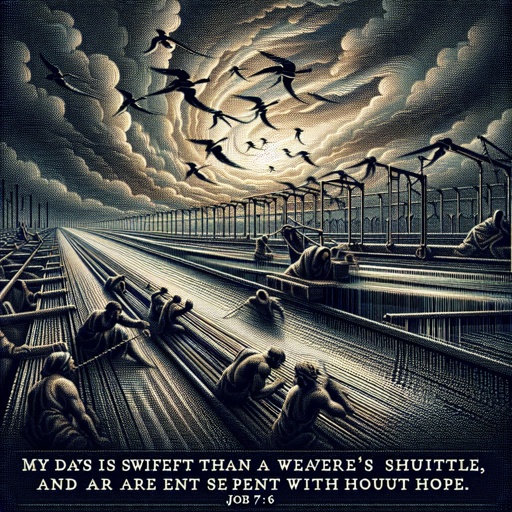
Job 7:6 - "My days are swifter than a weaver's shuttle, and are spent without hope."

Job 28:7 - "There is a path which no fowl knoweth, and which the vulture's eye hath not seen:"

"What man is like Job, who drinketh up scorning like water?" - Job 34:7

Job 32:7 - "I said, Days should speak, and multitude of years should teach wisdom."