What does Job 2:7 mean?
“So went Satan forth from the presence of the LORD, and smote Job with sore boils from the sole of his foot unto his crown.” — Job 2:7
Job 2:7 in the KJV reads, "So went Satan forth from the presence of the Lord, and smote Job with sore boils from the sole of his foot unto his crown." This verse comes from the book of Job in the Old Testament, a book that explores the question of why the righteous suffer.
In this verse, Satan has already tested Job's faith by taking away his possessions and his children. Now, he goes back to the Lord and asks for permission to inflict physical harm on Job. The Lord gives Satan permission, but he commands him to spare Job's life. In response to this command, Satan afflicts Job with painful boils all over his body.
This verse is rich with symbolism and provides several important themes and lessons for readers to ponder. One of the main themes in this verse is the nature of suffering. Job, who was a righteous and blameless man, has been stripped of all his possessions and now is afflicted with a painful and debilitating illness. This challenges the traditional understanding of suffering being a punishment for sin. Job's suffering, then, becomes a test of his faith and endurance. This theme of suffering and faith is further explored throughout the book of Job as he questions why he must endure such hardships.
Another important theme in this verse is the presence of evil in the world. Satan, as the embodiment of evil, is given permission by God to test and torment Job. This raises questions about the nature of evil and its role in the world. It also highlights the idea that even the most righteous and faithful individuals may face trials and tribulations at the hands of evil forces.
The verse also addresses the concept of divine permission and intervention. The fact that Satan must seek permission from God before afflicting Job emphasizes the sovereignty and authority of God over all things, including the forces of evil. It also raises questions about why a loving and just God would allow such suffering to occur, a question that is central to the entire book of Job.
The context of this verse is crucial to understanding its full meaning. Job was a wealthy and righteous man who experienced a series of calamities that tested his faith and endurance. Despite losing everything, he remains faithful to God. The verse in question occurs after Job has already lost his possessions and his children, and now he is afflicted with physical suffering. The context of his suffering and his response to it are central to the larger narrative of the book of Job.
The symbolism in this verse is also significant. The boils that afflict Job are a physical representation of his pain and suffering. They also serve as a symbolic representation of the trials and tribulations that all individuals may face in their lives. The infliction of boils on Job's body also serves as a visual reminder of the physical and emotional toll that suffering can take on a person.
In conclusion, Job 2:7 is a powerful and thought-provoking verse that explores themes of suffering, faith, the presence of evil, divine permission, and the nature of suffering. It challenges traditional understandings of suffering and raises important questions about the role of God and evil in the world. The verse's rich symbolism and powerful context make it a significant and impactful verse within the larger narrative of the book of Job.
Get our apps


Artwork for Job 2:7

Job 2:7 - "¶ So went Satan forth from the presence of the LORD, and smote Job with sore boils from the sole of his foot unto his crown."

"¶ So went Satan forth from the presence of the LORD, and smote Job with sore boils from the sole of his foot unto his crown." - Job 2:7

Job 7:2 - "As a servant earnestly desireth the shadow, and as an hireling looketh for the reward of his work:"

"As a servant earnestly desireth the shadow, and as an hireling looketh for the reward of his work:" - Job 7:2

Job 34:7 - "What man is like Job, who drinketh up scorning like water?"

Job 1:7

Job 1:7

Job 1:7

Job 3:2 - "And Job spake, and said,"

Job 7:7 - "O remember that my life is wind: mine eye shall no more see good."

Job 38:4-7

Job 13:7 - "Will ye speak wickedly for God? and talk deceitfully for him?"

Job 38:7 - "When the morning stars sang together, and all the sons of God shouted for joy?"

Job 9:7 - "Which commandeth the sun, and it riseth not; and sealeth up the stars."

"And Job spake, and said," - Job 3:2

Job 24:7 - "They cause the naked to lodge without clothing, that they have no covering in the cold."

Job 7:14 - "Then thou scarest me with dreams, and terrifiest me through visions:"

Job 42:7 - "¶ And it was so, that after the LORD had spoken these words unto Job, the LORD said to Eliphaz the Temanite, My wrath is kindled against thee, and against thy two friends: for ye have not spoken of me the thing that is right, as my servant Job hath."

Job 28:7 draw a hidden path

Job 30:7 - "Among the bushes they brayed; under the nettles they were gathered together."

Job 5:7 - "Yet man is born unto trouble, as the sparks fly upward."

Job 6:7 - "The things that my soul refused to touch are as my sorrowful meat."

Job 21:7 - "Wherefore do the wicked live, become old, yea, are mighty in power?"

Job 39:7 - "He scorneth the multitude of the city, neither regardeth he the crying of the driver."

Job 3:7 - "Lo, let that night be solitary, let no joyful voice come therein."

Job 7:12 - "Am I a sea, or a whale, that thou settest a watch over me?"
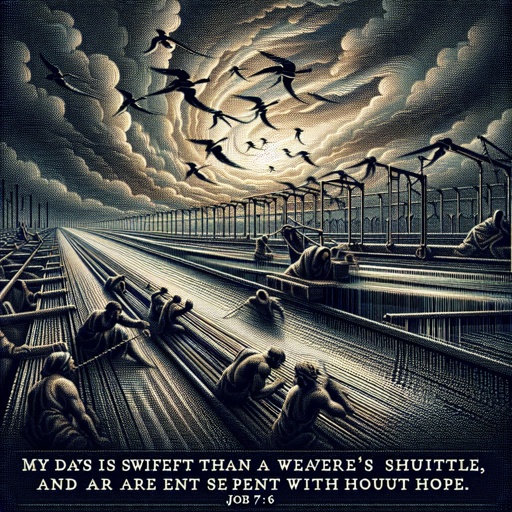
Job 7:6 - "My days are swifter than a weaver's shuttle, and are spent without hope."

Job 28:7 - "There is a path which no fowl knoweth, and which the vulture's eye hath not seen:"

"What man is like Job, who drinketh up scorning like water?" - Job 34:7

Job 32:7 - "I said, Days should speak, and multitude of years should teach wisdom."