The Challenge of Authority: A Heart Set on Truth
“And Gaal the son of Ebed said, Who is Abimelech, and who is Shechem, that we should serve him? is not he the son of Jerubbaal? and Zebul his officer? serve the men of Hamor the father of Shechem: for why should we serve him?” — Judges 9:28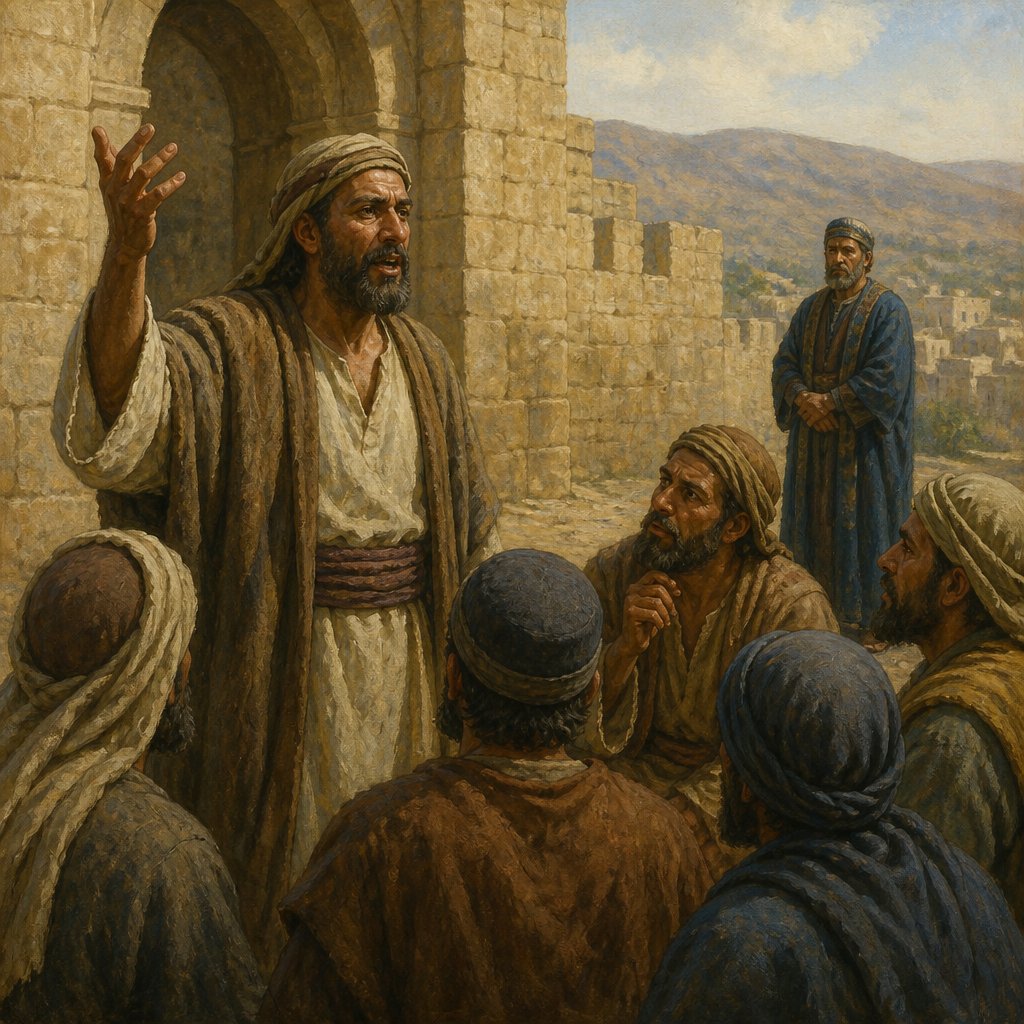
In Judges 9:28, we encounter a striking moment in the life of Gaal the son of Ebed, a character who dares to challenge the authority of Abimelech. The verse states, "And Gaal the son of Ebed said, Who is Abimelech, and who is Shechem, that we should serve him? is not he the son of Jerubbaal? and Zebul his officer? serve the men of Hamor the father of Shechem: for why should we serve him?" This verse invites us to explore themes of leadership, identity, and the struggles for authority that resonate deeply with our walk of faith in today’s world.
Abimelech, the illegitimate son of Gideon (also known as Jerubbaal), rose to power in Shechem through manipulation and force, having killed his brothers to secure his claim to leadership. It is this blood-soaked rise to power that Gaal openly questions, representing a moment when the people of Shechem stood at a crossroads: to continue submission under a tyrant or to reclaim their autonomy.
Gaal’s assertion of independence speaks to a universal question that many face: What is the legitimacy of the authorities we choose to follow? Gaal dismisses Abimelech’s claim by reminding his listeners of Abimelech's lineage, pointing out that the very identity by which he seeks to be served is marred by violence and deceit. This call to question authority is not merely political; it is a deeply spiritual exercise, urging us to examine whom we serve in our lives.
Today, we may not face Abimelech, but there are countless 'Abimelechs' in our world, figures or forces that demand our loyalty while lacking moral integrity. From societal expectations that push us toward compromise on our values, to doctrines or ideologies that lure us away from the truth of the Gospel, we are constantly asked to serve those with questionable motives.
In contrast to Gaal’s challenge, we should reflect on our own priorities. Are we choosing to follow Christ, the true shepherd, who laid down His life for us, or are we allowing ourselves to be swayed by the allure of popularity, power, or prestige? The ancient cry from Gaal calls upon us to embrace an identity that is not defined by the whims of this world, but by the transformative power of the Gospel.
Further, Gaal’s mention of “the men of Hamor” draws us to consider the importance of historical and community ties in shaping our identity and allegiance. The men of Hamor were the original inhabitants of Shechem, and by invoking their name, Gaal seeks to remind his audience of their tribally-oriented roots. There is strength in community, but we must always ask: Does that community align with God's principles? Are we engaged in the right affiliations?
As believers, we must actively pursue our call to challenge structures that oppose God's sovereignty. When faced with authorities that contradict our faith, we must exercise discernment and courage, much like Gaal, to declare, "Who are they that we should serve?" This does not imply rebellion for the sake of chaos but a passionate commitment to truth that ultimately serves our communities better than any tyrant possibly could.
The heart of Gaal’s argument is empowerment. It challenges passivity and encourages us to aspire for a robust faith that isn't tied to fear. He inspires the people of Shechem, inviting them to resist the status quo and foster a new allegiance based on God’s righteousness. In this sense, we are reminded to seek our true identity—rooted not in our worldly affiliations but in our position as children of God.
Thus, let us elevate our voices in discerning allegiance, grounded in truth and love. May we emulate Gaal’s courage to speak against corrupt authority, while rooted in our identity in Christ, whose authority is the epitome of love, grace, and righteousness. Let us daily choose to serve Him, aligning our lives with His purpose, even as the world clamors for our loyalty to its thinly-veiled calls for service.
Get our apps


Artwork for Judges 9:28
Judges 9:28 - "And Gaal the son of Ebed said, Who is Abimelech, and who is Shechem, that we should serve him? is not he the son of Jerubbaal? and Zebul his officer? serve the men of Hamor the father of Shechem: for why should we serve him?"
"And Gaal the son of Ebed said, Who is Abimelech, and who is Shechem, that we should serve him? is not he the son of Jerubbaal? and Zebul his officer? serve the men of Hamor the father of Shechem: for why should we serve him?" - Judges 9:28

Judges 9:8-15

Judges 11:28 - "Howbeit the king of the children of Ammon hearkened not unto the words of Jephthah which he sent him."

Judges 1:28 - "And it came to pass, when Israel was strong, that they put the Canaanites to tribute, and did not utterly drive them out."

Jeremiah 5:28 - "They are waxen fat, they shine: yea, they overpass the deeds of the wicked: they judge not the cause, the cause of the fatherless, yet they prosper; and the right of the needy do they not judge."

Judges 9:50 - "¶ Then went Abimelech to Thebez, and encamped against Thebez, and took it."

Judges 18:28 - "And there was no deliverer, because it was far from Zidon, and they had no business with any man; and it was in the valley that lieth by Beth-rehob. And they built a city, and dwelt therein."

Judges 8:28 - "¶ Thus was Midian subdued before the children of Israel, so that they lifted up their heads no more. And the country was in quietness forty years in the days of Gideon."

Judges 9:22 - "¶ When Abimelech had reigned three years over Israel,"

Judges 15:9 - "¶ Then the Philistines went up, and pitched in Judah, and spread themselves in Lehi."

Judges 9:39 - "And Gaal went out before the men of Shechem, and fought with Abimelech."

Luke 9:28-45

Create a digital art style rendition of a scene inspired by Judges 6:25-28

Job 31:28 - "This also were an iniquity to be punished by the judge: for I should have denied the God that is above."

Judges 21:9 - "For the people were numbered, and, behold, there were none of the inhabitants of Jabesh-gilead there."

Judges 9:10 - "And the trees said to the fig tree, Come thou, and reign over us."

Judges 9:42 - "And it came to pass on the morrow, that the people went out into the field; and they told Abimelech."

Judges 9:12 - "Then said the trees unto the vine, Come thou, and reign over us."

Judges 9:47 - "And it was told Abimelech, that all the men of the tower of Shechem were gathered together."

Psalms 98:9 - "Before the LORD; for he cometh to judge the earth: with righteousness shall he judge the world, and the people with equity."

Judges 5:28 - "The mother of Sisera looked out at a window, and cried through the lattice, Why is his chariot so long in coming? why tarry the wheels of his chariots?"

Judges 9:9 - "But the olive tree said unto them, Should I leave my fatness, wherewith by me they honour God and man, and go to be promoted over the trees?"

Judges 9:32 - "Now therefore up by night, thou and the people that is with thee, and lie in wait in the field:"

Judges 9:14 - "Then said all the trees unto the bramble, Come thou, and reign over us."

Judges 6:28 - "¶ And when the men of the city arose early in the morning, behold, the altar of Baal was cast down, and the grove was cut down that was by it, and the second bullock was offered upon the altar that was built."

Judges 9:46 - "¶ And when all the men of the tower of Shechem heard that, they entered into an hold of the house of the god Berith."

Acts 9:28 - "And he was with them coming in and going out at Jerusalem."

Judges 9:21 - "And Jotham ran away, and fled, and went to Beer, and dwelt there, for fear of Abimelech his brother."

Judges 9:30 - "¶ And when Zebul the ruler of the city heard the words of Gaal the son of Ebed, his anger was kindled."