What does 1 Chronicles 13:7 mean?
“And they carried the ark of God in a new cart out of the house of Abinadab: and Uzza and Ahio drave the cart.” — 1 Chronicles 13:7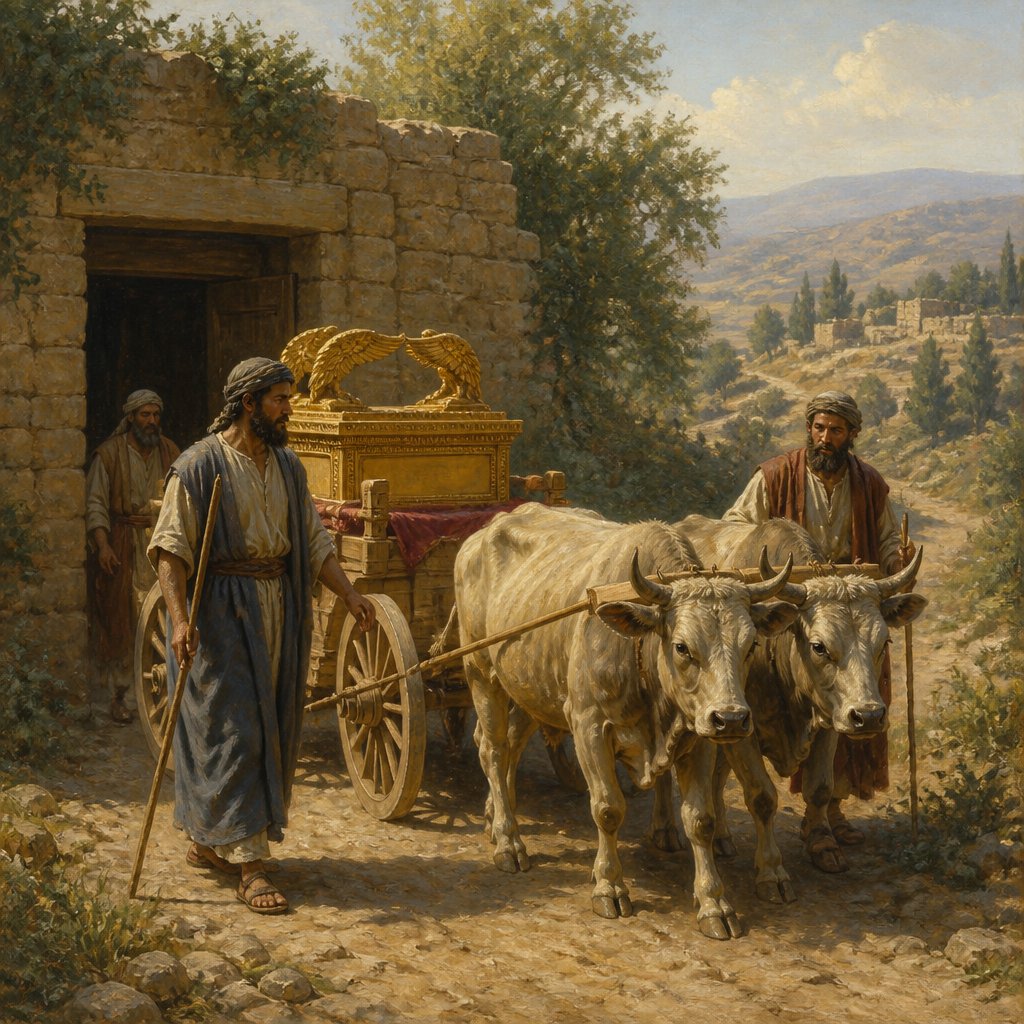
The Bible verse 1 Chronicles 13:7 from the King James Version (KJV) reads, "And they carried the ark of God in a new cart out of the house of Abinadab: and Uzza and Ahio drave the cart."
This verse comes from the book of 1 Chronicles, which is a historical account of the people of Israel, focusing on the lineage of King David and the establishment of the Davidic dynasty. The verse is part of a larger passage that describes King David's attempt to bring the ark of the covenant back to Jerusalem.
To understand the significance and meaning of this verse, it is important to examine the broader context. At this time, the ark of the covenant, which was a sacred object containing the stone tablets of the Ten Commandments, was being kept in the house of Abinadab. David, who had recently been anointed as king, desired to bring the ark to Jerusalem as a symbol of God's presence among the people.
However, in his eagerness to bring the ark to Jerusalem, David made a critical mistake. Instead of following the prescribed method for transporting the ark, which involved using poles and the Levites to carry it on their shoulders (Exodus 25:14-15), David chose to transport the ark on a new cart. This decision ultimately led to a tragic outcome, as Uzza, one of the men driving the cart, reached out to steady the ark when the oxen stumbled, and was struck dead by God for his irreverence towards the sacred object (1 Chronicles 13:9-10).
The verse 1 Chronicles 13:7 captures the moment when the ark is being transported on the new cart, highlighting the disobedience and presumption of David and the people involved in this ill-fated endeavor.
From a thematic standpoint, this verse serves as a cautionary tale about the importance of following God's instructions and honoring His holiness. The ark of the covenant was not merely a religious artifact; it represented the tangible presence of God among His people. By mishandling the ark and failing to observe the proper protocols for its transportation, David and his companions demonstrated a lack of reverence and obedience to God's commands.
The symbolism in this verse is profound. The ark of the covenant was a central symbol of God's covenant with Israel, and its mishandling by David serves as a metaphor for the dangers of treating sacred things with irreverence. The tragic death of Uzza, while harsh, serves as a sobering reminder of the need to approach God with humility and awe.
Furthermore, the verse underscores the distinction between human presumption and divine authority. David's decision to transport the ark on a new cart reflected his own desires and plans, rather than seeking God's guidance and following His decrees. The consequences of this disobedience illustrate the importance of submitting to God's will and acknowledging His sovereignty.
In conclusion, 1 Chronicles 13:7 conveys a powerful message about the significance of reverence, obedience, and humility in our relationship with God. It serves as a sobering reminder of the dangers of presuming upon God's presence and taking His holiness lightly. The verse challenges us to approach God with reverence and to heed His commands, recognizing that His ways are higher than ours, and His holiness demands our utmost respect and obedience.
Get our apps


Artwork for 1 Chronicles 13:7

1 Chronicles 13:7 - "And they carried the ark of God in a new cart out of the house of Abinadab: and Uzza and Ahio drave the cart."
"And they carried the ark of God in a new cart out of the house of Abinadab: and Uzza and Ahio drave the cart." - 1 Chronicles 13:7

1 Chronicles 7:13 - "¶ The sons of Naphtali; Jahziel, and Guni, and Jezer, and Shallum, the sons of Bilhah."
"¶ The sons of Naphtali; Jahziel, and Guni, and Jezer, and Shallum, the sons of Bilhah." - 1 Chronicles 7:13

1 Chronicles 1:13 - "And Canaan begat Zidon his firstborn, and Heth,"

1 Chronicles 13:1 - "And David consulted with the captains of thousands and hundreds, and with every leader."

1 Chronicles 24:13 - "The thirteenth to Huppah, the fourteenth to Jeshebeab,"

1 Chronicles 12:13 - "Jeremiah the tenth, Machbanai the eleventh."

1 Chronicles 1:7 - "And the sons of Javan; Elishah, and Tarshish, Kittim, and Dodanim."

1 Chronicles 14:7 - "And Elishama, and Beeliada, and Eliphalet."

1 Chronicles 3:7 - "And Nogah, and Nepheg, and Japhia,"

1 Chronicles 23:7 - "¶ Of the Gershonites were, Laadan, and Shimei."

1 Chronicles 6:13 - "And Shallum begat Hilkiah, and Hilkiah begat Azariah,"

1 Chronicles 13:13 - "So David brought not the ark home to himself to the city of David, but carried it aside into the house of Obed-edom the Gittite."

1 Chronicles 7:39 - "And the sons of Ulla; Arah, and Haniel, and Rezia."

1 Chronicles 7:38 - "And the sons of Jether; Jephunneh, and Pispah, and Ara."

1 Chronicles 12:7 - "And Joelah, and Zebadiah, the sons of Jeroham of Gedor."

1 Chronicles 7:1 - "Now the sons of Issachar were, Tola, and Puah, Jashub, and Shimron, four."

1 Chronicles 4:13 - "And the sons of Kenaz; Othniel, and Seraiah: and the sons of Othniel; Hathath."

1 Chronicles 14:13 - "And the Philistines yet again spread themselves abroad in the valley."

2 Chronicles 7:13 - "If I shut up heaven that there be no rain, or if I command the locusts to devour the land, or if I send pestilence among my people;"

1 Chronicles 7:6 - "¶ The sons of Benjamin; Bela, and Becher, and Jediael, three."

1 Chronicles 7:34 - "And the sons of Shamer; Ahi, and Rohgah, Jehubbah, and Aram."

1 Chronicles 4:7 - "And the sons of Helah were, Zereth, and Jezoar, and Ethnan."

1 Chronicles 6:7 - "Meraioth begat Amariah, and Amariah begat Ahitub,"

1 Chronicles 7:37 - "Bezer, and Hod, and Shamma, and Shilshah, and Ithran, and Beera."

1 Chronicles 7:27 - "Non his son, Jehoshua his son."

2 Chronicles 13:7 - "And there are gathered unto him vain men, the children of Belial, and have strengthened themselves against Rehoboam the son of Solomon, when Rehoboam was young and tenderhearted, and could not withstand them."

1 Chronicles 7:33 - "And the sons of Japhlet; Pasach, and Bimhal, and Ashvath. These are the children of Japhlet."

1 Chronicles 7:32 - "And Heber begat Japhlet, and Shomer, and Hotham, and Shua their sister."