What does Acts 7:55 mean?
“But he, being full of the Holy Ghost, looked up stedfastly into heaven, and saw the glory of God, and Jesus standing on the right hand of God,” — Acts 7:55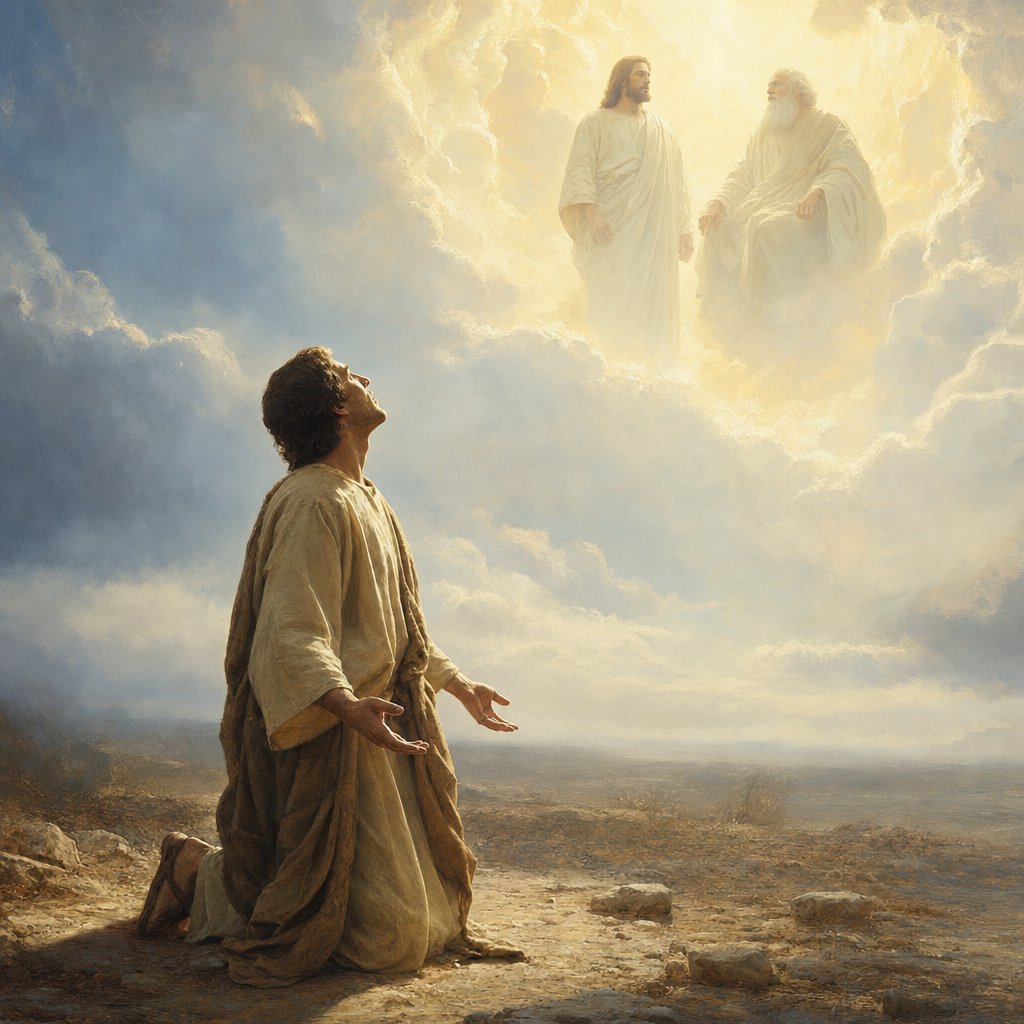
Acts 7:55 in the King James Version reads, “But he, being full of the Holy Ghost, looked up stedfastly into heaven, and saw the glory of God, and Jesus standing on the right hand of God.” This sentence stands at the climax of Stephen’s witness and marks the turning point between his faithful testimony on earth and his imminent martyrdom. It is not merely a report of what Stephen perceived; it is Scripture’s interpretation of what his death means, who is truly judging whom, and where the authority of Christ is located while the church is being opposed.
The immediate context is Stephen’s long defense before the council in Acts 7. He rehearses the history of Israel from Abraham to Moses to the prophets, showing a repeated pattern: God calls and sends, the people resist, and yet God continues his purpose. Stephen’s conclusion presses the charge home: “Ye stiffnecked and uncircumcised in heart and ears, ye do always resist the Holy Ghost: as your fathers did, so do ye.” The council’s rage is the human response to a divine indictment. Acts 7:55 then reveals that, at the very moment earthly authority is rising against Stephen, heaven is opened to him so that the true court, the true King, and the true verdict are made known. The council believes it is judging Stephen; the verse shows Stephen is being strengthened by God’s own presence, and the council is exposed as resisting the very Spirit who fills him.
The verse begins, “But he, being full of the Holy Ghost,” which establishes the source of Stephen’s steadiness. In Acts, being “full of the Holy Ghost” is not presented as a private mood but as the empowering of God for bold witness. Stephen’s fullness contrasts sharply with the council’s hostility. It also directly answers Stephen’s earlier accusation that they “do always resist the Holy Ghost.” Stephen is not speaking from stubbornness or personal outrage; he is filled, guided, and upheld by the Spirit of God. The Spirit’s fullness in Stephen is itself a testimony that God is with him even when men reject him, and it frames everything that follows as divine disclosure rather than imagination or self-comfort.
“Looked up stedfastly into heaven” portrays a deliberate, unwavering gaze. The steadiness matters. Stephen does not glance upward as a last resort; he fixes his attention where ultimate reality is. The word “stedfastly” suggests firmness of faith and clarity of perception, and it heightens the contrast with the chaotic fury around him. In the narrative, men are “cut to the heart” and soon will “gnash on him with their teeth,” yet Stephen’s posture is composed and directed. This upward gaze echoes a theme in Scripture where God grants sight beyond present suffering, not by removing the suffering, but by unveiling the greater truth that governs it.
Stephen then “saw the glory of God.” “Glory” in the KJV often signals the manifest weight and radiance of God’s presence, the disclosure of who God is. This is significant because Stephen has just spoken of Israel’s history with God’s presence—God appearing to Abraham, speaking to Moses, dwelling with his people, and being resisted. Now, at the end of Stephen’s testimony, the glory that many in Israel’s story either feared, misunderstood, or opposed is granted to Stephen as a confirming vision. The glory of God functions here like heaven’s endorsement of Stephen’s message: God is not absent, and God is not on the side of the violent majority. The glory is not described in detail, because the point is not scenery; the point is that Stephen is brought into awareness of God’s immediate, sovereign presence at the moment of death.
He also “saw… Jesus standing on the right hand of God.” The “right hand” is the place of authority, honor, and rule. In Stephen’s sermon, he has charged his hearers with betraying and murdering “the Just One.” Now Stephen sees that the One they condemned is exalted. The vision therefore vindicates Jesus as Lord in the very setting where the leaders of Israel presume to defend God’s honor against blasphemy. Stephen’s sight declares the opposite: the real blasphemy is the rejection of the exalted Christ.
The detail that Jesus is “standing” is especially striking, because elsewhere the New Testament commonly speaks of Christ seated at God’s right hand. In Acts 7:55, the KJV emphasizes “standing,” which conveys active involvement rather than distant repose. In the narrative, Stephen is about to be cast out and stoned; heaven is not indifferent. Jesus is presented as present and engaged, as if to acknowledge Stephen’s witness, to strengthen him, and to receive him. The standing posture also functions as a kind of divine testimony: Stephen is witnessing to Christ before men, and Christ is, in effect, witnessing to Stephen before God. Without departing from the language of the verse, the symbolism is that Stephen’s earthly condemnation is met by heavenly recognition.
The verse also carries a profound theme of reversal. The council sits in judgment, but Stephen is given sight of the throne. The crowd will soon drive him out of the city, but Stephen’s vision places him at the threshold of heaven. Stones will fall upon him, but the glory of God surrounds the reality into which he is passing. Acts 7:55 therefore interprets martyrdom not as defeat but as a passage under the gaze and honor of God. It shows that Christian witness, when it costs the witness everything, is not wasted; it is met by the nearness of Christ.
Finally, Acts 7:55 binds together the work of the Holy Ghost, the glory of God, and the exalted Jesus in a single moment. Stephen is “full of the Holy Ghost,” he sees “the glory of God,” and he sees “Jesus” at God’s right hand. The verse is not written as an abstract lesson, but as a lived revelation: the Spirit strengthens the believer, God’s glory assures the believer, and Jesus’ exaltation vindicates the believer’s confession. In that way, Acts 7:55 becomes a window into the meaning of Stephen’s death and into the nature of Christian hope—hope that rests not on escape from suffering, but on the certainty that Christ reigneth and that God’s glory is the truest horizon of the believer’s life and death.
Get our apps


Artwork for Acts 7:55

Acts 7:55-56 – "Stephen, full of the Holy Spirit, looked up to heaven and saw the glory of God."

Acts 7:55-56 – "Stephen, full of the Holy Spirit, looked up to heaven and saw the glory of God."

Acts 7:55-56 – "Stephen, full of the Holy Spirit, looked up to heaven and saw the glory of God."

Acts 7:55 - "But he, being full of the Holy Ghost, looked up stedfastly into heaven, and saw the glory of God, and Jesus standing on the right hand of God,"
"But he, being full of the Holy Ghost, looked up stedfastly into heaven, and saw the glory of God, and Jesus standing on the right hand of God," - Acts 7:55
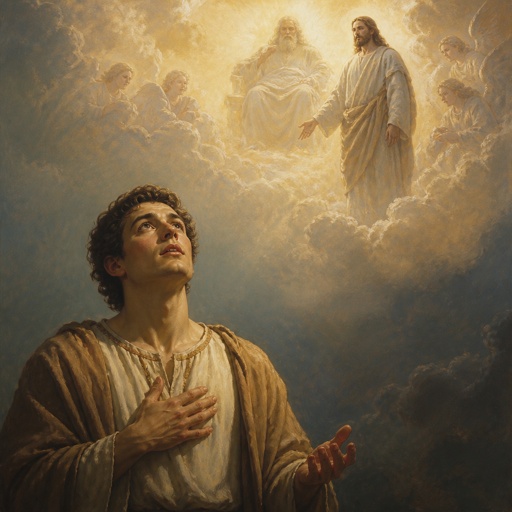
"But he, being full of the Holy Ghost, looked up stedfastly into heaven, and saw the glory of God, and Jesus standing on the right hand of God," - Acts 7:55

Nehemiah 7:55 - "The children of Barkos, the children of Sisera, the children of Tamah,"

Psalms 55:7 - "Lo, then would I wander far off, and remain in the wilderness. Selah."

"The children of Barkos, the children of Sisera, the children of Tamah," - Nehemiah 7:55

"Lo, then would I wander far off, and remain in the wilderness. Selah." - Psalms 55:7

Numbers 7:55 - "His offering was one silver charger of the weight of an hundred and thirty shekels, one silver bowl of seventy shekels, after the shekel of the sanctuary; both of them full of fine flour mingled with oil for a meat offering:"

Isaiah 55:7 - "Let the wicked forsake his way, and the unrighteous man his thoughts: and let him return unto the LORD, and he will have mercy upon him; and to our God, for he will abundantly pardon."

Acts 3:6-7

Acts 3:6-7

Acts 3:6-7

Acts 3:6-7

Acts 3:6-7

Isaiah 55:6-7 - "Seek the LORD while he may be found; call on him while he is near. Let the wicked forsake their ways and the unrighteous their thoughts. Let them turn to the LORD, and he will have mercy on them, and to our God, for he will freely pardon."

Acts 14:7 - "And there they preached the gospel."

acts 20:7-12

Acts 7:47 - "But Solomon built him an house."

Acts 7:1 - "Then said the high priest, Are these things so?"

Acts 19:7 - "And all the men were about twelve."

"And there they preached the gospel." - Acts 14:7

Acts 7:50 - "Hath not my hand made all these things?"

Acts 7:7 - "And the nation to whom they shall be in bondage will I judge, said God: and after that shall they come forth, and serve me in this place."

Acts 7:18 - "Till another king arose, which knew not Joseph."

Acts 7:53 - "Who have received the law by the disposition of angels, and have not kept it."

Acts 7:9 - "And the patriarchs, moved with envy, sold Joseph into Egypt: but God was with him,"

Acts 7:22 - "And Moses was learned in all the wisdom of the Egyptians, and was mighty in words and in deeds."