What does Ezekiel 1:4 mean?
“And I looked, and, behold, a whirlwind came out of the north, a great cloud, and a fire infolding itself, and a brightness was about it, and out of the midst thereof as the colour of amber, out of the midst of the fire.” — Ezekiel 1:4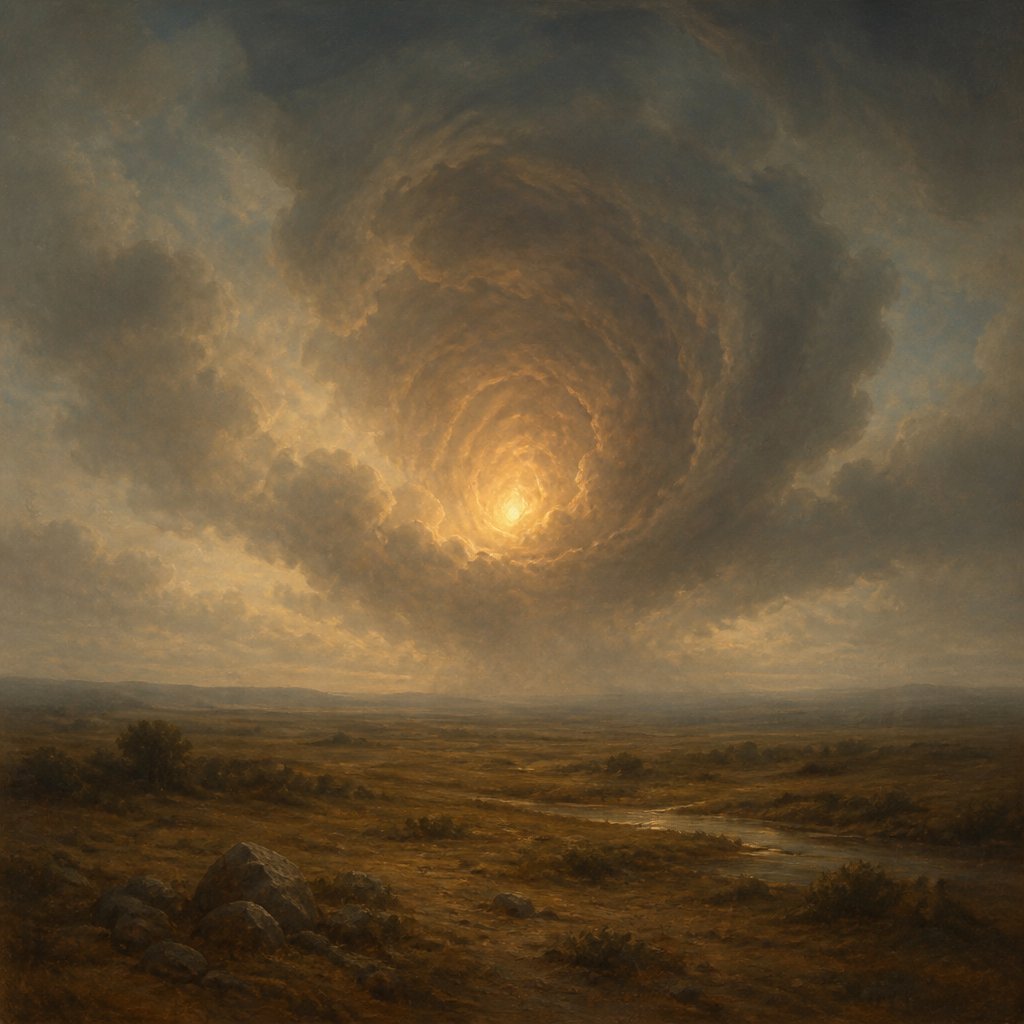
Ezekiel 1:4 in the King James Bible introduces the opening scene of Ezekiel’s first great vision, the vision of “the likeness of the glory of the LORD,” and it does so with imagery meant to overwhelm the reader with God’s majesty, holiness, and irresistible approach. The verse reads, “And I looked, and, behold, a whirlwind came out of the north, a great cloud, and a fire infolding itself, and a brightness was about it, and out of the midst thereof as the colour of amber, out of the midst of the fire.”
The setting of Ezekiel 1 matters for understanding why this description is so charged with meaning. Ezekiel is among the captives in exile by “the river of Chebar” (Ezekiel 1:1), far from Jerusalem and far from the temple, which many Israelites would have associated with God’s dwelling and presence. Into that displaced and disorienting situation, Ezekiel does not first receive a calm word but a theophany, an appearing of God in storm and fire. The verse’s first impact is theological: the LORD is not confined to the land or the temple. Even in Babylonian territory, God can reveal His glory. The exiles have not escaped God’s sight, and neither has God been defeated by the nations. Ezekiel 1:4 begins to show that the God of Israel comes where He wills, in sovereign freedom.
The “whirlwind” signals violent, unstoppable power. In Scripture, storm imagery often accompanies divine intervention, not because God is identical with nature, but because the storm’s force and awe provide fitting language for the nearness of the Holy One. A whirlwind is not manageable. It is felt as judgment, as purification, and as the arrival of a King. Ezekiel’s vision will soon unfold into living creatures, wheels, and a throne, but the first note is the coming of a presence that cannot be domesticated.
The fact that it comes “out of the north” also carries weight. In the prophetic world, “the north” is the direction from which judgment historically came upon Judah, because invading armies, including Babylon’s, approached from that route. In Ezekiel’s lifetime, the disaster of Jerusalem was bound up with an enemy coming from the north, and that threat is not absent from the symbolism here. Yet Ezekiel 1:4 does something crucial: it places even that feared direction under God’s command. The storm is not merely Babylonian power; it is the vehicle by which God makes Himself known. The point is not that God is the author of evil, but that the LORD is the ultimate governor of history, able to use even terrifying forces to accomplish His holy purposes, including judgment upon sin and the eventual restoration of His people.
The “great cloud” intensifies the sense of mystery and concealment. In the Bible, cloud imagery often marks God’s presence as both near and veiled: His glory is real, but not fully approachable by human sight. A cloud can indicate that God reveals Himself truly, yet not exhaustively. It suggests that what Ezekiel is about to witness is not an ordinary spectacle but a sacred disclosure that must be received with reverence. The cloud also evokes earlier scenes where God’s presence is associated with cloud and glory, drawing a line from Israel’s foundational encounters with the LORD to this new moment in exile.
The “fire infolding itself” introduces holiness and purgation. Fire in prophetic visions commonly speaks of God’s purity, His consuming opposition to sin, and the power that refines. The phrase “infolding itself” conveys a fire that is alive with motion, self-feeding and churning, not a static flame. The image is of intensity, of energy that cannot be extinguished by human resistance. In the context of Ezekiel’s message, that is a warning and a hope at once: God’s holiness will not accommodate Judah’s idolatry, yet God’s holy power is also sufficient to cleanse, to judge rightly, and to renew.
“A brightness was about it” adds the note of glory. Brightness surrounding the cloud and fire suggests radiance that cannot be contained within the storm. This is not mere destruction; it is splendor. Ezekiel is being prepared to understand that the LORD’s actions in judgment are not arbitrary violence but expressions of a glorious, righteous kingship. The brightness hints that behind what appears dark and terrifying lies a purpose bound up with God’s majesty.
Then Ezekiel says that “out of the midst thereof” there appeared “as the colour of amber, out of the midst of the fire.” The verse repeats “out of the midst,” drawing attention to the center of the vision. The heart of the storm is not chaos but a concentrated, radiant reality. “Amber” here communicates a glowing, metallic brilliance, something like molten splendor. The effect is to suggest uncreated light and otherworldly purity, a brilliance associated not with ordinary flame but with the overwhelming, refined radiance of divine glory. Ezekiel’s language strains to describe what cannot be fully described, and that strain is part of the point: God’s glory is not an object to be captured but a reality that humbles the observer.
Taken together, Ezekiel 1:4 sets the themes that govern the entire book. It announces divine sovereignty, because God comes as the One who commands storms and history alike. It announces divine holiness, because the vision is wrapped in fire and brilliance that imply purity and judgment. It announces divine presence in exile, because the glory appears by the river of Chebar and not only in Jerusalem. And it prepares the reader for the paradox at the heart of Ezekiel: the LORD’s coming is terrifying and majestic, because He comes to confront sin and to display His glory, yet His coming is also the beginning of hope, because a God who draws near—even in whirlwind and fire—is a God who has not abandoned His people. In Ezekiel 1:4, the exile does not silence God; it becomes the stage on which His glory begins to be revealed in a new and arresting way.
Get our apps


Artwork for Ezekiel 1:4

Ezekiel 1:4-28 – The vision of the four living creatures and the wheels.

Ezekiel 1:4-28

Ezekiel 1:4-28 – The vision of the four living creatures and the wheels.

Ezekiel 1:4-28 – The vision of the four living creatures and the wheels.

Ezekiel 1:4-28 – The vision of the four living creatures and the wheels.

Ezekiel 1:4-28 – The vision of the four living creatures and the wheels.

Ezekiel 1:4 - "¶ And I looked, and, behold, a whirlwind came out of the north, a great cloud, and a fire infolding itself, and a brightness was about it, and out of the midst thereof as the colour of amber, out of the midst of the fire."
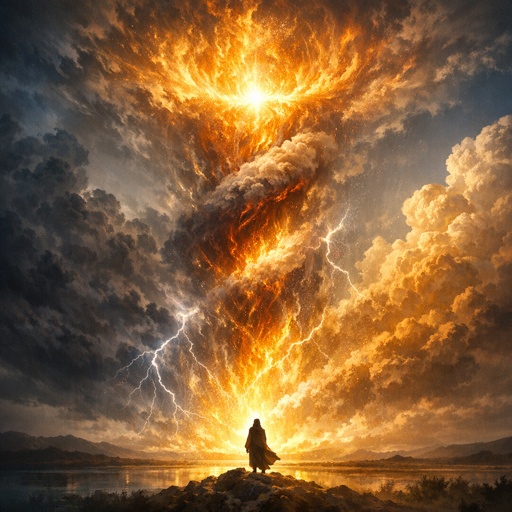
"And I looked, and, behold, a whirlwind came out of the north, a great cloud, and a fire infolding itself, and a brightness was about it, and out of the midst thereof as the colour of amber, out of the midst of the fire." - Ezekiel 1:4
"¶ And I looked, and, behold, a whirlwind came out of the north, a great cloud, and a fire infolding itself, and a brightness was about it, and out of the midst thereof as the colour of amber, out of the midst of the fire." - Ezekiel 1:4
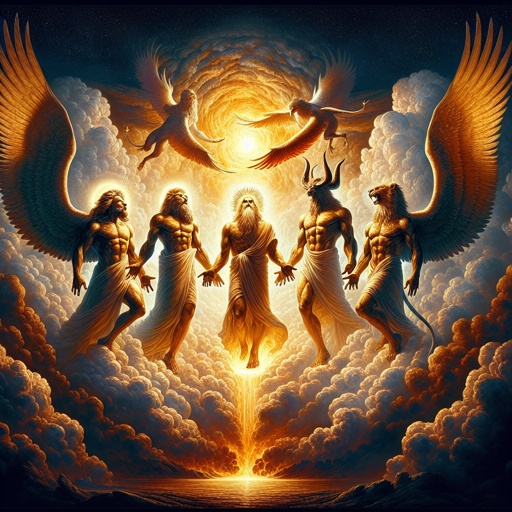
Ezequiel 1: 4. Olhei, e eis que um vento tempestuoso vinha do norte, uma grande nuvem, com um fogo revolvendo-se nela, e um resplendor ao redor, e no meio dela havia uma coisa, como de cor de âmbar, que saía do meio do fogo. 5. E do meio dela saía a semelhança de quatro seres viventes. E esta era a sua aparência: tinham a semelhança de homem. 6. E cada um tinha quatro rostos, como também cada um deles quatro asas. 7. E os seus pés eram pés direitos; e as plantas dos seus pés como a planta do pé de uma bezerra, e luziam como a cor de cobre polido. 8. E tinham mãos de homem debaixo das suas asas, aos quatro lados; e assim todos quatro tinham seus rostos e suas asas. 9. Uniam-se as suas asas uma à outra; não se viravam quando andavam, e cada qual andava continuamente em frente. 10. E a semelhança dos seus rostos era como o rosto de homem; e do lado direito todos os quatro tinham rosto de leão, e do lado esquerdo todos os quatro tinham rosto de boi; e também tinham rosto de águia todos os quatro. 11. Assim eram os seus rostos. As suas asas estavam estendidas por cima; cada qual tinha duas asas juntas uma a outra, e duas cobriam os corpos deles.

Ezekiel 4:1-3

Ezekiel 4:1 - "Thou also, son of man, take thee a tile, and lay it before thee, and pourtray upon it the city, even Jerusalem:"

Ezekiel 34:3–4

Ezekiel 13:4 - "O Israel, thy prophets are like the foxes in the deserts."

Ezekiel 11:4 - "¶ Therefore prophesy against them, prophesy, O son of man."

Ezekiel 1:1-28

Ezekiel 1:1-28 I would like to see your vision of what a cherubim is as it is described in EZEKIEL

Ezekiel 1:1-28

Ezekiel 1:1-28

Ezekiel 1:1-28

Ezekiel 1:1-28

Ezekiel 1:1-28

Ezekiel 1:1-28

Ezekiel 8:4 - "And, behold, the glory of the God of Israel was there, according to the vision that I saw in the plain."

Ezekiel 1:1-28

Ezekiel 1:1-28

Ezekiel 4:17 - "That they may want bread and water, and be astonied one with another, and consume away for their iniquity."

Ezekiel 43:4 - "And the glory of the LORD came into the house by the way of the gate whose prospect is toward the east."

Ezekiel 27:4 - "Thy borders are in the midst of the seas, thy builders have perfected thy beauty."

Ezekiel 48:4 - "And by the border of Naphtali, from the east side unto the west side, a portion for Manasseh."