What does Genesis 34:12 mean?
“Ask me never so much dowry and gift, and I will give according as ye shall say unto me: but give me the damsel to wife.” — Genesis 34:12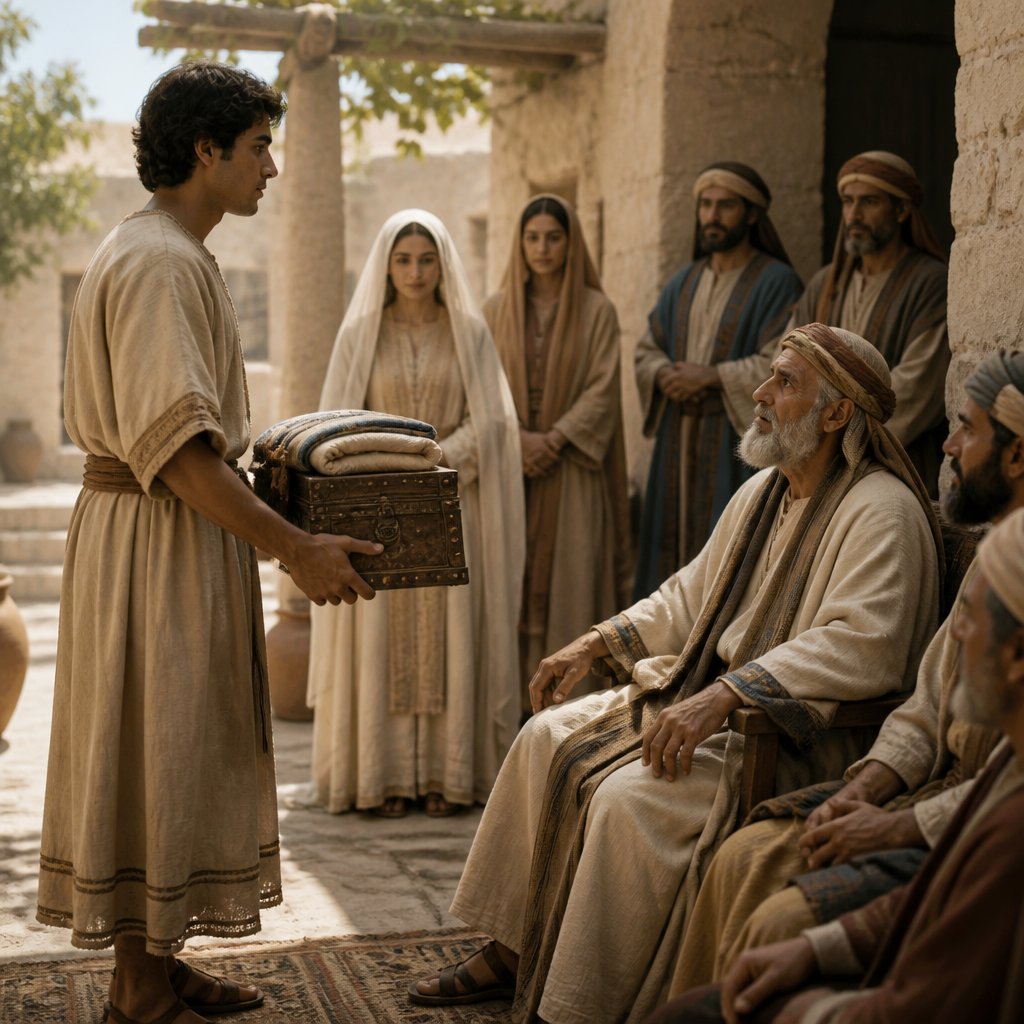
In the King James Version of the Bible, Genesis 34:12 reads, "Ask me never so much dowry and gift, and I will give according as ye shall say unto me: but give me the damsel to wife." This verse is part of the story of Dinah, the daughter of Jacob and Leah, and the events that transpire after she is raped by Shechem, the son of Hamor the Hivite.
The context of this verse is important to understand its meaning and significance. Dinah's brothers, Simeon and Levi, are deeply angered by their sister's violation and seek revenge. They devise a plan to deceive the men of Shechem's city, convincing them to undergo circumcision as a sign of unity and intermarriage. However, on the third day after the circumcision, when the men are in pain and vulnerable, Simeon and Levi attack and kill them, rescuing their sister and looting the city.
In verse 12, Shechem's father, Hamor, is pleading with Jacob and his sons for Dinah to become Shechem's wife, offering a large dowry and gifts as compensation. The verse can be interpreted as Jacob's sons responding to this request, stating that they will agree to the marriage and accept the dowry and gifts, but only if the men of the city agree to be circumcised. This is a deceptive and manipulative response, as Simeon and Levi had already planned to use the men's circumcision as a means of revenge.
The themes present in this verse and the surrounding story include deception, revenge, and the consequences of sinful actions. Simeon and Levi's actions, while seemingly justified in defense of their sister, are carried out deceitfully, and their violent retaliation brings disastrous repercussions. This passage also highlights the cultural and societal norms of the time, specifically regarding marriage and relationships between different tribes or clans. The idea of intermarriage and the importance of dowry and gifts are significant elements in this narrative.
Symbolism can also be found in this verse and the overall story. The act of circumcision, which is central to the deceitful plan of Simeon and Levi, can be seen as a symbol of identity and belonging. By deceiving the men of Shechem's city into undergoing this act, Simeon and Levi are manipulating their sense of unity and loyalty, ultimately using it to carry out their vengeful plan. Additionally, the dowry and gifts offered by Hamor symbolize the attempt to make amends and seek reconciliation, though it ultimately fails due to the underlying deceit and violence present in the situation.
This passage and the story of Dinah's violation and the subsequent revenge of her brothers present complex moral and ethical questions. While it illustrates the deep bond and protective nature of family, it also showcases the dangers of deceit and vengeful actions. The consequences of Simeon and Levi's deceitful plan result in a loss of trust and a tainted reputation for Jacob and his family.
In conclusion, Genesis 34:12 from the King James Version of the Bible, while seemingly straightforward in its language, carries deep moral, ethical, and cultural implications within the context of the surrounding story. It serves as a cautionary tale about the dangers of deceit and vengeful actions, highlighting the heavy consequences that can result from such behaviors. The themes of identity, unity, and the complexities of interpersonal relationships are also prevalent, making this verse and its surrounding narrative a rich source of reflection and contemplation.
Get our apps


Artwork for Genesis 34:12
Genesis 34:12 - "Ask me never so much dowry and gift, and I will give according as ye shall say unto me: but give me the damsel to wife."
"Ask me never so much dowry and gift, and I will give according as ye shall say unto me: but give me the damsel to wife." - Genesis 34:12

Genesis 21-34

Genesis 19-34

Genesis 24-34

Luke 12:34

Luk2 12:34

Dopsalms 34:1-12

Genesis 21:34 - "And Abraham sojourned in the Philistines' land many days."

Nehemiah 12:34 - "Judah, and Benjamin, and Shemaiah, and Jeremiah,"

Genesis 24:34 - "And he said, I am Abraham's servant."

Genesis 34:18 - "And their words pleased Hamor, and Shechem Hamor's son."

Genesis 34:31 - "And they said, Should he deal with our sister as with an harlot?"

Genesis 36:34 - "And Jobab died, and Husham of the land of Temani reigned in his stead."

Genesis 34:28 - "They took their sheep, and their oxen, and their asses, and that which was in the city, and that which was in the field,"

Luke 12:34 - "For where your treasure is, there will your heart be also."

Genesis 30:34 - "And Laban said, Behold, I would it might be according to thy word."

Genesis 34:6 - "¶ And Hamor the father of Shechem went out unto Jacob to commune with him."

Genesis 34:15 - "But in this will we consent unto you: If ye will be as we be, that every male of you be circumcised;"

Jeremiah 34:12 - "¶ Therefore the word of the LORD came to Jeremiah from the LORD, saying,"

Genesis 34:27 - "The sons of Jacob came upon the slain, and spoiled the city, because they had defiled their sister."

Genesis 34:4 - "And Shechem spake unto his father Hamor, saying, Get me this damsel to wife."

Genesis 34:17 - "But if ye will not hearken unto us, to be circumcised; then will we take our daughter, and we will be gone."

"Judah, and Benjamin, and Shemaiah, and Jeremiah," - Nehemiah 12:34

Job 34:12 - "Yea, surely God will not do wickedly, neither will the Almighty pervert judgment."

Genesis 34:29 - "And all their wealth, and all their little ones, and their wives took they captive, and spoiled even all that was in the house."

Genesis 34:20 - "¶ And Hamor and Shechem his son came unto the gate of their city, and communed with the men of their city, saying,"

Genesis 34:1 - "And Dinah the daughter of Leah, which she bare unto Jacob, went out to see the daughters of the land."

1 Chronicles 12:34 - "And of Naphtali a thousand captains, and with them with shield and spear thirty and seven thousand."

Genesis 37:34 - "And Jacob rent his clothes, and put sackcloth upon his loins, and mourned for his son many days."