What does Genesis 36:34 mean?
“And Jobab died, and Husham of the land of Temani reigned in his stead.” — Genesis 36:34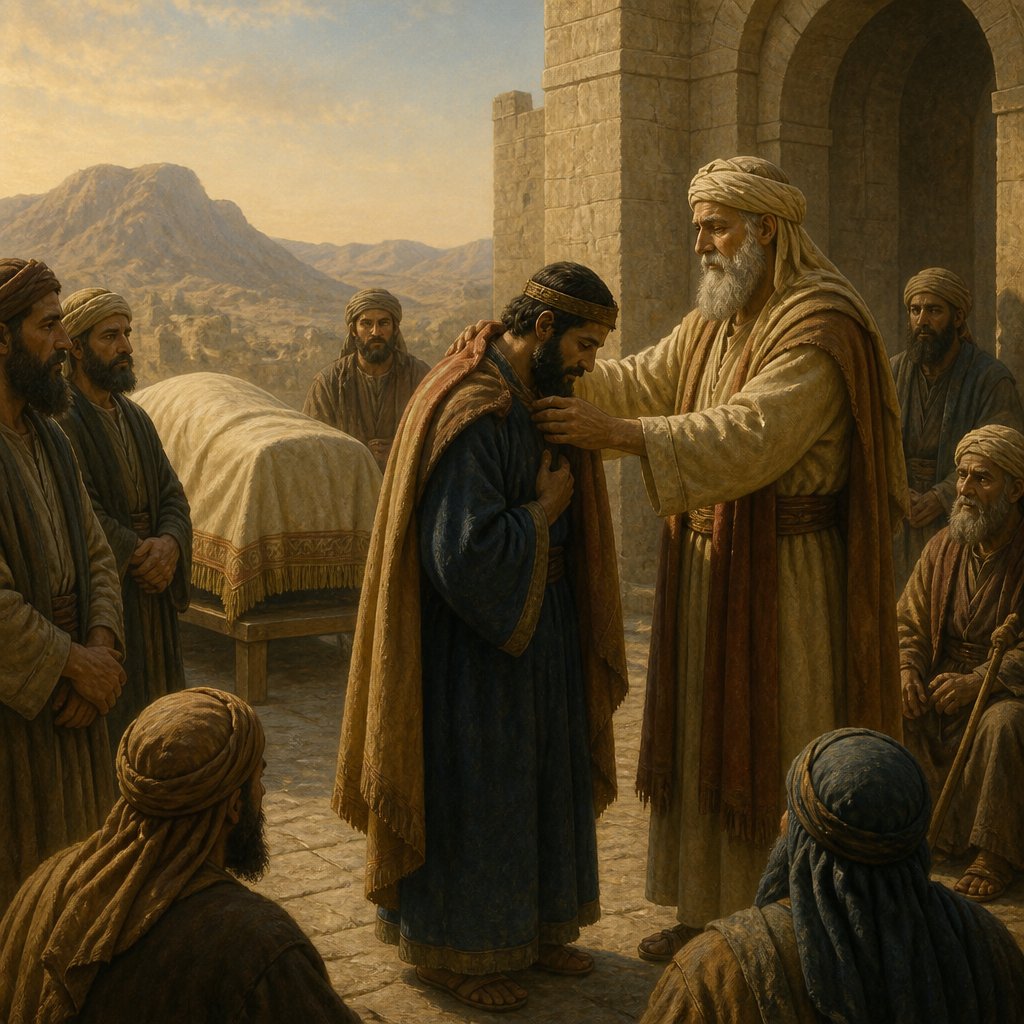
Genesis 36:34 in the King James Version of the Bible reads: "And Jobab died, and Husham of the land of Temani reigned in his stead." This verse is part of the genealogy of Esau, which is recorded in Genesis 36.
The genealogy of Esau is a significant part of the Old Testament, as it serves as a historical record of the descendants of Esau, who was the twin brother of Jacob. The lineage of Esau is important in understanding the origins of the Edomites, who were the descendants of Esau and played a significant role in the history of the Israelites.
The verse specifically mentions the death of Jobab and the reign of Husham of the land of Temani. This transition of leadership signifies the passing of one generation to the next, and the continuation of the lineage of Esau. It also gives insight into the political and social structure of the time, as leadership succession was a crucial aspect of ancient societies.
One of the themes that can be inferred from this verse is the passage of time and the concept of mortality. The mention of Jobab's death serves as a reminder of the transient nature of life and the inevitability of death. This theme is a recurring motif throughout the Bible, emphasizing the importance of making use of one's time on earth and the fleeting nature of human existence.
Furthermore, the succession of leadership from Jobab to Husham also highlights the theme of continuity and legacy. The genealogy of Esau is a testament to the preservation of a family line and the passing down of authority and responsibility from one generation to the next. It underscores the significance of lineage and heritage in ancient societies, as well as the perpetuation of ancestral traditions and customs.
The context of this verse within the larger genealogy of Esau is essential in understanding its significance. The genealogy of Esau is traced back to the descendants of Esau, who became the father of the Edomites. The Edomites were a people who settled in the region of Seir, which was located to the southeast of the land of Israel. The rivalry and conflicts between the descendants of Esau (Edomites) and the descendants of Jacob (Israelites) are a recurring theme in the Old Testament and have significant historical implications.
Symbolically, the transition of leadership from Jobab to Husham can be seen as a representation of the cyclical nature of power and authority. It serves as a reminder that no earthly ruler holds power indefinitely and that leadership is subject to change. This has relevance not only in the historical context of the genealogy of Esau but also in the broader scope of human history and governance.
In conclusion, Genesis 36:34 may seem like a simple verse on the surface, but it has deeper themes and implications that contribute to the broader narrative of the Old Testament. Its portrayal of the passage of time, the continuity of lineage, and the symbolism of leadership transition all add to the rich tapestry of biblical literature. Studying and understanding verses like this can provide valuable insights into the historical, social, and spiritual aspects of the Bible.
Get our apps


Artwork for Genesis 36:34

Genesis 36:34 - "And Jobab died, and Husham of the land of Temani reigned in his stead."

"And Jobab died, and Husham of the land of Temani reigned in his stead." - Genesis 36:34

Proverbs 8:34-36

2 kings 9:34-36

Genesis 36:36 - "And Hadad died, and Samlah of Masrekah reigned in his stead."

Ezekiel 36:34 - "And the desolate land shall be tilled, whereas it lay desolate in the sight of all that passed by."

Genesis 24:36

Genesis 19-36

Exodus 36:34 - "And he overlaid the boards with gold, and made their rings of gold to be places for the bars, and overlaid the bars with gold."

Job 34:36 - "My desire is that Job may be tried unto the end because of his answers for wicked men."

Genesis 21-34

Genesis 19-34

Genesis 24-34

Genesis 36:28 - "The children of Dishan are these; Uz, and Aran."

"And Hadad died, and Samlah of Masrekah reigned in his stead." - Genesis 36:36

Genesis 36:27 - "The children of Ezer are these; Bilhan, and Zaavan, and Akan."

Genesis 36:3 - "And Bashemath Ishmael's daughter, sister of Nebajoth."

Genesis 36:19 - "These are the sons of Esau, who is Edom, and these are their dukes."

Genesis 36:1 - "Now these are the generations of Esau, who is Edom."

Genesis 36:26 - "And these are the children of Dishon; Hemdan, and Eshban, and Ithran, and Cheran."

Genesis 36:42 - "Duke Kenaz, duke Teman, duke Mibzar,"

Genesis 36:9 - "¶ And these are the generations of Esau the father of the Edomites in mount Seir:"

Genesis 36:41 - "Duke Aholibamah, duke Elah, duke Pinon,"

Genesis 36:8 - "Thus dwelt Esau in mount Seir: Esau is Edom."

Genesis 19:36 - "Thus were both the daughters of Lot with child by their father."

Genesis 36:25 - "And the children of Anah were these; Dishon, and Aholibamah the daughter of Anah."

Genesis 36:4 - "And Adah bare to Esau Eliphaz; and Bashemath bare Reuel;"

Genesis 21:34 - "And Abraham sojourned in the Philistines' land many days."

Genesis 36:11 - "And the sons of Eliphaz were Teman, Omar, Zepho, and Gatam, and Kenaz."

Genesis 36:23 - "And the children of Shobal were these; Alvan, and Manahath, and Ebal, Shepho, and Onam."