What does John 2:4 mean?
“Jesus saith unto her, Woman, what have I to do with thee? mine hour is not yet come.” — John 2:4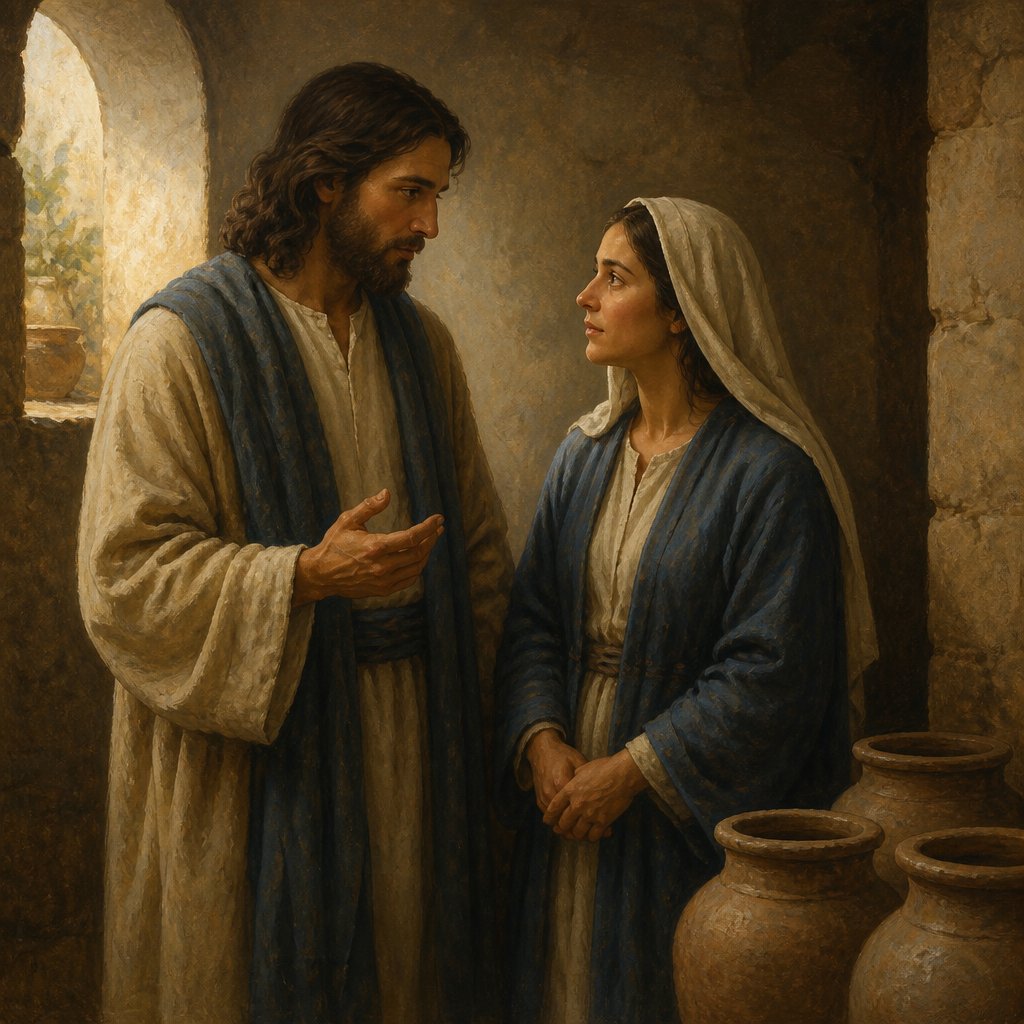
John 2:4 (KJV) reads "Jesus saith unto her, Woman, what have I to do with thee? mine hour is not yet come."
This verse is part of the story of Jesus turning water into wine at the wedding in Cana. The verse reflects a pivotal moment in the narrative as it displays an interesting interaction between Jesus and his mother, Mary. Understanding the context and symbolism of this verse is crucial to comprehending its deeper meaning and significance within the larger biblical narrative.
The story begins with Jesus and his disciples being invited to a wedding in Cana. During the celebration, the hosts run out of wine, causing a significant social embarrassment. Mary, the mother of Jesus, approaches her son and informs him of the situation. Jesus responds by telling her, "Woman, what have I to do with thee? mine hour is not yet come."
This response from Jesus to his mother can be initially misunderstood as dismissive or harsh. However, upon closer examination, it reveals several layers of meaning.
Firstly, Jesus refers to Mary as "Woman," which may seem unusual to modern readers but holds deeper significance in this cultural and religious context. In the Bible, this term is a title of respect and honor, used to address women in a formal and respectful manner. By addressing Mary in this way, Jesus acknowledges her as a figure of importance and significance. It also echoes the language used in the book of Genesis, where God addresses Eve as "Woman." This connection points to Mary's role as the new Eve, the mother of all the living, and highlights her position in the unfolding of redemption history.
Furthermore, Jesus's response, "what have I to do with thee?," can also be understood as a rhetorical question. He is not rejecting his mother's request outright but rather hinting at the fact that his ministry and divine nature are beyond the sphere of mere human concerns. This statement underscores the tension between Jesus' human and divine identities. As the Son of God, Jesus is on a mission to fulfill the will of the Father and bring about the salvation of humanity. This mission takes precedence over any personal or social obligations, including those to his family.
When Jesus says, "mine hour is not yet come," he is pointing to the fact that his public ministry and the revelation of his divine nature have not yet begun. The phrase "mine hour" is a recurring motif throughout the Gospel of John, referring to the appointed time when Jesus will be glorified through his sacrificial death and resurrection. This hour is intricately linked to the fulfillment of God's redemptive plan and the ultimate demonstration of Jesus' authority and divine nature.
Additionally, the interaction between Jesus and Mary at the wedding in Cana serves as a prelude to the miraculous sign of turning water into wine. This sign is significant not only for its immediate impact on the wedding celebration but also for its symbolic foreshadowing of the greater signs and wonders that will characterize Jesus' ministry. It is the first of the seven "signs" in the Gospel of John, each of which reveals something about Jesus' identity and mission.
In conclusion, John 2:4 captures a pivotal moment in the narrative of Jesus' ministry, revealing the complex interplay between his divine calling, his human relationships, and the unfolding of God's redemptive plan. It invites readers to reflect on the nature of Jesus' identity and the significance of his mission, ultimately pointing to his ultimate "hour" of glorification through his sacrificial death and resurrection. This verse challenges us to consider the profound implications of Jesus' words and actions and invites us to encounter the transformative power of his divine authority and grace.
Get our apps


Artwork for John 2:4

1 John 2:4 - "He that saith, I know him, and keepeth not his commandments, is a liar, and the truth is not in him."

John 2:4 - "Jesus saith unto her, Woman, what have I to do with thee? mine hour is not yet come."

"He that saith, I know him, and keepeth not his commandments, is a liar, and the truth is not in him." - 1 John 2:4
"Jesus saith unto her, Woman, what have I to do with thee? mine hour is not yet come." - John 2:4

John 4:2 - "(Though Jesus himself baptized not, but his disciples,)"

1 John 4:2 - "Hereby know ye the Spirit of God: Every spirit that confesseth that Jesus Christ is come in the flesh is of God:"

"(Though Jesus himself baptized not, but his disciples,)" - John 4:2

2 John 1:4 - "I rejoiced greatly that I found of thy children walking in truth, as we have received a commandment from the Father."

Matthew 10:2-4…Matthew 10:2-4 New International Version 2 These are the names of the twelve apostles: first, Simon (who is called Peter) and his brother Andrew; James son of Zebedee, and his brother John; 3 Philip and Bartholomew; Thomas and Matthew the tax collector; James son of Alphaeus, and Thaddaeus; 4 Simon the Zealot and Judas Iscariot, who betrayed him.

Matthew 10:2-4…Matthew 10:2-4 New International Version 2 These are the names of the twelve apostles: first, Simon (who is called Peter) and his brother Andrew; James son of Zebedee, and his brother John; 3 Philip and Bartholomew; Thomas and Matthew the tax collector; James son of Alphaeus, and Thaddaeus; 4 Simon the Zealot and Judas Iscariot, who betrayed him.

John 4:4 - "And he must needs go through Samaria."

John 4:16

John 3:4

John 4:16

John 4:16

John 4:16

John 4:16

John 4:16

John 4:16

John 4:16

John 3:4

John 4:16

John 4:16

John 4:16

John 3:4

John 4:16

John 4:16

John 4:16

John 3:4

John 4:16