What does Mark 1:6 mean?
“And John was clothed with camel’s hair, and with a girdle of a skin about his loins; and he did eat locusts and wild honey;” — Mark 1:6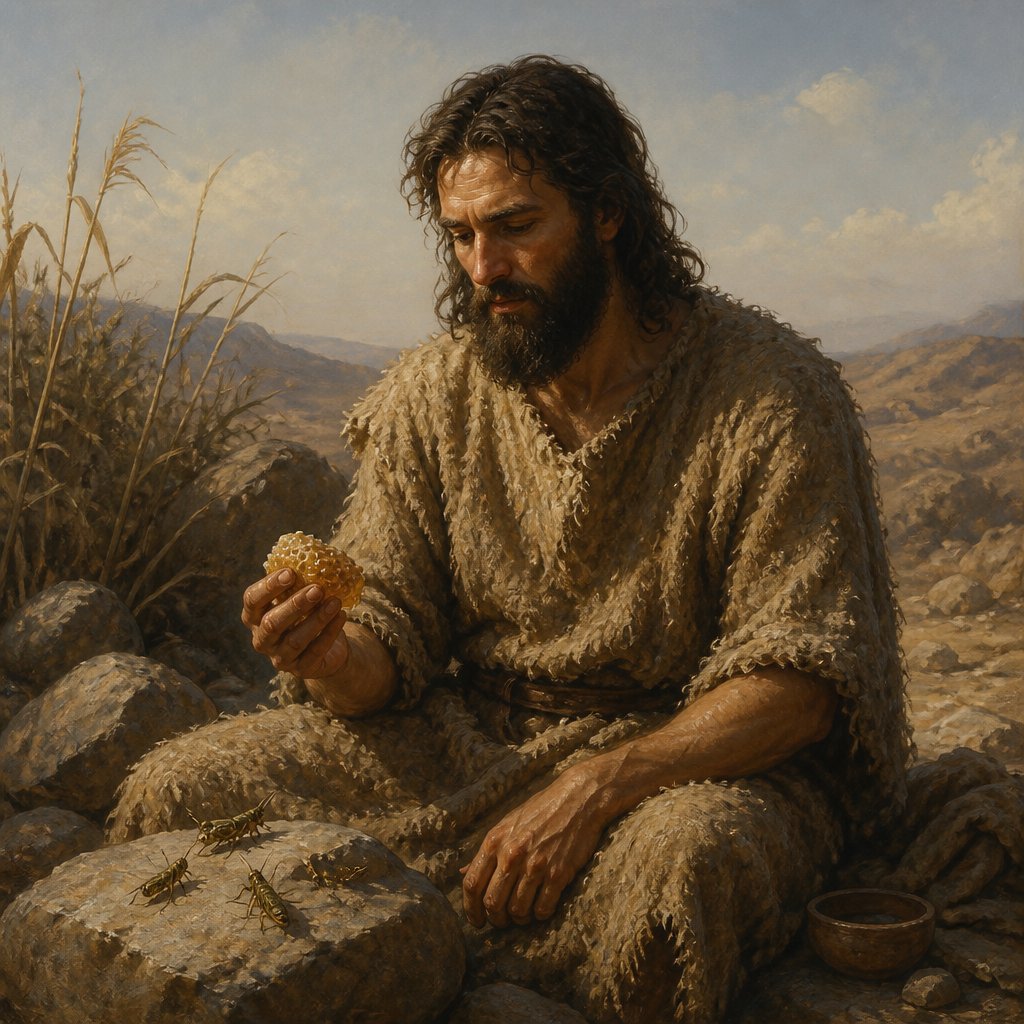
The Bible verse Mark 1:6 in the King James Version (KJV) reads, "And John was clothed with camel's hair, and with a girdle of a skin about his loins; and he did eat locusts and wild honey." This verse is a description of the appearance and lifestyle of John the Baptist, a central figure in the New Testament. The verse offers valuable insights into the character and mission of John the Baptist and can be interpreted in various ways that reveal important themes and symbols found throughout the Bible.
One of the primary themes of this verse is the idea of simplicity and humility. John the Baptist is depicted as wearing clothes made from camel's hair and a girdle of a skin around his loins, and he sustains himself with a diet of locusts and wild honey. These details serve to portray John as an ascetic figure who rejects the material comforts and luxuries of the world in favor of a humble and austere way of life. Through his appearance and practices, John embodies the virtues of simplicity, self-denial, and detachment from worldly possessions. This emphasis on simplicity and humility echoes the teachings of Jesus, who also advocated for a humble and modest way of life.
Another important theme in this verse is the idea of prophetic fulfillment. The description of John's appearance and lifestyle in this verse harkens back to Old Testament prophecies, particularly the book of Isaiah. In Isaiah 40:3, it is prophesied, "The voice of him that crieth in the wilderness, Prepare ye the way of the Lord, make straight in the desert a highway for our God." John the Baptist is often seen as the fulfillment of this prophecy, as he is the one who prepares the way for the coming of Jesus Christ. By depicting John in the wilderness, dressed in camel's hair and subsisting on a diet of locusts and wild honey, the verse establishes a connection between John's actions and the fulfillment of Old Testament prophecies, showing how John's life and actions were predetermined to fulfill a divine purpose.
The symbolism found in this verse is also worth noting. The camel's hair garment and skin girdle that John wears can be seen as symbols of his role as a prophet and forerunner. The usage of camel's hair recalls the image of the Old Testament prophet Elijah, who was known to wear a garment made of hair (2 Kings 1:8). By dressing in a similar manner, John aligns himself with the legacy of Old Testament prophets, signaling his status as a prophetic figure. The imagery of the wilderness and John's diet of locusts and wild honey also carries symbolic significance. The wilderness is a place of spiritual testing and renewal, and by residing in the desert, John embodies the idea of separation from worldly distractions in order to focus on his divine mission. Additionally, the diet of locusts and wild honey can be seen as a rejection of the pleasures and excesses of the world, emphasizing John's asceticism and his single-minded devotion to his calling.
In conclusion, Mark 1:6 in the King James Version provides a rich and multi-layered portrayal of John the Baptist, offering insights into his character, mission, and significance in the larger narrative of the Bible. The verse conveys themes of simplicity, humility, and prophetic fulfillment, while also utilizing powerful symbolism to underscore the central role of John the Baptist in preparing the way for the coming of Jesus Christ. By examining the verse in this manner, we gain a deeper understanding of the spiritual and historical significance of John the Baptist and his impact on the Christian faith.
Get our apps


Artwork for Mark 1:6

Mark 1:6 - "And John was clothed with camel's hair, and with a girdle of a skin about his loins; and he did eat locusts and wild honey;"
"And John was clothed with camel's hair, and with a girdle of a skin about his loins; and he did eat locusts and wild honey;" - Mark 1:6

Mark 6:1-6

Mark 6:1 - "And he went out from thence, and came into his own country; and his disciples follow him."

Mark 16:6-8

Mark 16:6-8

Mark 6:6 - "And he marvelled because of their unbelief. And he went round about the villages, teaching."

Mark 16:6-8

Mark 6:32 - "And they departed into a desert place by ship privately."
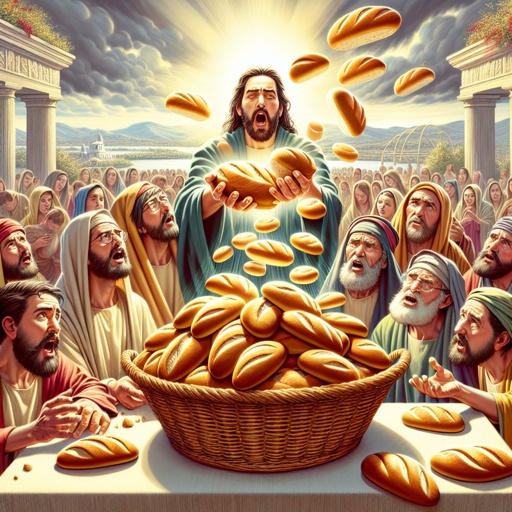
Mark 6:52 - "For they considered not the miracle of the loaves: for their heart was hardened."

Mark 6:9 - "But be shod with sandals; and not put on two coats."

Mark 6:40 - "And they sat down in ranks, by hundreds, and by fifties."

Mark 6:42 - "And they did all eat, and were filled."

Mark 2:6 - "But there were certain of the scribes sitting there, and reasoning in their hearts,"
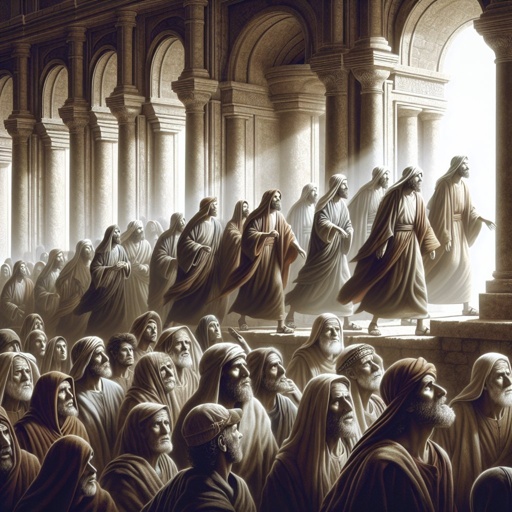
Mark 6:12 - "And they went out, and preached that men should repent."

Mark 6:43 - "And they took up twelve baskets full of the fragments, and of the fishes."

Mark 9:6 - "For he wist not what to say; for they were sore afraid."

Mark 6:44 - "And they that did eat of the loaves were about five thousand men."

Mark 6:15 - "Others said, That it is Elias. And others said, That it is a prophet, or as one of the prophets."

Mark 10:6 - "But from the beginning of the creation God made them male and female."

Mark 6:54 - "And when they were come out of the ship, straightway they knew him,"

Mark 6:47 - "And when even was come, the ship was in the midst of the sea, and he alone on the land."
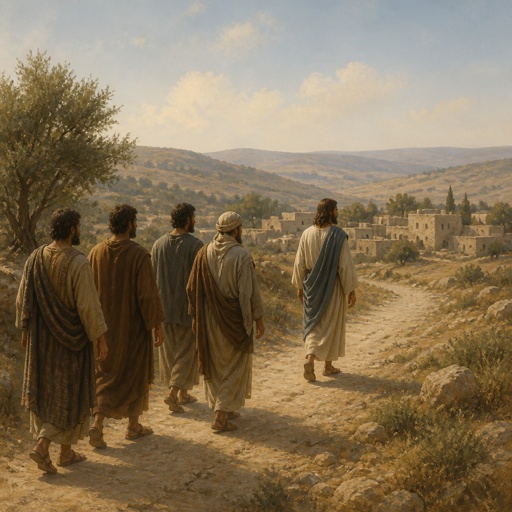
"And he went out from thence, and came into his own country; and his disciples follow him." - Mark 6:1

Mark 6:53 - "And when they had passed over, they came into the land of Gennesaret, and drew to the shore."

Mark 4:6 - "But when the sun was up, it was scorched; and because it had no root, it withered away."
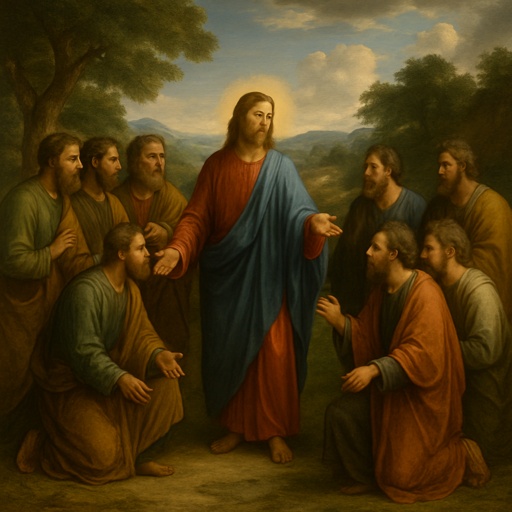
Mark 6:7 says that Jesus called his twelve disciples and began to send them out two by two, giving them authority over unclean spirits.

Mark 6:28 - "And brought his head in a charger, and gave it to the damsel: and the damsel gave it to her mother."

Mark 6:46 - "And when he had sent them away, he departed into a mountain to pray."

Mark 5:6 - "But when he saw Jesus afar off, he ran and worshipped him,"

Mark 15:6 - "Now at that feast he released unto them one prisoner, whomsoever they desired."