What does Matthew 8:8 mean?
“The centurion answered and said, Lord, I am not worthy that thou shouldest come under my roof: but speak the word only, and my servant shall be healed.” — Matthew 8:8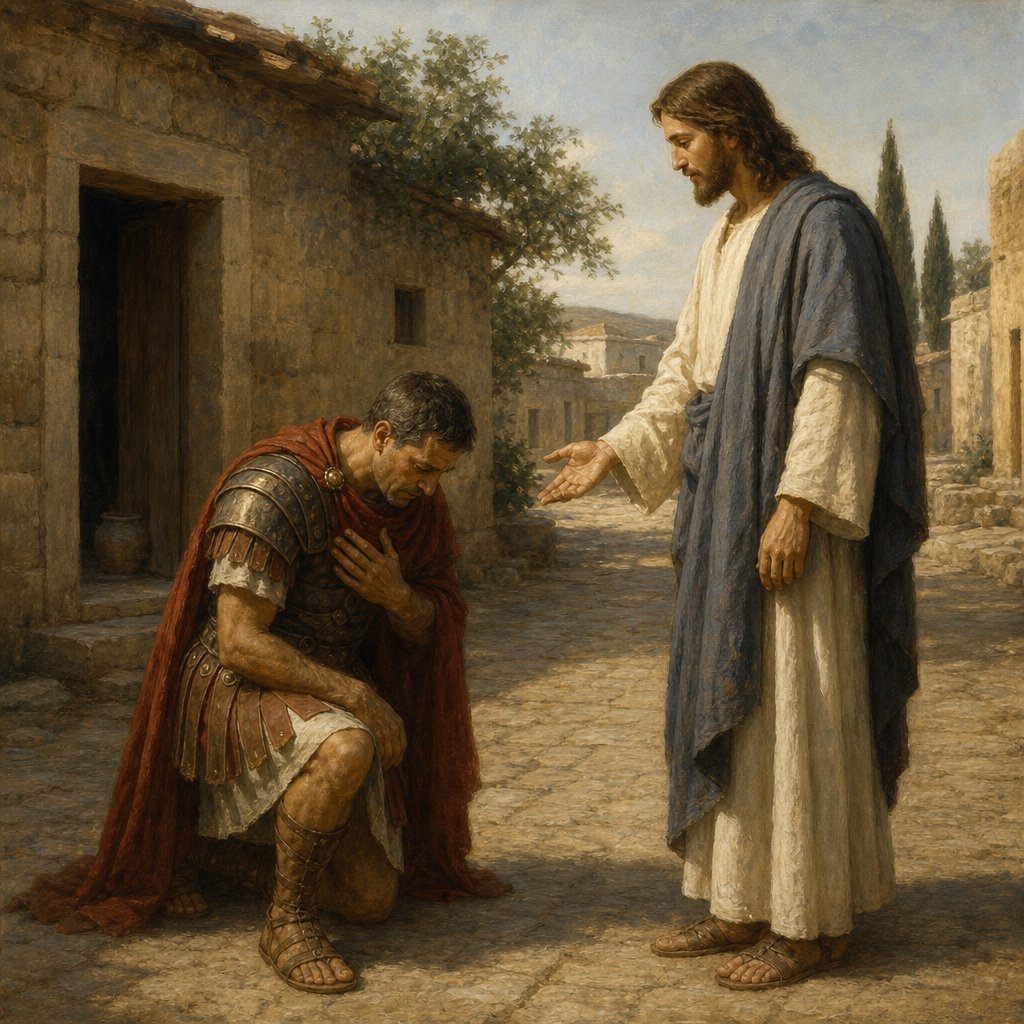
Matthew 8:8 in the King James Version reads, “The centurion answered and said, Lord, I am not worthy that thou shouldest come under my roof: but speak the word only, and my servant shall be healed.” In the plain sense of the sentence, a Roman centurion is asking Jesus to heal his servant, yet he refuses to presume upon Jesus’ presence in his house. He confesses unworthiness, and at the same time he expresses a confidence so strong that he believes no physical journey, no touch, and no visible act is required. For him, Christ’s word is sufficient cause for a real change in the servant’s condition. The verse is therefore built on a striking combination of humility and faith: humility that will not claim a right to God’s nearness, and faith that dares to expect God’s power.
The immediate context heightens its force. Matthew 8 records a sequence of mighty works that display Christ’s authority: the cleansing of a leper, the healing associated with the centurion’s request, and other miracles that follow. The centurion’s words occur at the moment when Jesus is approached as the one who can remedy what human strength cannot. The centurion is not presented as someone debating whether Jesus can help; he is presented as someone convinced that Jesus can help, and the only question is how. When he says, “speak the word only,” he is treating Jesus’ speech as action. In Scripture, God’s word is never mere sound; it is command, decree, and execution. The centurion’s request implicitly places Jesus within that divine pattern: a word from Christ carries the effective power to heal.
The themes of authority and submission saturate the verse. A centurion is himself a man of command within Rome’s military structure, accustomed to orders that travel from a superior officer through him to soldiers, producing immediate obedience. His confession, “I am not worthy,” reverses his social power in the presence of Jesus. Though he holds earthly rank, he takes the posture of a petitioner and acknowledges a higher authority. His logic is that if his own spoken orders can cause movement at a distance, then the Lord’s word can cause healing at a distance. What is implied is not only that Jesus has power, but that his power operates by rightful sovereignty. Healing is not treated as a lucky outcome; it is treated as obedience to a kingly command. This is one reason the verse is significant: it frames Christ not simply as a compassionate helper, but as the one whose word has dominion over sickness itself.
The centurion’s statement also carries the theme of unworthiness, which in Matthew’s narrative has moral and spiritual weight rather than mere etiquette. “Not worthy that thou shouldest come under my roof” is more than politeness; it is a confession that he does not deserve the honor of hosting the holy. In the biblical world, to come under one’s roof suggests fellowship and intimate association. The centurion senses a distance between himself and Jesus that cannot be crossed by merit. Yet this unworthiness does not drive him away into despair; it drives him toward grace. He does not say, “Therefore do nothing,” but “but speak the word only.” His unworthiness becomes the backdrop against which Christ’s free power is displayed. The verse thus embodies a gospel pattern: human need and insufficiency are answered not by human qualification but by Christ’s sufficiency.
There is also an important symbolic tension in the setting of “my roof.” The man is a Gentile officer in an occupying force, a representative of Rome in Israel. For such a figure to address Jesus as “Lord” and to seek help from him already signals a crossing of boundaries. The roof can be heard as a symbol of social separation—Jew and Gentile, occupied and occupier, insider and outsider. The centurion does not demand inclusion on his own terms; he approaches with reverence and a kind of self-effacement. Yet the miracle that follows in the larger passage affirms that Christ’s authority and mercy are not confined by ethnic borders. This makes Matthew 8:8 a window into the widening horizon of the kingdom of heaven as Matthew presents it: faith can be found in unexpected places, and Christ’s word can reach into homes that stand outside Israel’s covenant privileges by birth.
The verse also emphasizes the nature of faith as trust in Christ’s person rather than dependence on visible signs. Many would assume that for healing to occur, Jesus must be physically present, must touch, must perform something observable. The centurion believes the opposite: the word alone is enough. In that sense, the verse dramatizes the movement from sight to faith, from reliance on proximity to reliance on promise. It teaches that Christ is not limited by distance, and by implication, that his help is not bound to a particular place. The centurion’s confidence dignifies the unseen. His servant’s healing is expected on the basis of who Christ is and what he can say, not on the basis of what the centurion can watch.
Another layer of significance is the centurion’s concern for “my servant.” He is not asking for himself, but interceding for one under his care. In a world where a servant could be treated as disposable property, the centurion’s plea reveals compassion and responsibility. That compassion does not become the ground of his claim; unworthiness remains his confession. Yet it shows that genuine faith often expresses itself in merciful concern for others. The centurion stands as an intercessor, and his faith seeks the good of the vulnerable.
Matthew 8:8 also echoes a broader biblical symbolism of God’s creative and restorative speech. In Scripture, God speaks and reality responds. When the centurion says, “speak the word only,” he is, perhaps more than he knows, aligning his request with the foundational truth that God’s word creates, commands, and restores. In the ministry of Jesus, that divine speech is present in human form. The verse therefore points to the identity of Christ as one whose utterance is not merely instructive but effectual.
Taken together, the verse is significant because it portrays a model response to Christ: reverent humility that does not presume upon God, joined to a bold faith that does not limit God. It places the center of hope not in the worthiness of the petitioner, not in the power of the officer, and not even in the proximity of the healer, but in the authority of the Lord who can “speak the word” and make it so. In a single sentence, Matthew 8:8 shows faith recognizing both the majesty of Christ and the immediacy of his power, and it suggests that the true doorway into blessing is not a roof opened to God by human deserving, but a heart opened to God by trusting his word.
Get our apps


Artwork for Matthew 8:8
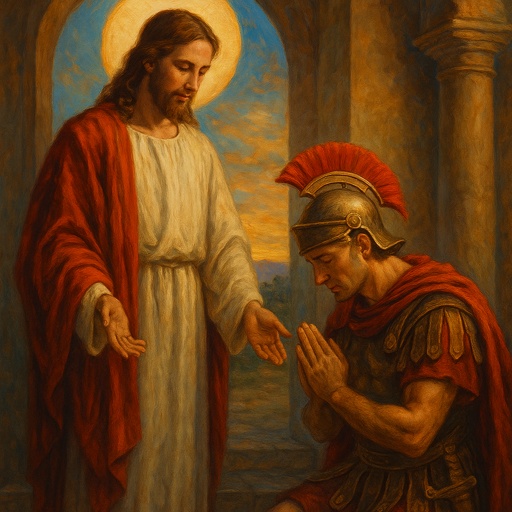
"The centurion answered and said, Lord, I am not worthy that thou shouldest come under my roof: but speak the word only, and my servant shall be healed." - Matthew 8:8

Matthew 8:8 - "The centurion answered and said, Lord, I am not worthy that thou shouldest come under my roof: but speak the word only, and my servant shall be healed."
"The centurion answered and said, Lord, I am not worthy that thou shouldest come under my roof: but speak the word only, and my servant shall be healed." - Matthew 8:8

Matthew 8:32

Matthew 8:13

Matthew 8:13

Matthew 8:13

Matthew 8:32

Matthew 8:32

Matthew 13:8

matthew 8:28

Matthew 24:8

Matthew 24:8 - "All these are the beginning of sorrows."

Matthew 8:1-4

Matthew 5:8-12

Matthew 5:8 - "Blessed are the pure in heart: for they shall see God."

Matthew 3:8 - "Bring forth therefore fruits meet for repentance:"

Matthew 12:8 - "For the Son of man is Lord even of the sabbath day."

Matthew 27:8 - "Wherefore that field was called, The field of blood, unto this day."

"All these are the beginning of sorrows." - Matthew 24:8

Matthew 8:7 - "And Jesus saith unto him, I will come and heal him."

Matthew 8:23 - "¶ And when he was entered into a ship, his disciples followed him."

Matthew 1:8 - "And Asa begat Josaphat; and Josaphat begat Joram; and Joram begat Ozias;"

Matthew 8:30 - "And there was a good way off from them an herd of many swine feeding."

Matthew 8:5 - "¶ And when Jesus was entered into Capernaum, there came unto him a centurion, beseeching him,"

Matthew 17:8 - "And when they had lifted up their eyes, they saw no man, save Jesus only."

Matthew 8:22 - "But Jesus said unto him, Follow me; and let the dead bury their dead."
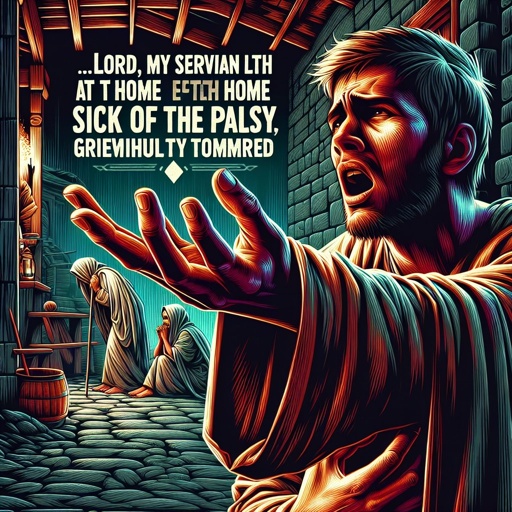
Matthew 8:6 - "And saying, Lord, my servant lieth at home sick of the palsy, grievously tormented."

Matthew 26:8 - "But when his disciples saw it, they had indignation, saying, To what purpose is this waste?"

Matthew 8:1 - "When he was come down from the mountain, great multitudes followed him."