What does Psalms 8:3-4 mean?
“When I consider thy heavens, the work of thy fingers, the moon and the stars, which thou hast ordained; What is man, that thou art mindful of him? and the son of man, that thou visitest him?” — Psalms 8:3-4
Psalm 8 is a hymn of praise in which David looks outward at creation and, from that vastness, turns inward to wonder at God’s attention to humankind. The psalm is framed by the same declaration at the beginning and end, “O LORD our Lord, how excellent is thy name in all the earth!” (Psalm 8:1, 9, KJV). That refrain establishes the context for verses 3–4: David is not mainly trying to make man look large, but to make the LORD’s majesty look unmistakably great. When he arrives at the question of man, it is because the greatness of the Creator makes human life seem astonishingly small by comparison, and therefore God’s care for it even more astonishing.
Psalm 8:3–4 (KJV) says, “When I consider thy heavens, the work of thy fingers, the moon and the stars, which thou hast ordained; What is man, that thou art mindful of him? and the son of man, that thou visitest him?” The movement of thought begins with contemplation: “When I consider.” David is not speaking from casual glance but from sustained reflection. He directs his mind to “thy heavens,” not merely the heavens as a neutral phenomenon but as belonging to God. The sky becomes a witness to divine ownership and artistry. Calling them “the work of thy fingers” is deliberate symbolism. Fingers suggest fine craftsmanship, ease, and precision, as though the immense cosmos, which overwhelms human scale, is for God the delicate work of a skilled hand. It does not diminish creation; it magnifies the Creator, implying that what appears infinite to us is not difficult for him.
He then names “the moon and the stars,” the dominant lights of the night sky, those objects that most naturally provoke awe and a sense of smallness. In the ancient world especially, the moon and stars were often associated with power, fate, or divinity in surrounding cultures, but David places them firmly under the LORD’s authority: they are “which thou hast ordained.” The word “ordained” carries the idea of appointment and establishment. They are not random or self-governing; they are set in their place by God’s purposeful decree. The order of the heavens is therefore a kind of silent sermon about God’s sovereignty, wisdom, and intentional design.
Against that backdrop David asks, “What is man, that thou art mindful of him?” The question is not a denial of human value but a confession of human littleness when compared to the cosmos. “Man” here points to humanity in its frailty and earthbound limitations. The wonder is not that man can think about the stars, but that God thinks about man. “Mindful” speaks of attentive remembrance and deliberate regard. David is struck that the God who established the celestial bodies does not overlook human beings as insignificant. The theme is divine condescension in the best sense: God’s gracious stooping to notice and care.
The parallel phrase intensifies the thought: “and the son of man, that thou visitest him?” “Son of man” is a Hebrew way of emphasizing human mortality and weakness—someone born of man, sharing the same fragile condition. The verb “visitest” is rich in biblical symbolism. In the KJV, God “visiting” can mean coming near in providential attention, whether to help, deliver, correct, or fulfill his purposes. Here, within a psalm of praise, it carries the sense of God’s personal involvement with humanity. God does not merely hold man in abstract awareness; he comes to him, attends to him, involves himself with him. The distance between Creator and creature is vast, yet God crosses it in care.
These two verses, then, hold together two truths that Scripture repeatedly joins: God is immeasurably exalted, and man is genuinely significant because God chooses to be mindful of him. The night sky functions as a mirror in which human pride is humbled and human despair is answered. Humbled, because man is not the measure of all things when set beside “thy heavens.” Answered, because man is not forgotten—God is mindful; God visits. The awe David feels is not merely scientific amazement at size and number, but worshipful amazement at a Lord whose greatness does not make him distant and whose majesty does not make him indifferent.
In the flow of Psalm 8, verses 3–4 are the turning point that prepares for what follows: the surprising honor God gives to man in creation, “For thou hast made him a little lower than the angels, and hast crowned him with glory and honour” (Psalm 8:5, KJV), and the stewardship entrusted to him over other creatures (Psalm 8:6–8). In other words, David’s question is not left hanging as a riddle; it is answered by the doctrine of human dignity under God. Yet even that dignity is not self-generated. It rests on the fact that the LORD, whose fingers made the stars, is “mindful” of man and “visitest” him. That is the significance of Psalm 8:3–4: creation declares God’s vastness, and that vastness makes God’s intimate regard for humanity shine as an act of breathtaking grace.
Get our apps


Artwork for Psalms 8:3-4

"When I consider thy heavens, the work of thy fingers, the moon and the stars, which thou hast ordained; What is man, that thou art mindful of him? and the son of man, that thou visitest him?" - Psalms 8:3-4

Psalms 8:3 - "When I consider thy heavens, the work of thy fingers, the moon and the stars, which thou hast ordained;"
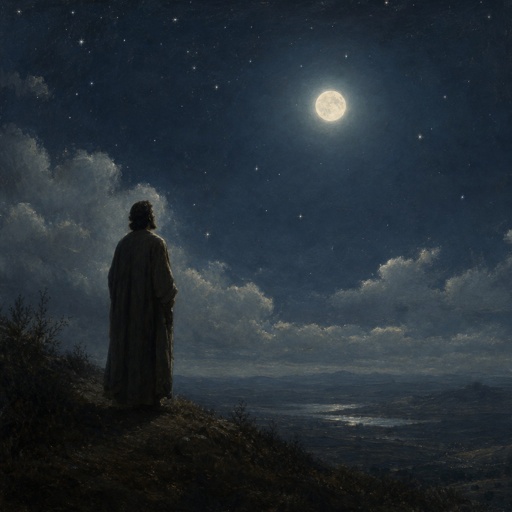
"When I consider thy heavens, the work of thy fingers, the moon and the stars, which thou hast ordained;" - Psalms 8:3
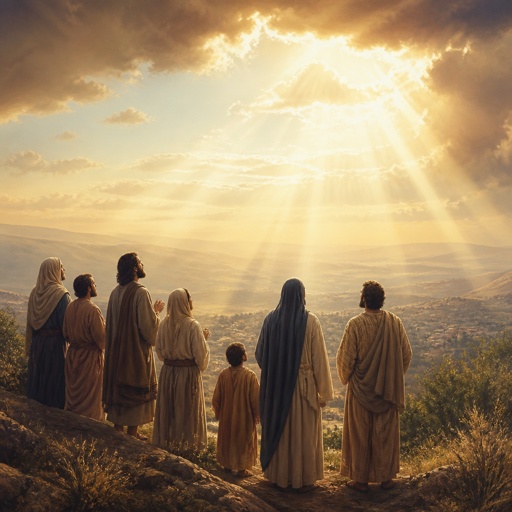
"Salvation belongeth unto the LORD: thy blessing is upon thy people. Selah." - Psalms 3:8
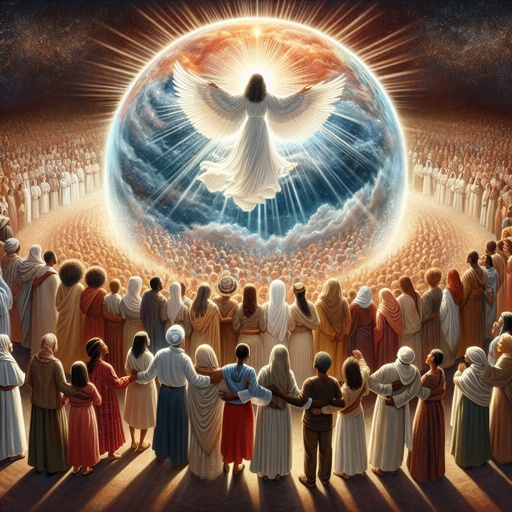
Psalms 3:8 - "Salvation belongeth unto the LORD: thy blessing is upon thy people. Selah."

Psalms 4:8 - "I will both lay me down in peace, and sleep: for thou, LORD, only makest me dwell in safety."

"What is man, that thou art mindful of him? and the son of man, that thou visitest him?" - Psalms 8:4

Psalms 8:4 - "What is man, that thou art mindful of him? and the son of man, that thou visitest him?"

Psalm 8:3-4 - "When I consider your heavens, the work of your fingers, the moon and the stars, which you have set in place, what is mankind that you are mindful of them, human beings that you care for them?"

Psalms 49:8 - "(For the redemption of their soul is precious, and it ceaseth for ever:)"

Psalms 4:8 - "I will both lay me down in peace, and sleep: for thou, LORD, only makest me dwell in safety."

"All sheep and oxen, yea, and the beasts of the field;" - Psalms 8:7
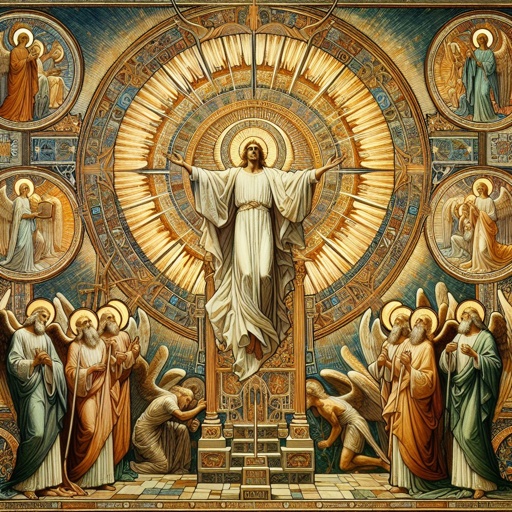
Psalms 111:3 - "His work is honourable and glorious: and his righteousness endureth for ever."

Psalm 8:3

Psalms 3:4 - "I cried unto the LORD with my voice, and he heard me out of his holy hill. Selah."

Psalms 4:3 - "But know that the LORD hath set apart him that is godly for himself: the LORD will hear when I call unto him."

Psalm 8:3

Psalm 8:3-6

Psalms 88:3 - "For my soul is full of troubles: and my life draweth nigh unto the grave."

Psalms 103:3 - "Who forgiveth all thine iniquities; who healeth all thy diseases;"

Psalms 87:3 - "Glorious things are spoken of thee, O city of God. Selah."

Psalms 114:4 - "The mountains skipped like rams, and the little hills like lambs."

"O LORD our Lord, how excellent is thy name in all the earth!" - Psalms 8:9

Psalm 8:3-6

Psalms 139:3-4 KJV (3) Thou compassest my path and my lying down, and art acquainted with all my ways. (4) For there is not a word in my tongue, but, lo, O LORD, thou knowest it altogether.
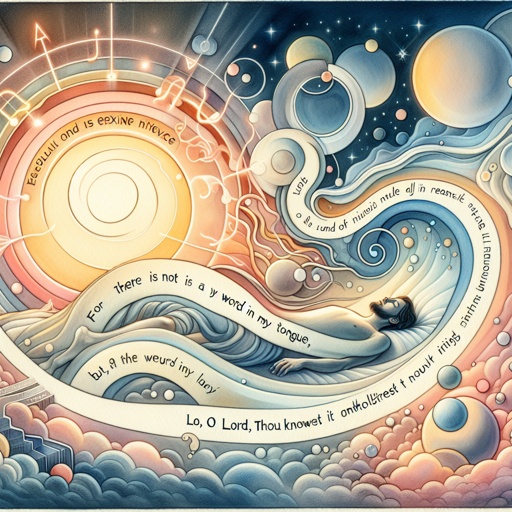
Psalms 139:3-4 KJV (3) Thou compassest my path and my lying down, and art acquainted with all my ways. (4) For there is not a word in my tongue, but, lo, O LORD, thou knowest it altogether.

"For this was a statute for Israel, and a law of the God of Jacob." - Psalms 81:4

"For there are no bands in their death: but their strength is firm." - Psalms 73:4

"To bind their kings with chains, and their nobles with fetters of iron;" - Psalms 149:8

Psalms 139:3-4 KJV (3) Thou compassest my path and my lying down, and art acquainted with all my ways. (4) For there is not a word in my tongue, but, lo, O LORD, thou knowest it altogether.