What does Genesis 16:1 mean?
“Now Sarai Abram’s wife bare him no children: and she had an handmaid, an Egyptian, whose name was Hagar.” — Genesis 16:1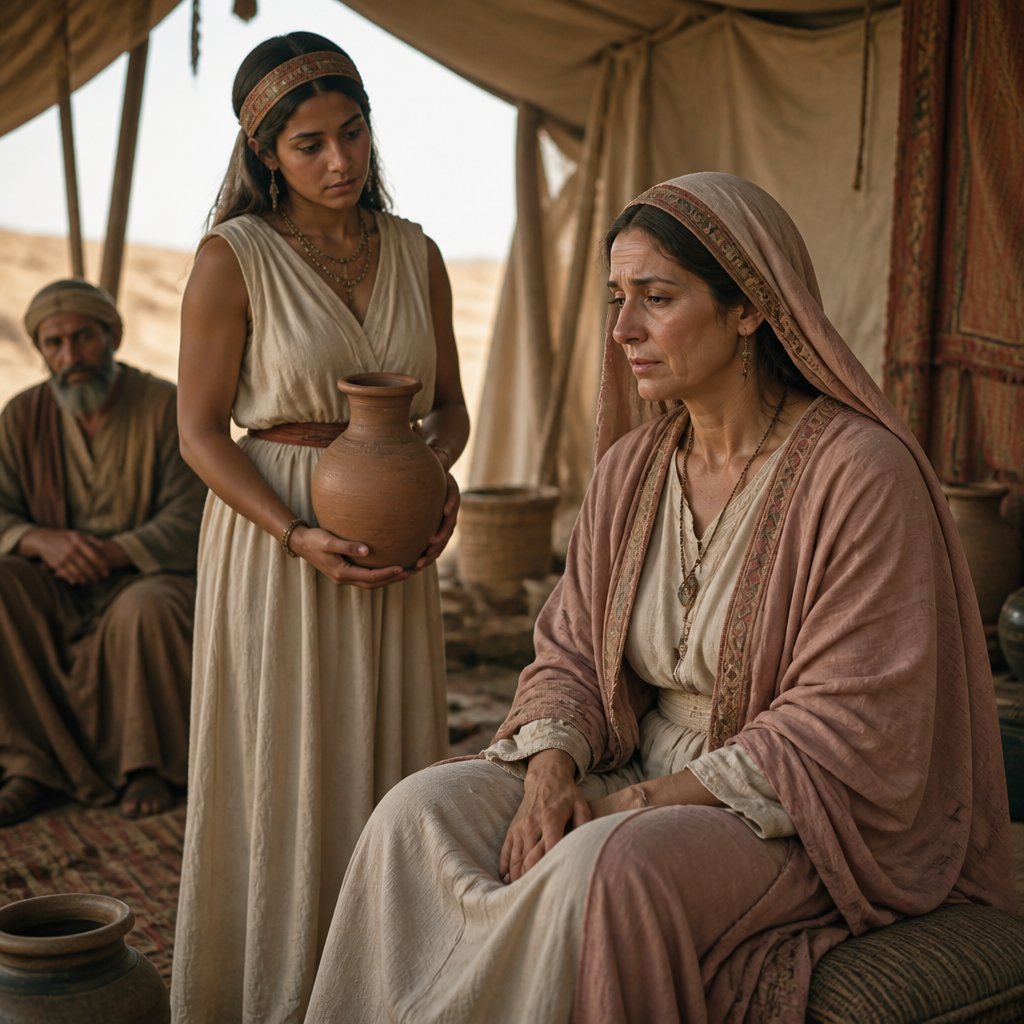
Genesis 16:1 (KJV) reads: "Now Sarai Abram's wife bare him no children: and she had an handmaid, an Egyptian, whose name was Hagar."
The story of Genesis 16 begins with a stark portrayal of the pain experienced by Sarai, the wife of Abram (later known as Abraham) because she was unable to bear children. In the ancient Near East, the ability to bear children was of paramount importance, not only for personal fulfillment but also for the continuation of the family line and the perpetuation of the family inheritance. For Sarai, her inability to conceive was not merely a personal disappointment but a source of shame and a challenge to the very continuation of her family's line.
At this point, Sarai comes up with a plan to solve her dilemma. She suggests to Abram that he should take her handmaid, Hagar, an Egyptian servant, as a second wife. This custom of providing a female servant to bear children on behalf of a barren wife was a well-established practice in the ancient Near East. By offering Hagar to Abram, Sarai hoped to secure a child through her who could then become her own. Abram, complying with Sarai's request, took Hagar as his wife, and she conceived a child (Genesis 16:4).
The themes of this passage are profound, touching on issues of family, fertility, and faith. It portrays the depths of human emotions and desperation, as Sarai's longing for a child leads her to take matters into her own hands. This passage also highlights the cultural and social norms of the ancient Near East, showing how the institutions of marriage and family were intertwined with concerns about legacy and inheritance.
From a larger biblical context, this passage also raises questions about the nature of human faith and God's promises. Sarai's decision to offer Hagar to Abram communicates a lack of trust in God's ability to fulfill his promise to give them a child. It serves as a cautionary tale about the potential consequences of trying to manipulate God's plan rather than waiting on His timing and trusting in His providence.
The symbolism in this passage is also powerful. Hagar, as a handmaid, represents a lower social status in the household, and her willingness to submit to Sarai's plan reflects the power dynamics within the family. Moreover, the presence of an Egyptian handmaid in the household of Abram and Sarai foreshadows the future enslavement of the Israelites in Egypt, serving as a harbinger of the trials and tribulations that await the descendants of Abram.
Overall, Genesis 16:1 portrays a complex interplay of human emotions, cultural customs, and spiritual themes. It provides a deep insight into the complexities of human relationships and the consequences of attempting to manipulate God's will. Ultimately, it serves as a reminder of the importance of patience, faith, and trust in God's promises, even in the face of seemingly insurmountable challenges.
Get our apps


Artwork for Genesis 16:1

Genesis 16:1

Genesis 16:1 - "Now Sarai Abram's wife bare him no children: and she had an handmaid, an Egyptian, whose name was Hagar."
"Now Sarai Abram's wife bare him no children: and she had an handmaid, an Egyptian, whose name was Hagar." - Genesis 16:1

Genesis 1:16

Genesis 3:16

Genesis 35:16-20

Genesis 29:16-35

Genesis 16:16

Genesis 1:16 - "And God made two great lights; the greater light to rule the day, and the lesser light to rule the night: he made the stars also."

Genesis 16:3

Genesis 16:14

Genesis 16:6

Genesis 16:2

Genesis 15:16

Genesis 18-16

Genesis 25-16

Genesis 16:8

Genesis 16:12

Genesis 17-16

Genesis 16:11

Genesis 16:4

Genesis 16:7

Genesis 20-16

Genesis 28-16

Genesis 16:5

Genesis 16:9

Genesis 23-16

Genesis 22-16

Genesis 16:15

Genesis 16:3